Claude Mythos Vulnerability: How AI Finds Software Flaws
TL;DR
- A vulnerability becomes materially different when several individually limited bugs combine into one exploit path. Developers therefore need to assess exploitability in the context of sandboxing, memory protections, control flow, and privilege boundaries rather than treating each scanner result as an isolated severity score.
- Faster discovery shifts the security bottleneck into validation and remediation. When report volume rises faster than teams can reproduce, classify, assign, disclose, and patch issues, backlog grows even when detection quality remains high.
- Legacy systems raise the cost of validating an AI-generated vulnerability because engineers first have to reconstruct undocumented dependencies, ownership boundaries, and affected behavior. Forge's ForgeScore approach addresses part of that context problem by assessing an existing codebase before modernization work begins.
- A generated patch isn't evidence that an exploit path has been closed. Remediation needs explicit acceptance criteria, exploit reproduction, regression testing, architectural constraints, and an accountable owner, with Forge's Work Orders providing a structured place for those requirements and evidence.
- Security controls placed after deployment force teams to unwind completed work when an agent introduces a defect earlier in the delivery chain. Forge's documented security checks and human approval gates place review between intent, architecture, and implementation instead.
What The Claude Mythos Vulnerability Query Really Refers To
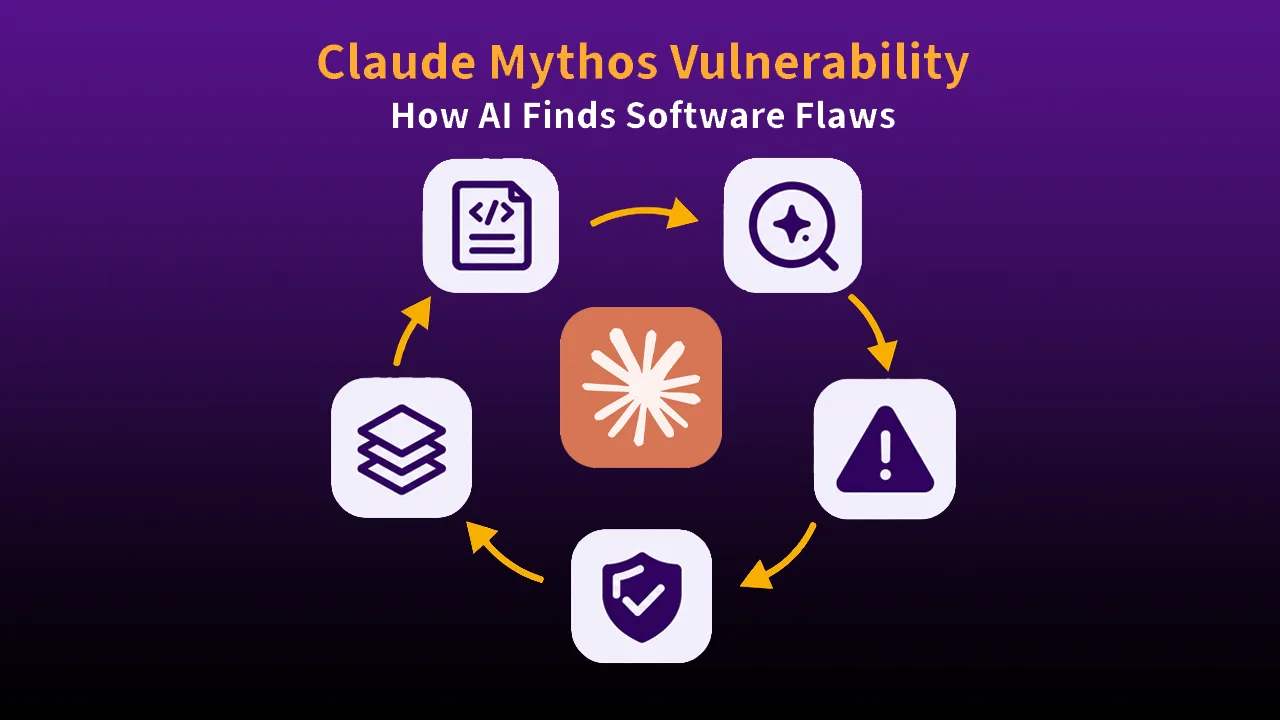
"Claude Mythos vulnerability" turns up in search bars for two very different reasons, and only one of them is accurate. The phrase doesn't refer to a disclosed flaw inside Anthropic's Claude Mythos Preview model. It refers to a capability: Mythos Preview reads source code, forms a hypothesis about where a weakness might sit, tests that hypothesis by running the program, and in a documented set of cases builds a working exploit from what it finds. Anthropic's April 2026 technical report walks through examples spanning a 27-year-old OpenBSD denial-of-service bug, a 17-year-old FreeBSD NFS remote code execution flaw tracked as CVE-2026-4747, and browser exploit chains that combine four separate vulnerabilities into a single renderer-and-OS sandbox escape.
The gap between finding a bug and closing it is where this gets operational. Only 26% of vulnerabilities on CISA's Known Exploited Vulnerabilities catalog were fully remediated by organizations in 2025, with median resolution time stretching to 43 days. That's the baseline throughput of the human side of the pipeline, before AI-assisted discovery changes the input rate. When one side of a system speeds up and the other doesn't, backlog is the predictable outcome, not an anomaly.
Open-source maintainers are already living this from the reporting side. In January 2026, curl's Daniel Stenberg shut down the project's six-year bug bounty program, citing a submission pool where confirmed vulnerabilities had dropped from over 15% to under 5% as AI-generated reports flooded in. Mozilla saw the inverse case at Firefox: testing Mythos Preview against Firefox 150 turned up 271 confirmed vulnerabilities, over ten times what the same team found in Firefox 148 using Claude Opus 4.6. Whichever side of that ratio a team lands on, the constraint is the same. Discovery got fast; verification didn't keep pace.
This matters past security research the moment code generation speeds up too. A team shipping AI-generated pull requests several times a day needs a way to separate an intentional architecture change from an unsafe one before either reaches production, not after a scanner flags it weeks later. The rest of this piece works through how Mythos chains vulnerabilities into exploits, why that strains conventional scanning assumptions, and what a delivery pipeline needs to hold up once AI-discovered vulnerabilities and AI-generated code move through the same system at the same speed.
How Claude Mythos Turns Code Analysis Into Exploit Paths
A single vulnerability rarely hands an attacker anything by itself; most modern defenses assume exactly that. What separates Mythos Preview's output from a routine scanner report is what happens after it finds the first one.
Chained Vulnerabilities Create A Different Security Problem
Anthropic's report describes a case where Mythos Preview chained four separate browser vulnerabilities into a JIT heap spray that got past both the renderer sandbox and the operating system sandbox. On the Linux kernel side, the model has independently strung together two, three, and in some cases four bugs: one to defeat address space randomization, a second to read a data structure, a third to write to freed memory, and a fourth to place a matching object exactly where that write lands. None of those bugs crosses a privilege boundary on its own. Combined, in the right order, they do.
That's also why finding a bug and proving it's exploitable are different jobs. Sandboxing, kernel address space layout randomization, and memory-safety protections exist specifically to make a raw read or write primitive useless in isolation. A vulnerability that looks severe on its own might be unreachable once those defenses are accounted for, and one that looks minor might turn out to be the missing link in an existing chain. Severity only becomes concrete once someone, or something, tries to build the exploit against a hardened target.
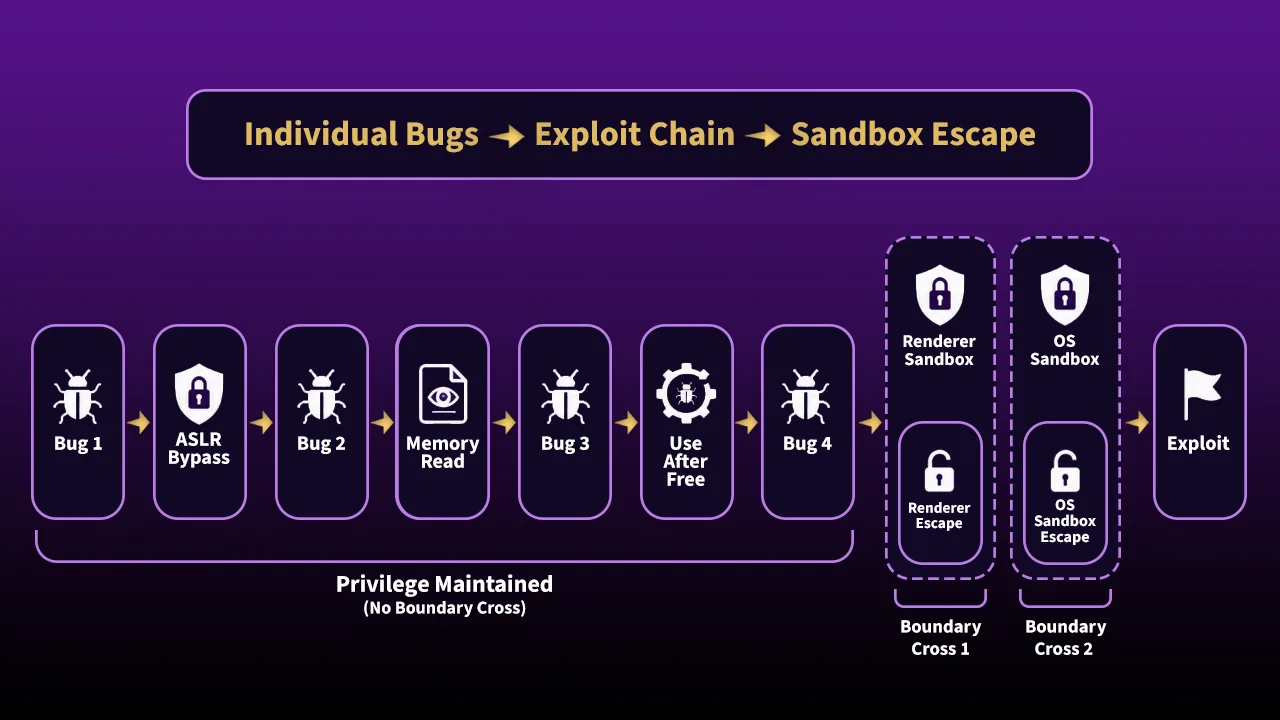
Focus first on the arrows connecting the individual bugs, because the order of the primitives determines whether the chain works. The easiest state to misread is the individual vulnerability, since none of the isolated bugs cross the privilege boundary by itself.
Why Traditional Scanner Findings Don't Capture The Entire Path
Static analysis and software composition analysis tools work by matching code against known-bad patterns: an unsafe function call, a vulnerable library version, an unescaped input. That approach catches a great deal, and dismissing it would be a mistake. What it handles less well is reasoning across program state, control flow, and the specific conditions under which several individually low-risk quirks become exploitable together.
A CVE record, a vulnerable code path, a proof of concept, and a working exploit are four distinct artifacts, and a Mythos-generated report can land anywhere in that range depending on how much validation has happened. A report that reads "possible out-of-bounds write in this function" isn't the same claim as one that hands over a working root shell. Treating every AI-generated report as automatically critical-severity, without reproducing it, means inheriting the model's confidence level as a verified fact. Reproduction and security review aren't optional steps to skip when volume is high; they're the step that turns a report into a decision.
The Bottleneck Moves From Discovery To Verification
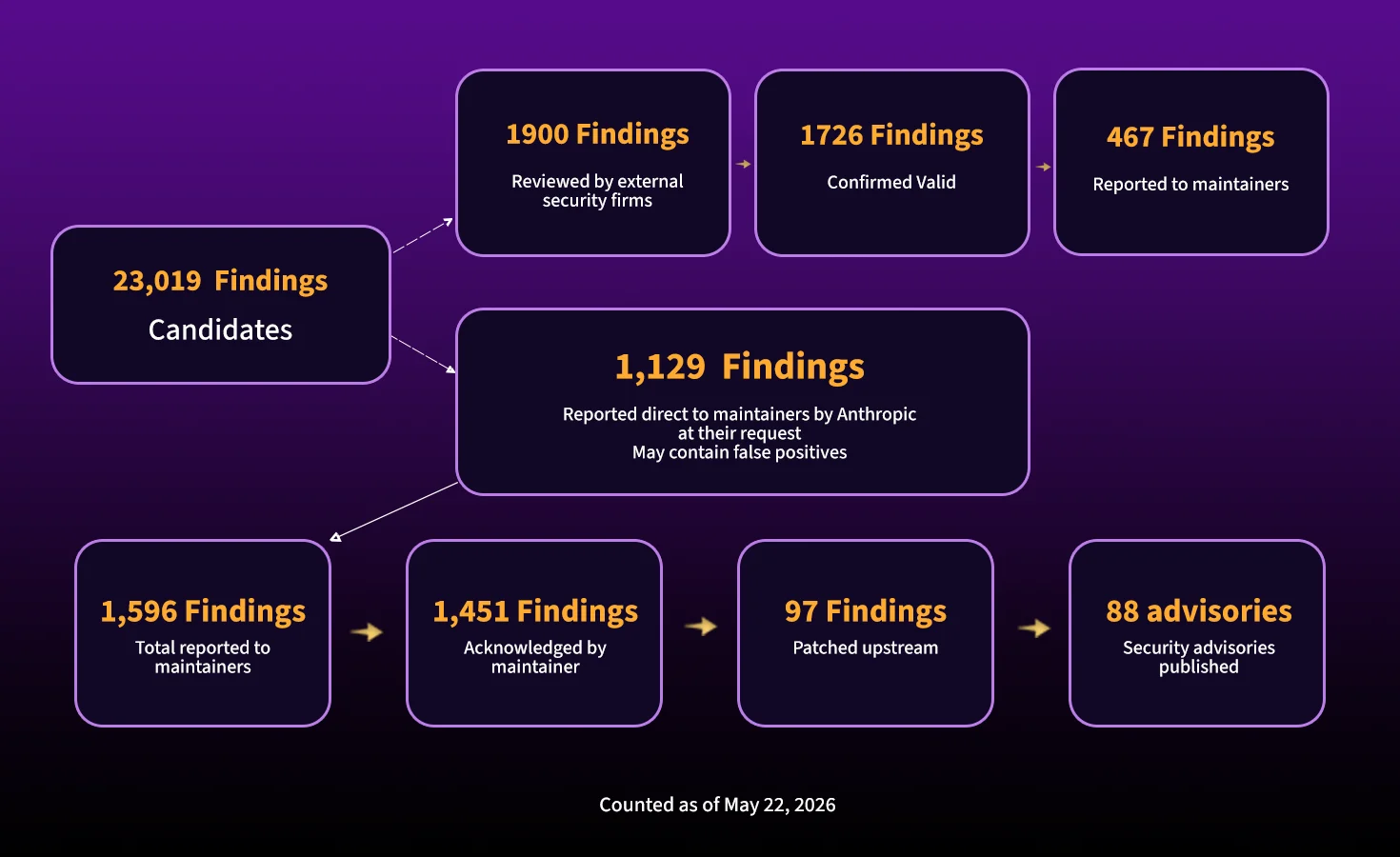
Anthropic's Project Glasswing update gives this a concrete shape. Across more than 1,000 open-source projects, Mythos Preview reported an estimated 6,202 high- or critical-severity vulnerabilities out of 23,019 total. Of the 1,752 that independent security firms formally assessed, 90.6% turned out to be true positives, and 62.4% held up at high or critical severity after review.
A step-chart dashboard showing a sharp drop-off across the stages of open-source vulnerability disclosure, from total discovered issues down through validation, disclosure to maintainers, and confirmed patches. The width of each bar shows how much volume is lost at each human-review step, which is the point of the chart: discovery outpaces every stage that follows it.
Getting from a Mythos report to a patched vulnerability still runs through the same steps it always has: reproduce the issue, check whether a fix already exists, write a report a maintainer can act on, and confirm the patch closes the hole. None of that work compresses just because the report arrived faster. A vulnerability that lands in an engineering backlog without an assigned owner, clear acceptance criteria, and context on where the affected code deploys still needs a person to do the expensive coordination work: figuring out who owns it, what it touches, and what "fixed" means for that specific system.
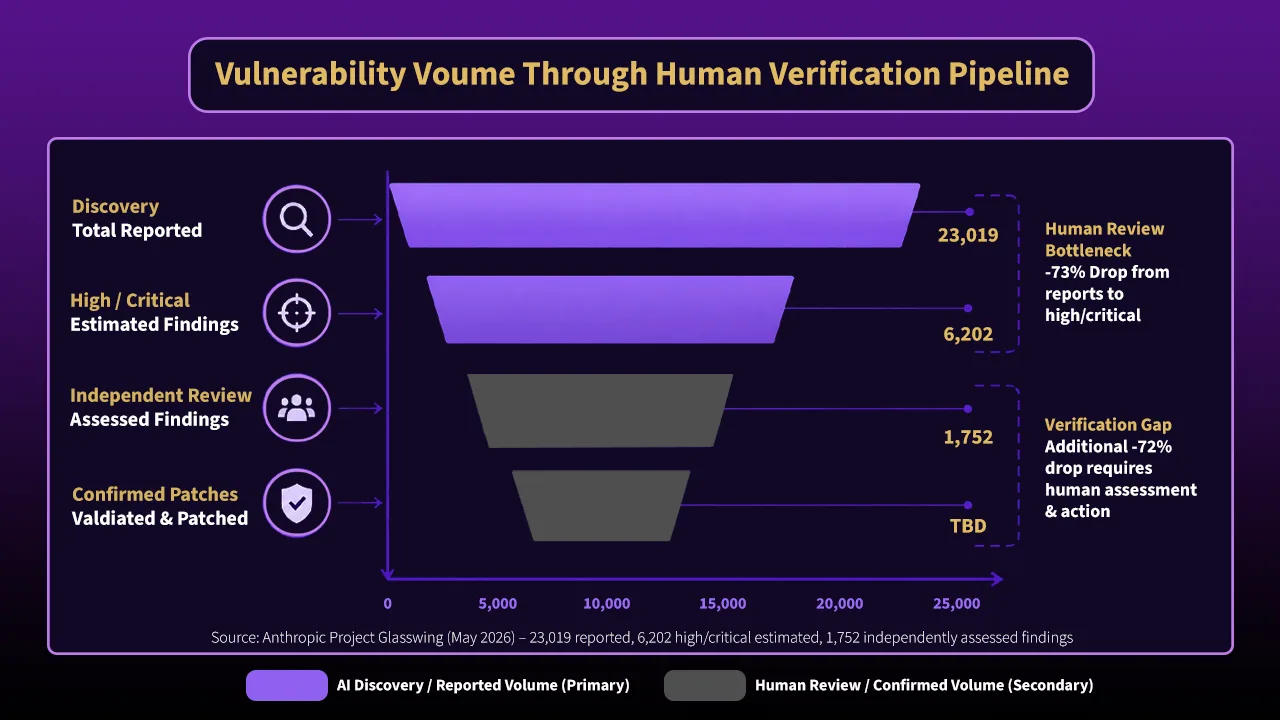
Look first at the narrowing from total reports to independently assessed findings, because that contraction represents the human review work between discovery and action. The easiest value to misread is 6,202, since it represents estimated high or critical findings rather than independently verified vulnerabilities.
Why AI-Discovered Vulnerabilities Stress Existing Patch Workflows
Most vulnerability management programs were sized for a trickle of new reports each week, arriving from a handful of known sources. That assumption breaks first at the triage desk, before a report ever reaches an engineer.
Triage Fails When Finding Volume Exceeds Review Capacity
Every report needs a human decision before code work starts: is this real, is it a duplicate, does a fix already exist, and how severe is it. Anthropic's coordinated disclosure dashboard for its open-source scanning work shows a steep drop at each of those steps, from initial reports through validation, disclosure, and confirmed patches. That drop isn't a waste. It's the visible cost of separating real vulnerabilities from noise.
Raw counts don't tell a security lead much on their own. A report that duplicates one already fixed upstream costs review time and returns nothing. A false positive costs the same. A vulnerability with no reachable attack path under the current configuration might be technically correct and operationally irrelevant. The number that matters isn't how many vulnerabilities a scan produced; it's how many of those, after triage, represent an attack path an adversary could use against the system as configured and deployed today.
Legacy Code Makes Verification More Expensive
Old systems compound the triage problem instead of just adding to it. A vulnerability in a component with sparse documentation, a custom framework nobody currently on the team wrote, or a dependency graph nobody has fully mapped takes longer to verify precisely because verifying it means reconstructing context that was never written down. Finding the vulnerable line is rarely the hard part; knowing what else touches that line, and what breaks if it changes, is.
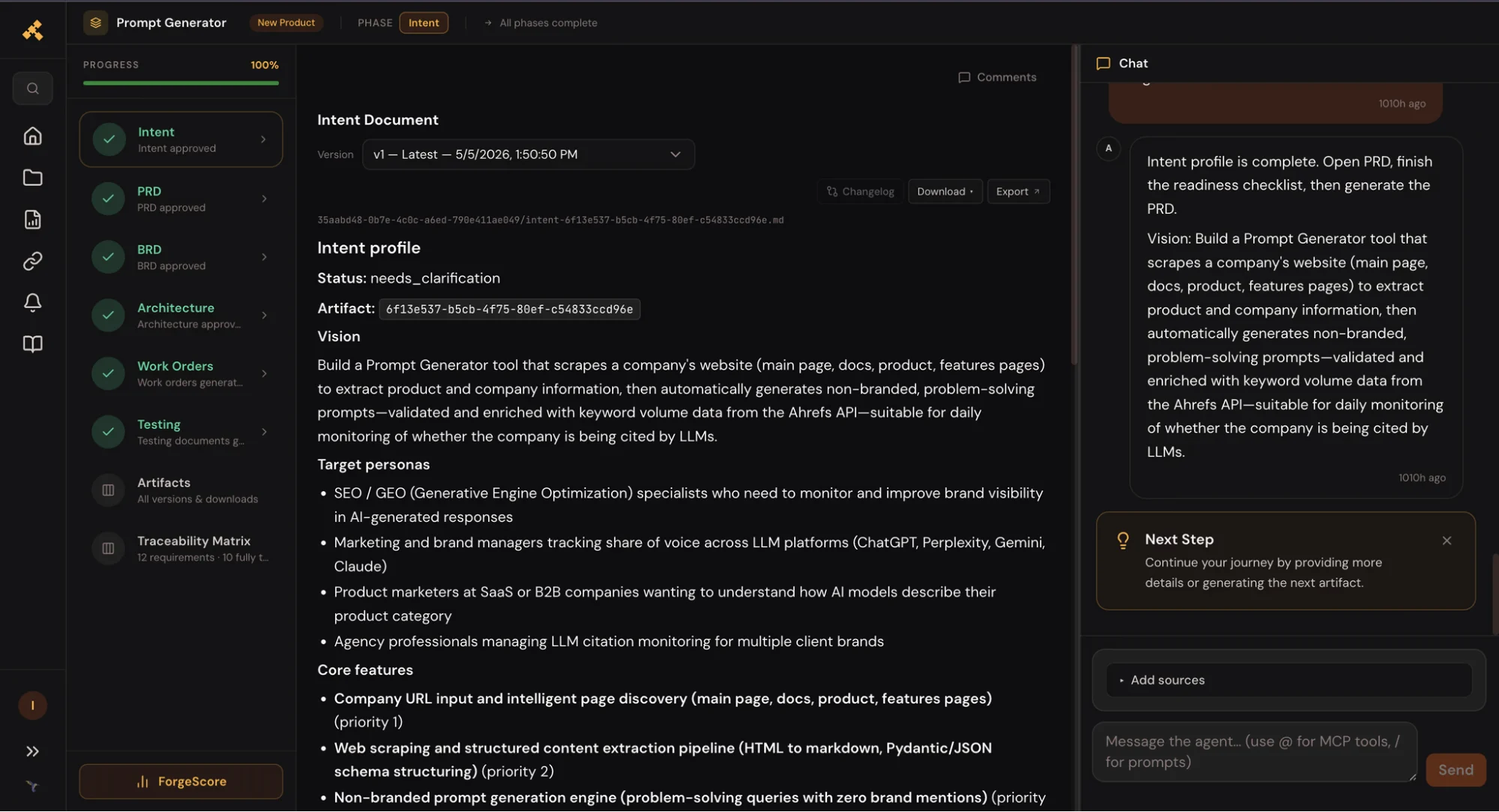
Forge's approach to legacy modernization is to reverse-engineer that missing context before any modernization work starts, generating an eight-dimension ForgeScore assessment of the existing codebase and feeding that context to the agents doing the work. A representative excerpt, built from the dimension names in Forge documents for ForgeScore, illustrates the shape of that output:
{
  "forgescore": {
    "target": "legacy/billing-engine",
    "dimensions": {
      "logic_narrative": 84,
      "trust_boundaries": 61,
      "future_proofing": 58,
      "dependency_health": 47
    },
    "flagged_for_review": ["trust_boundaries", "dependency_health"]
  }
}
A split-panel view of a legacy codebase import screen, showing older files like legacy/core.js and utils/parser.js on one side and newly generated modules on the other, with a health-score summary layered over the legacy side. What matters here is the pairing: the score is attached directly to the specific legacy file, not to the project as a whole.
The premise is narrow but useful: a security engineer reviewing a Mythos-class report against a legacy system does the same reconstruction work a modernization project does, just under time pressure and without the benefit of having already mapped the codebase in advance.
Patch Generation Still Needs A Controlled Delivery Contract
Generating a plausible-looking patch isn't the same job as shipping a safe one. A fix has to close the specific gap a report describes, preserve every behavior the system depends on that wasn't part of the bug, pass the existing test suite, respect whatever architectural constraints the codebase carries, and stay traceable back to the report that triggered it. Skipping any one of those turns a patch into a new source of risk instead of a fix.
Forge frames each unit of remediation work as a Work Order, carrying fields for any change moving through the platform: acceptance criteria, dependencies, story points, and an assigned owner, with requirements traced back through the PRD and architecture stage that produced them. A representative Work Order, built from those documented fields, looks like this:
work_order:
  id: WO-2201
  title: Patch out-of-bounds write in legacy parser module
  source_report: mythos-scan-6202-3841
  acceptance_criteria:
    - Input fuzzing suite passes 100,000 iterations with no crash
    - Original exploit reproduction no longer succeeds
    - No change to documented public API surface
  dependencies: [ARCH-114, PRD-econ-parser]
  story_points: 5
  assigned_to: platform-security-pod
That structure doesn't replace the security testing the fix still needs. It gives the patch a place to carry evidence that the testing happened before anyone approves the change.
Where Software Factory Controls Intercept AI Security Risk
Discovering a security problem after an agent has already produced a large, merged change set is expensive to unwind. The alternative is deciding, before that code exists, what an agent is allowed to touch and what evidence has to exist before it can touch more.
Security Checks Need To Run Before Code Reaches Review
A control that fires after deployment carries a different risk profile than one that blocks progression between intent, architecture, and implementation, even if both eventually catch the same class of problem. The cost of an authentication bypass caught in code review is a rejected pull request. The cost of the same bypass caught six weeks post-deployment is an incident.
Forge documents a Security Agent that checks each artifact at the point it's generated, covering authentication coverage, secrets handling, dependency risk, and prompt injection, with a human sign-off gate between each of the platform's five stages: intent, PRD, BRD, architecture, and Work Orders. A representative check manifest, reflecting those documented categories, looks like this:
security_agent_check:
  stage: architecture
  checks:
    - auth_coverage
    - secrets_handling
    - dependency_risk
    - prompt_injection
  gate: human_approval_required
  status: waiting
A pipeline view showing five sequential stages labeled Intent, PRD, BRD, Architecture, and Work Orders, with green checkmarks on the completed stages and the current stage marked "waiting" for human sign-off. The detail worth noticing is that the pipeline halts rather than queues; the next stage doesn't start until a person approves the one before it.
Whether a team builds that timing itself or adopts a platform that already does it, the underlying requirement doesn't change: security review has to sit close enough to the point of code generation that catching a problem doesn't mean unwinding work that already shipped.
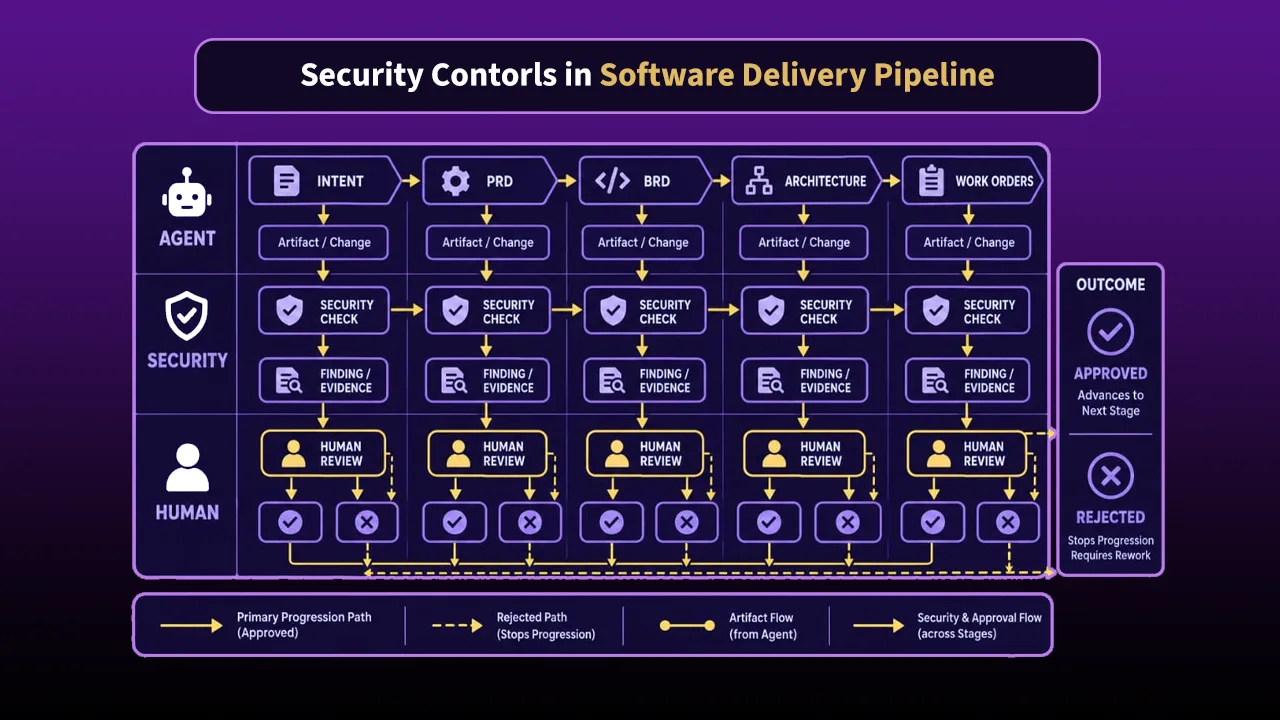
Focus first on the security check and approval boundary between two delivery stages, because the timing determines whether an unsafe change progresses. The easiest state to misread is Approval, which permits the next stage but doesn't establish that the entire application is secure.
Architecture Context Limits Unsafe Agent Decisions
An agent that solves a narrow ticket and breaks an assumption three other services depend on usually just wasn't given the context to know better. That's a gap in what the agent was told, not a limit on what the model can do.
Take authentication middleware as a concrete case. An agent patching a session-handling bug needs to know, going in, which downstream services trust that middleware's output unchecked, whether token format is part of a documented contract, and where the boundary between "fix this" and "don't touch that" sits. Forge's Living Spec model stores requirements, architecture, and Work Orders as versioned specifications specifically so an agent inherits that context with the task rather than reconstructing it from a codebase it's seeing for the first time. Acceptance criteria and architectural constraints set the boundary the agent works inside; a human reviewer stays responsible for approving whatever comes out the other end.
Traceability Connects Findings To The Change That Fixed Them
Vulnerability reports, agent sessions, pull requests, and remediation decisions living across four separate systems creates an audit problem the moment someone needs a simple answer: what fixed this, and who approved it. Reconstructing that chain after the fact, across tools with no shared identifiers, can take longer than writing the original patch did.
Forge documents a traceability matrix connecting each requirement to its PRD, architecture, and Work Orders, with code changes and agent actions tracked through delivery. Once a Mythos-class report enters an organization through that kind of record, a security engineer can trace the affected requirement or component, the remediation Work Order tied to it, the acceptance criteria used to validate the fix, and the approval that released it. That's the difference between answering an auditor's question in an afternoon and spending a week doing git archaeology first.
What Claude Mythos Changes For AI-Assisted Software Development
Periodic security review, built around quarterly audits and scheduled penetration tests, assumed vulnerability discovery happened at a human pace. A model that can search a codebase continuously removes that assumption without asking permission first.
Faster Discovery Changes The Required Security Cadence
Anthropic's Project Glasswing experience makes the shape of the problem explicit: discovery got fast enough that verification and patching capacity became the limiting factor, not the reverse. That's a flip from how most security programs are staffed, where budget and headcount get allocated on the premise that finding vulnerabilities is the hard, expensive part and fixing them is comparatively routine.
The engineering response isn't necessarily more headcount. It's moving security review closer to the code-generation boundary for high-risk changes, rather than routing everything through a quarterly audit or a vulnerability-management queue sized for a much smaller intake. A team that checks security posture once a quarter is running that check at a cadence built for a world where new critical vulnerabilities arrived by the dozen, not by the thousand.
Model Choice Doesn't Remove The Need For Governance
It's tempting to treat "which model" as the whole security decision, and it isn't, not by a long shot. Forge's Work Orders are documented as model-agnostic, carrying scope, acceptance criteria, architecture context, and quality requirements regardless of which coding agent executes them, whether that's Claude Code, Cursor, or another supported tool.
Claude Mythos is a useful stress case for that design, precisely because a more capable model raises the stakes on the questions governance is supposed to answer: what an agent is allowed to change, what evidence counts as the task being done, and which human signs off before it goes further. Forge isn't positioned as a substitute for dedicated vulnerability research or specialized AppSec tooling, and treating a delivery platform as if it replaced that work would leave a real gap open. It's positioned as the layer that decides what happens to a change once a model, any model, has produced it.
AI-Generated Remediation Needs Evidence, Not Just Code
A patch that compiles, passes its unit tests, and clears a static analysis pass can still leave the original exploit path open. Those are four different kinds of evidence, and only one, exploit reproduction against the specific vulnerability, confirms the hole is closed rather than just quiet.
Forge's documented acceptance criteria and security gates give that evidence a place to live, attached to the Work Order rather than scattered across a CI log and a chat thread. But the platform's own limits matter here too: structuring and tracing remediation work isn't the same as running specialized security testing against a sophisticated, chained vulnerability, and a team that treats the two as interchangeable is trusting evidence it never generated.
Claude Mythos Vulnerability And The New Security Decision
For developers, the practical lesson from Claude Mythos isn't to replace SAST, SCA, exploit testing, or human review. The harder requirement is giving each security-sensitive change enough context and a checkable definition of done before an agent writes code. Forge's study across 937 projects recorded rework falling from 3.2 to 1.3 tries per task, with every Work Order traceable through the requirements traceability matrix; the same study reports roughly eight acceptance criteria per Work Order, giving reviewers specific conditions to verify rather than judging an agent's output from the diff alone.
That approach also changes how a developer should structure remediation. A Mythos finding should enter a Work Order with the affected component, architectural constraints, acceptance criteria, exploit reproduction, and required security checks, then remain linked to the change and approval that closes it. Forge documents security and compliance checks at commit and RTM traceability across Work Orders, while its reported 70–85% delivery-time reduction and roughly 75% token reduction are modeled estimates rather than measured project outcomes.
The engineering decision is therefore narrower than choosing the strongest model: decide whether every agent-generated security change has enough context to make the intended change, enough evidence to prove the vulnerability was closed, and enough traceability to show who approved it.
Questions.
What Is The Claude Mythos Vulnerability?
It isn't a single disclosed flaw in Anthropic's model. The phrase describes Claude Mythos Preview's capability to identify zero-day vulnerabilities in software and, in documented cases, build working exploits from them, including a chained browser sandbox escape and a FreeBSD NFS remote code execution flaw confirmed as CVE-2026-4747 in April 2026.
Can Claude Mythos Find Zero-Day Vulnerabilities?
Yes. Anthropic's research team used Mythos Preview to identify previously unknown vulnerabilities across major operating systems, browsers, and open-source libraries, including a 27-year-old OpenBSD bug and a 16-year-old FFmpeg flaw. Access remains restricted to Project Glasswing partners; the model hasn't seen a general release.
How Does Claude Mythos Find Software Vulnerabilities?
It runs an agentic loop: reading source code, forming a hypothesis about where a weakness might sit, testing that hypothesis by running the program, and repeating across a codebase. Anthropic reports it can also identify which vulnerabilities chain together into a viable exploit path.
Can AI-Discovered Vulnerabilities Be Exploited Automatically?
Some can. Mythos Preview has autonomously written working exploits, including privilege escalation chains, without human guidance after an initial prompt. That's precisely why security teams treat every AI-generated report as needing reproduction and review before assuming severity, rather than accepting the model's initial assessment as final.