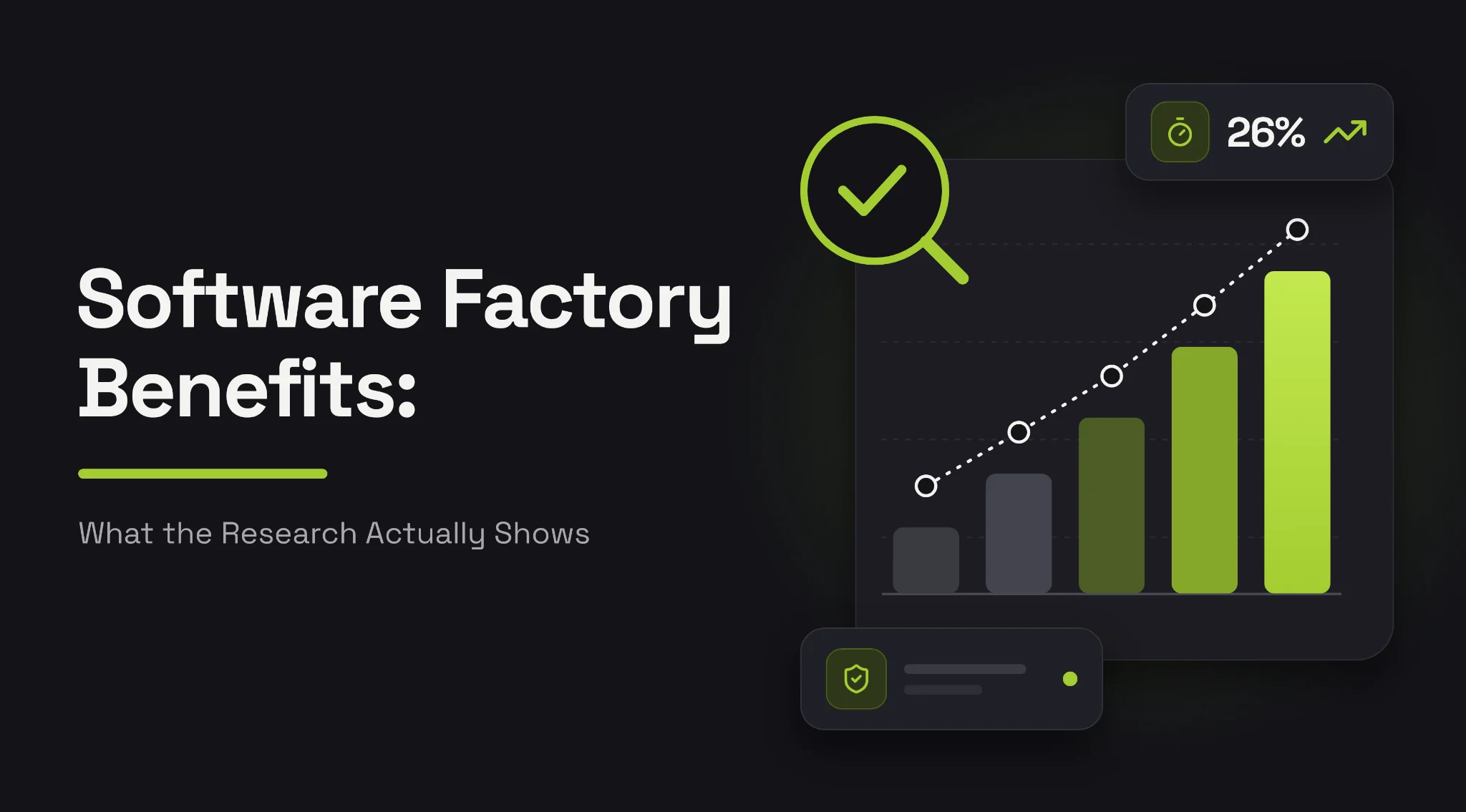
Software Factory Benefits: What the Research Actually Shows
TL;DR
- A rigorous study of more than 4,800 developers at Microsoft, Accenture, and a Fortune 100 company found that AI-assisted execution alone lifted individual task completion by 26 percent on average, with junior developers gaining the most.
- Faster individual work doesn't automatically mean faster delivery: the 2024 DORA research estimated that a 25 percent increase in AI adoption came with a 1.5 percent drop in delivery throughput and a 7.2 percent drop in delivery stability.
- McKinsey's research points to the reason: organizations that redesign the workflow capture far more value than those that only add AI tools to it.
- The software factory benefits that hold up cluster into three groups: individual execution speed, delivery throughput when the whole system is connected, and governance benefits that reduce risk rather than add raw speed.
- Opsera's Forge is built to capture the governance and measurement benefits execution-only tools miss, turning individual AI productivity gains into auditable, enterprise-scale delivery improvements.
Every vendor in this category promises transformative benefits, and the real story is more interesting than the marketing version. Some claims are well measured. Others are early, directional, or true only under conditions most case studies don't disclose.
Picture a composite travel-booking company with 220 engineers as a useful lens for sorting one from the other. When its platform team rolled out an AI coding assistant to 40 developers on its booking-engine team, the first-month report to leadership claimed a sweeping productivity win.
Three months later, the team's release cadence hadn't moved, and nobody could say why the two numbers told different stories. This guide works through the evidence behind software factory benefits, organized by where in the system each benefit shows up, and uses the travel company's experience to show where the gap between individual and organizational gains tends to open.
What Are the Key Software Factory Benefits?
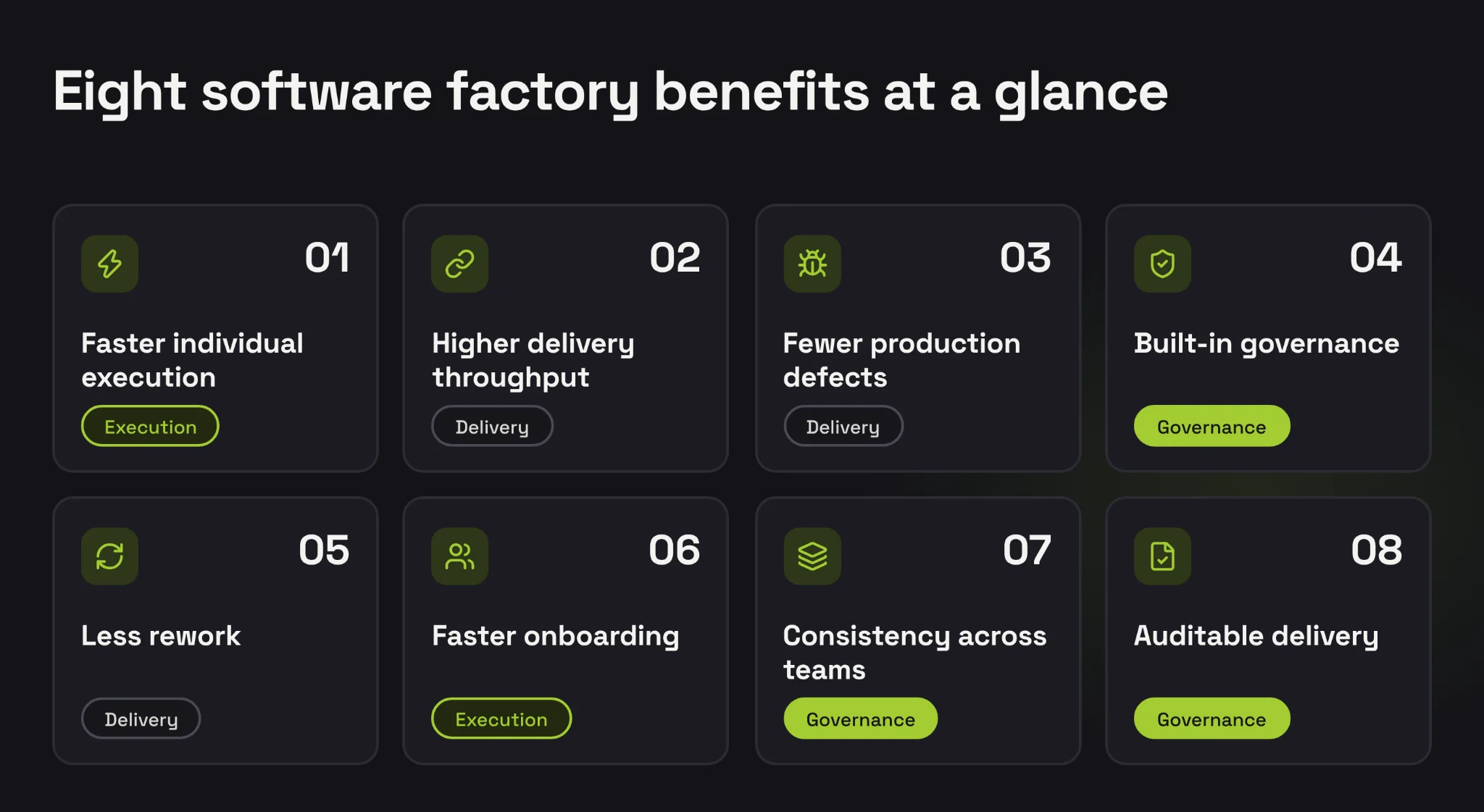
The key software factory benefits are faster individual execution, higher delivery throughput, fewer defects reaching production, built-in governance and compliance, less rework, faster onboarding, consistency across teams, and auditable delivery. Individual speed is the best-measured benefit; the rest depend on connecting context, specifications, governance, and measurement around execution.
Here are the eight benefits, in rough order of how strong the evidence is today:
- Faster individual execution. Developers complete more tasks with AI-assisted execution.
- Higher delivery throughput. Features ship faster, but only when the workflow around execution is redesigned.
- Fewer defects reaching production. Earlier checks catch problems before they become incidents.
- Built-in governance and compliance. The system enforces policy instead of memory.
- Less rework. Structured specs reduce the drift between what was asked for and what got built.
- Faster onboarding. New engineers and agents start from a shared, accurate picture of the codebase.
- Consistency across teams. Every team follows the same paved path instead of inventing its own.
- Auditable delivery. Every change links back to a requirement, its tests, and its approver.
What Are the Different Levels of Software Factory Benefits?
Not every productivity number in this market measures the same thing, and mixing them up produces a rosier picture than reality:
- Individual-level metrics (tasks completed, commits made, lines generated) measure execution speed, nothing more.
- Team-level metrics (cycle time, release cadence, defect rate) account for review, integration, and testing, the stages where faster individual output often gets absorbed.
- Enterprise-level metrics (incident rate, audit response time, architectural violations) measure governance, a different benefit from either of the above.
A 26 percent individual task completion gain and a real reduction in release risk are both well-supported benefits, but they're not the same claim. The travel company's first-month report cited the individual number. Its unchanged release cadence was the team-level number nobody had checked yet.
When a vendor quotes a benefit, ask three questions:
- At which level was it measured? Individual, team, or enterprise.
- Against what baseline? A before-and-after on the same team means more than a comparison against an industry average.
- Over how long? First-month numbers often reflect novelty, not a steady state.
How Much Faster Does a Software Factory Make Individual Developers?
The strongest, most rigorously measured benefit in this category is at the individual execution level. Economists from MIT, Princeton, and the University of Pennsylvania examined more than 4,800 developers at Microsoft, Accenture, and a Fortune 100 company who were given access to GitHub Copilot, and found:
- Developers completed 26 percent more tasks on average.
- Weekly code commits rose 13.5 percent.
- Code compilation frequency, a proxy for iteration speed, rose 38.4 percent.
- Junior developers saw the largest gains, 21 to 40 percent; senior developers saw a smaller 7 to 16 percent lift.
- Roughly 60 to 70 percent of developers used the tool consistently enough to show these gains.
Individual Execution Gains by Experience Level
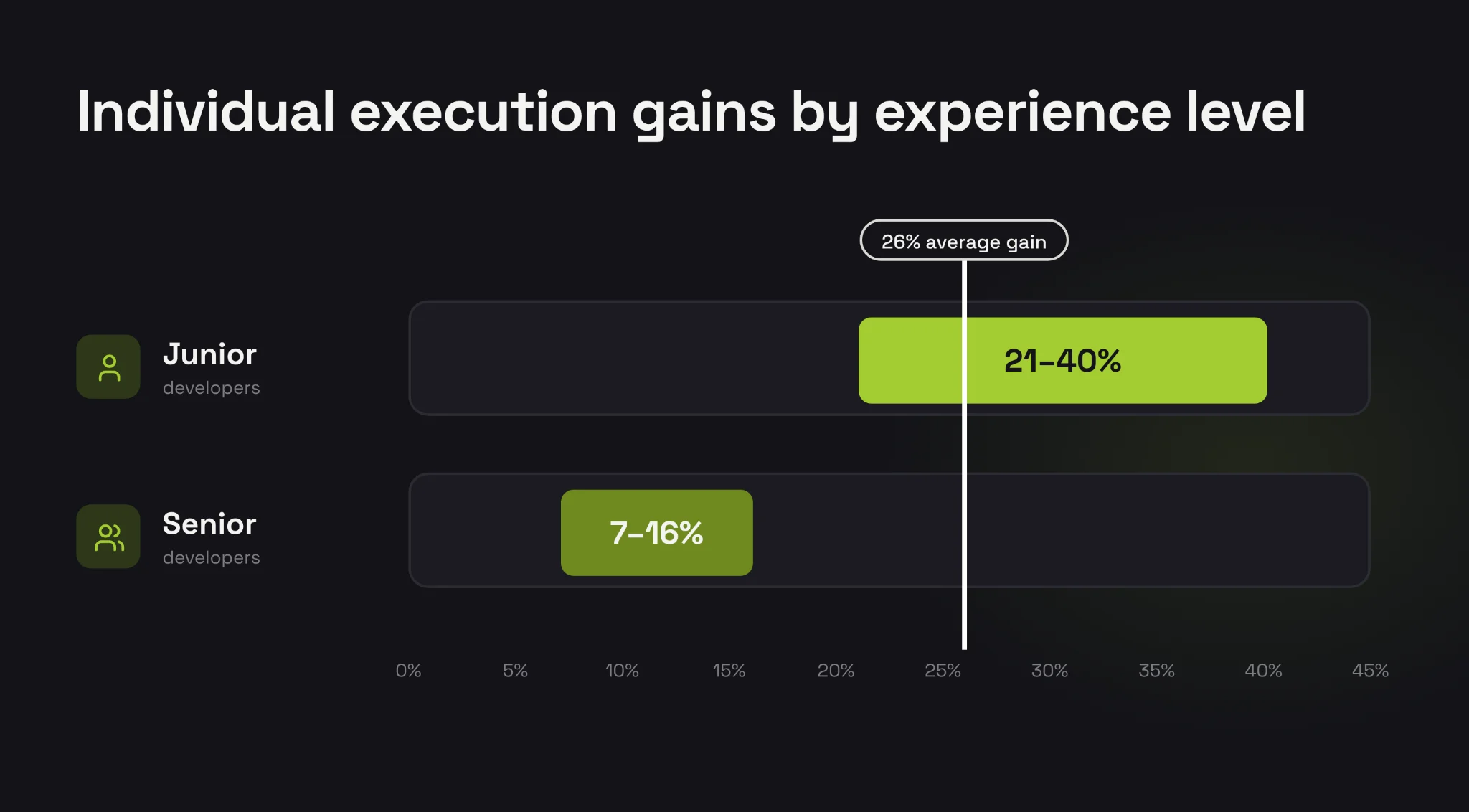
The travel company's 40-developer rollout matched the pattern closely: its junior engineers reported the most visible speedup. But the study tracked individual output and activity, not whether entire projects shipped faster. That distinction is exactly where the travel company's story picks back up.
Why Doesn't Faster Code Automatically Mean Faster Delivery?
This is where the evidence draws its sharpest line, and where the travel company's unchanged release cadence came from. Two independent bodies of research point the same way:
- DORA's 2024 research found that 75 percent of respondents reported productivity gains from AI, yet a 25 percent increase in AI adoption was associated with an estimated 1.5 percent decrease in delivery throughput and a 7.2 percent decrease in delivery stability.
- DORA's 2025 research describes AI as an amplifier that magnifies an organization's existing strengths and weaknesses, and finds the biggest returns come from improving the underlying system rather than the tools alone.
- McKinsey's research found that organizations adopting AI coding tools without changing the surrounding workflow capture only a fraction of the value available to those that redesign the delivery process itself.
When the travel company's platform lead dug into the three-month numbers, the cause was simple:
- Developers were generating code faster, consistent with the research.
- The code review queue, staffed and sized for the old pace, became the new bottleneck.
- Pull requests piled up waiting for review, erasing the individual speed gain by the time a feature shipped.
- Larger AI-generated changes were harder to review, so some slipped through with less scrutiny than before.
A software factory's core delivery-level benefit is closing exactly that gap. It connects execution to context, specifications, governance, and measurement, so faster individual contributions flow through a pipeline built for the new pace instead of piling up at the next unchanged bottleneck.
What Are the Governance, Security, and Compliance Benefits of a Software Factory?
This group of benefits gets less attention in productivity marketing, but it often justifies the investment for a risk-conscious buyer. An ungoverned AI agent can produce a large volume of plausible-looking but architecturally wrong code faster than a traditional review process was designed to catch. Governance built into the factory means faster execution doesn't bring a proportional increase in risk:
- Pre-generation policy checks catch violations before code is written, not after.
- Traceability records turn governance from a point-in-time check into an ongoing audit trail.
- Fewer architectural surprises reach production, since drift gets blocked earlier in the pipeline.
- Faster audit response, because the evidence an auditor asks for already exists instead of being reconstructed from tickets and chat threads.
Three Categories of Software Factory Benefit
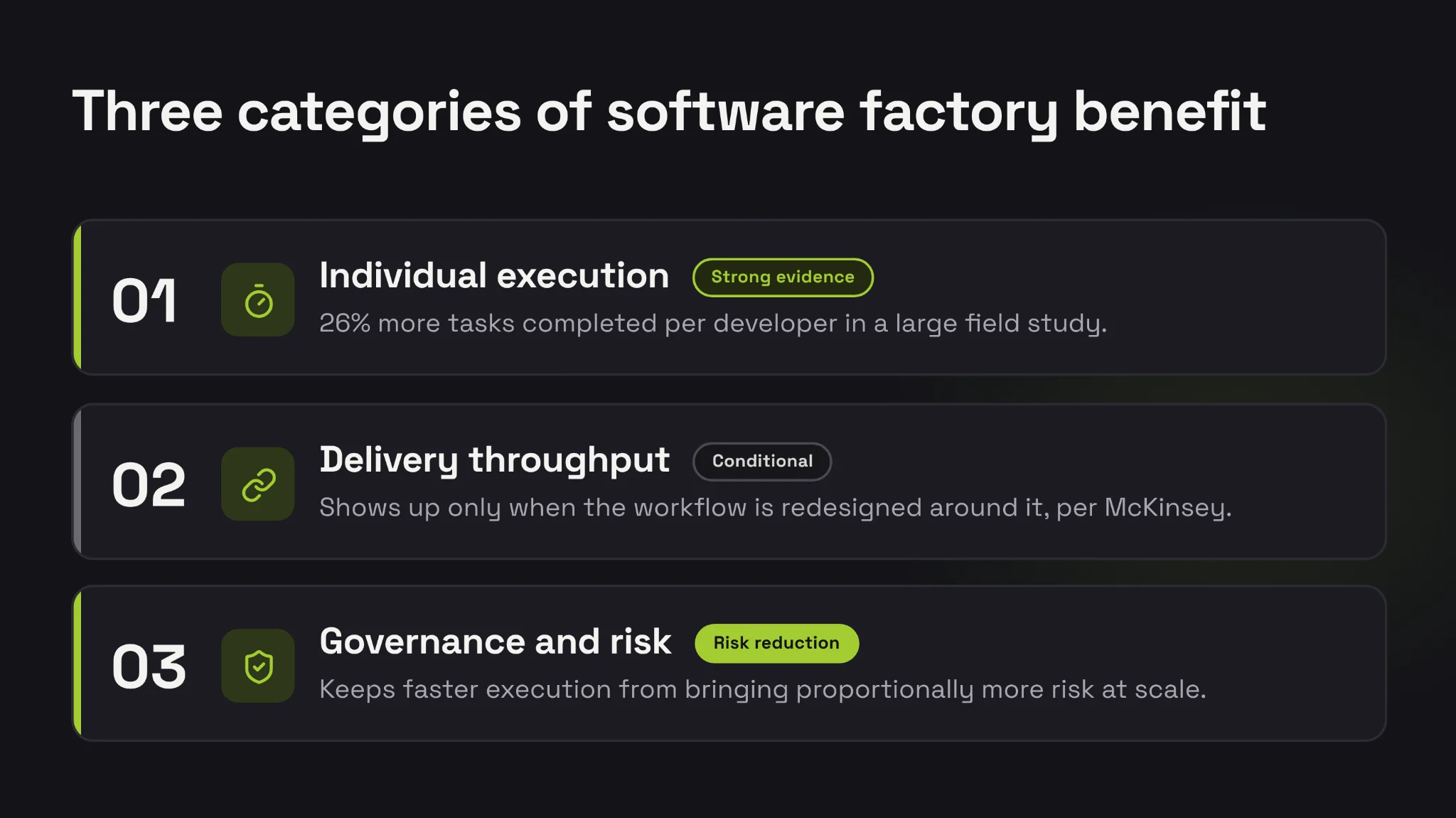
For a travel company that handles payment card data, this benefit mattered as much as throughput. An unreviewed architectural change reaching a payment flow carries compliance exposure that a speed metric alone doesn't capture.
Which Software Factory Benefits Do Vendor Pitches Usually Skip?
Some of the most durable benefits are hard to put in a headline number, so they rarely make the pitch deck:
- Knowledge that survives turnover. When context lives in a maintained graph instead of a few senior engineers' heads, a resignation stops being a delivery risk.
- Faster onboarding. A new hire, or a new AI agent, starts from the same accurate picture as everyone else instead of weeks of tribal-knowledge interviews.
- Less rework from spec drift. When requirements stay attached to code, "that's not what we asked for" gets caught at the spec stage instead of in user acceptance testing.
- Consistency across teams. Shared patterns and guardrails mean one team's good practice becomes every team's default.
The travel company saw the onboarding benefit first. Engineers moved onto the booking-engine team mid-project reached their first merged change noticeably faster once the context layer was current, a gain that never appeared in the original productivity report because nobody had thought to measure it.
How Do Software Factory Benefits Differ by Role?
The same platform produces different benefits depending on who's looking at it, which is why a single headline number rarely convinces everyone in the room:
- Engineering leaders care about throughput and predictability: whether release dates hold, and whether faster execution shows up in cycle time instead of disappearing into review queues.
- Developers care about flow: less time hunting for context, fewer "that's not what we meant" rewrites, and clearer done-criteria before they start.
- Security and compliance teams care about evidence: policy enforced before code is written, and an audit trail that exists without anyone having to assemble it.
- Architects care about drift: whether new code, human or AI-written, respects the boundaries the system was designed around.
- Business stakeholders care about time to value: how long it takes for an approved requirement to reach customers.
When the travel company's platform lead presented the three-month results, the slide that landed with the CFO wasn't the 26 percent figure. It was the drop in review wait time after the workflow changed, because that number translated directly into features reaching travelers sooner.
What Do Software Factory Benefits Look Like Over the First 90 Days?
Benefits arrive in a predictable order, and knowing that order keeps leadership from judging the investment too early:
- Weeks 1 to 4: execution gains. Individual speedups show up almost immediately, especially for junior engineers. This is also when expectations get set too high.
- Weeks 4 to 8: the bottleneck appears. Review queues and integration testing start absorbing the extra output. Delivery metrics may look flat or slightly worse, consistent with DORA's findings.
- Weeks 8 to 12: workflow changes pay off. Once specs, governance gates, and review capacity are adjusted, cycle time and rework start to move.
- After 90 days: governance and knowledge benefits compound. Audit response, onboarding speed, and cross-team consistency become visible as more services join the loop.
The travel company's experience followed this curve almost exactly. Its mistake was reporting at week four, at the top of the first curve, and then having to explain the flat delivery numbers that followed.
What Are the Challenges and Trade-offs of a Software Factory?
A fair look at software factory benefits has to include the costs. The common ones:
- Upfront setup effort. Connecting repositories, tickets, and policies takes real platform-team time, even with a managed service.
- Context maintenance. A context layer only helps if it stays current; a stale one actively misleads agents.
- Review capacity. If you speed up execution without resizing review, you move the bottleneck instead of removing it.
- Cultural change. Spec-first work feels slower to developers used to jumping straight into code, at least at first.
- Vendor dependence. A managed platform holds your specs and audit trail, so export options matter.
None of these cancel the benefits, but they explain why the same tool produces strong results in one organization and flat results in another.
How Does Opsera's Forge Capture the Full Range of Software Factory Benefits?
Opsera built Forge to capture the benefits execution-only tools leave on the table. Forge is the orchestration layer above the models and coding agents a team already uses, so the delivery and governance gains that only appear when context, specifications, and governance are connected to execution show up whichever agent writes the code.
Forge's Evidence View: Requirement-to-Release Traceability
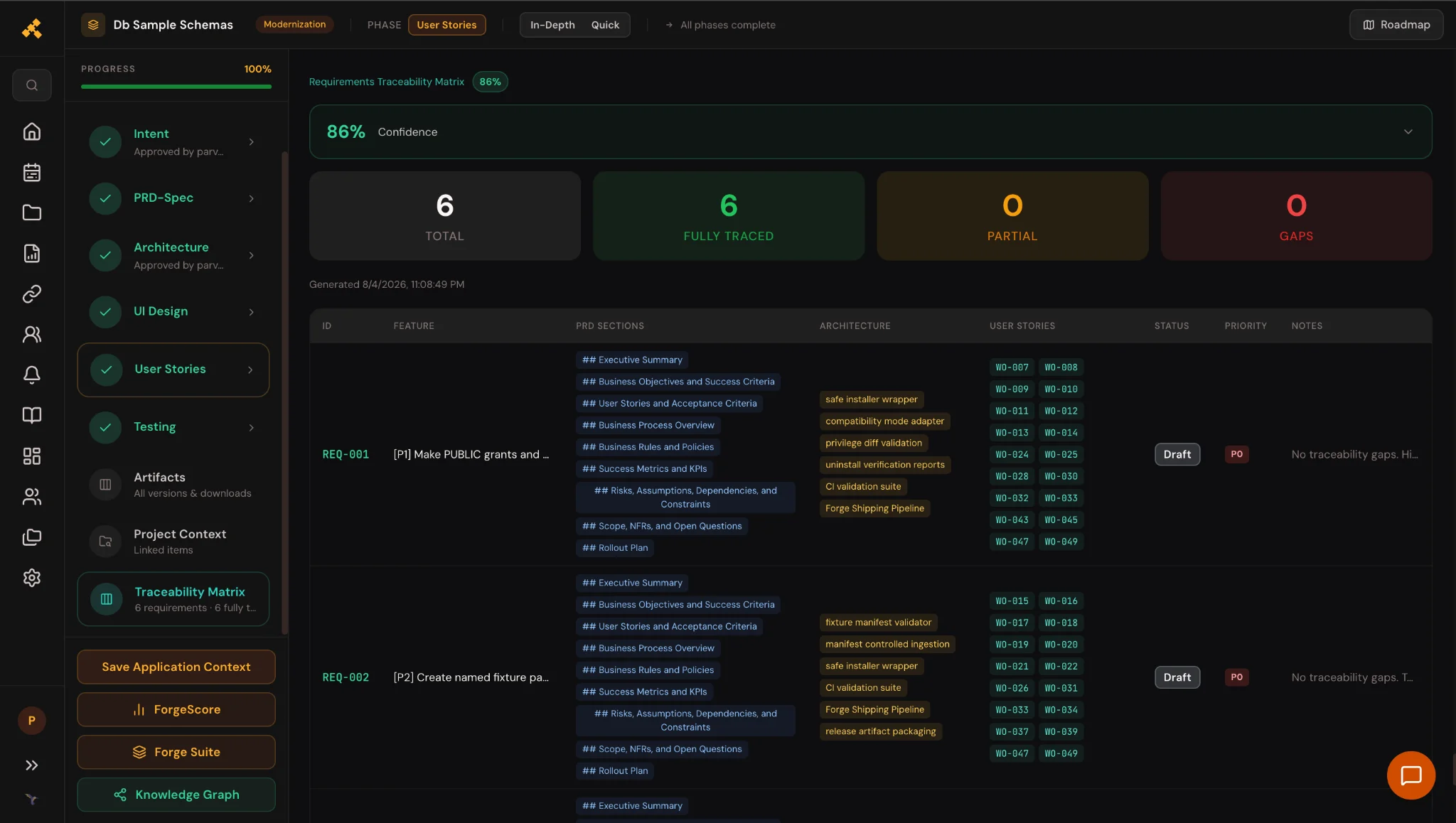
Forge's five-stage pipeline addresses each gap directly:
- Context keeps the knowledge graph current, so execution starts from accurate information and onboarding gets faster.
- Living Specs and Work Orders keep requirements structured and attached to code, reducing the rework the travel company saw when implementation drifted from intent.
- Guarded Build runs policy and security checks before generation, the governance benefit directly.
- Evidence delivers the measurement benefit, a traceability record for every human-agent handoff.
A companion ForgeScore assessment rates a codebase across eight engineering dimensions before modernization work gets planned, turning prioritization into a repeatable number. The combined effect addresses McKinsey's specific finding: Forge doesn't just add an AI tool to an existing workflow, it redesigns the context, specification, and governance layers around what AI execution now makes possible, closing the gap that stalled the travel company's release cadence in the first place.
How Do You Measure Software Factory Benefits and ROI?
Measure at more than one level, the way the travel company eventually had to. Capture a baseline before rollout, then track the same metrics after:
| Level | What to track | What it tells you |
|---|---|---|
| Individual | Tasks completed, time to first commit | Whether execution got faster |
| Team | Cycle time, review wait time, release cadence | Whether the speed survived the pipeline |
| Quality | Change failure rate, rework rate, escaped defects | Whether faster also means safer |
| Enterprise | Audit response time, policy violations caught pre-merge | Whether governance improved |
A simple way to frame ROI for leadership:
- Time saved across the team-level metrics, not just individual output, converted to engineering hours.
- Risk avoided, such as incidents or audit findings prevented, which often outweighs the time savings in regulated industries.
- Cost of the platform, including integration time and any assistant licenses that stay separate.
An organization that adopts AI execution but leaves every downstream step untouched should expect McKinsey's lower-value outcome, and DORA's throughput and stability numbers suggest it may even go backward for a while.
The pattern across all of this research is consistent. Individual speed is real and well measured, but it only becomes an organizational benefit when review, governance, and measurement are rebuilt to handle it. That's the difference between buying a faster tool and building a faster system.
Enterprises that want the full range of software factory benefits should evaluate whether their platform covers context, specifications, and governance as connected components, not execution alone. Opsera's Forge is built around that full range, and Opsera's guide to the software factory details how each pipeline stage contributes beyond raw execution speed.
Questions.
What's the best-supported software factory benefit?
Faster individual execution has the strongest evidence. A study by MIT, Princeton, and University of Pennsylvania economists of more than 4,800 developers found a 26 percent average increase in completed tasks with an AI coding assistant, with junior developers gaining the most.
Why don't individual productivity gains always mean faster delivery?
Because the steps after coding usually stay the same. Review, integration, and testing were sized for the old pace, so extra output piles up there instead of reaching production. DORA's 2024 research found AI adoption was associated with slightly lower delivery throughput and stability when workflows weren't redesigned.
Are governance benefits as measurable as productivity benefits?
Yes, they're just measured differently. Instead of a productivity percentage, track policy violations caught before merge, change failure rate, and how long it takes to answer an audit request. In regulated industries, these numbers often justify the investment more than speed does.
Does company size change which software factory benefits matter most?
It does. Smaller teams usually feel the execution gains first, because fewer handoffs means faster code reaches production quickly. Larger enterprises feel the governance and throughput benefits more, since every extra team and handoff multiplies the risk of ungoverned speed.
How soon do software factory benefits show up?
Individual execution gains usually appear within the first few weeks. Delivery and governance benefits take two to three months or more because review capacity, specs, and policy gates must change before faster code becomes faster, safer releases.