Software Factory as a Service: What It Is, How It Works, and How to Evaluate It
TL;DR
- Software factory as a service applies the same build-versus-buy logic that made SaaS the default for infrastructure to software delivery itself: an enterprise subscribes to a managed system instead of building one from scratch.
- Building a genuine software factory in-house is a multi-year undertaking even for well-resourced teams, because the context layer alone needs continuous engineering investment just to stay accurate as a codebase changes.
- The term gets used loosely. Some platforms marketed as a "software factory" are really a coding agent with a factory label attached, strong at execution but thin on context, specifications, and governance.
- A genuine managed service covers the full pattern, context, specifications, execution, governance, and measurement, as one connected system, and the right way to adopt it is one team and one service at a time.
- Opsera's Forge is a context-aware software factory delivered as a service. It sits above the models and coding assistants a team already uses as an orchestration layer, supplying the specification, governance, and context layers they lack rather than replacing them.
Buying infrastructure instead of building it used to be a hard sell. A decade ago, running your own data center was the default, and renting compute from someone else felt like a compromise for teams that couldn't afford to do it properly. SaaS won that argument so thoroughly that the burden of proof flipped: today, building your own version of something a vendor already operates at scale is the choice that needs justifying.
Software delivery is going through the same argument now. Take a composite manufacturer with 260 engineers modernizing its supply-chain planning platform: its platform team spent eight months scoping an internal effort to build its own context graph, spec tooling, and governance checks before a VP asked the obvious question: why are we building this instead of buying it?
This guide works through that question for any enterprise in a similar position: what software factory as a service actually means, how it differs from the tools you already have, how pricing usually works, how to tell a real platform from a relabeled one, and how to adopt one without a risky big-bang rollout.
What is a Software Factory as a Service?
Software factory as a service is a vendor-hosted, continuously maintained system that turns business intent into shipped, governed code. Instead of building their own context layer, specification tooling, governance checks, and delivery metrics, enterprises subscribe to a managed platform that connects these pieces and works alongside the coding tools their teams already use.
A software factory is a system that turns business intent into shipped, governed code through a repeatable set of components: a shared context layer, structured specifications, automated execution, governance checks, and a measurement loop. BMC's long-running description of the underlying idea, freeing developers from undifferentiated, repetitive work, still holds even though the tooling underneath it has changed completely.
Software factory as a service takes that system and delivers it the way SaaS delivers any other category:
- Hosted and maintained by a vendor, not operated by the enterprise's own platform team.
- Continuously updated, so governance rules, context modeling, and supported coding assistants improve without an internal project cycle.
- Configured, not built, meaning the enterprise's work is setup and integration, not years of internal engineering.
- Connected end to end, so the output of one component is the input to the next instead of a manual handoff between tools.
The manufacturer's internal estimate for building its own version was 18 engineers, two years, and a standing team just to keep the context layer accurate. That gap between building and subscribing is the whole argument for this category.
How Is a Software Factory Different From a CI/CD Pipeline or a Coding Assistant?
Most enterprises already own two things that look like parts of a software factory: a CI/CD pipeline and at least one AI coding assistant. Neither one is a factory on its own, and confusing them is the most common reason a "software factory" initiative stalls.
| CI/CD pipeline | AI coding assistant | Software factory as a service | |
|---|---|---|---|
| Main job | Build, test, and deploy code that already exists | Help one developer write code faster | Turn intent into shipped, governed code across teams |
| Know your architecture? | No | Partially, from the open files and prompt | Yes, through a maintained context layer |
| Works from structured specs? | No | No, works from prompts | Yes, specs are first-class artifacts |
| Governance timing | After code exists | Rarely built in | Before and after generation |
| Measures outcomes? | Deploy metrics only | Usage metrics only | Requirement-to-release traceability |
The practical takeaway:
- CI/CD covers the end of the line. It moves code to production reliably, but has no opinion on whether the code matches intent.
- Coding assistants cover the middle. They speed up execution, but each developer's session starts from whatever context fits in the prompt.
- A software factory covers the whole line. It supplies the context and specifications before execution and the governance and measurement behind it.
Why Is Building a Software Factory In-House Harder Than It Looks?
Execution is the easy part to demo, since every major coding assistant already handles it reasonably well, and it's the hardest part to turn into a real differentiator. What's hard to build in-house is everything around execution:
- Context that stays current. A context graph that's accurate on day one but stale by month three isn't delivering ongoing value; it's a one-time audit. Keeping it accurate as a codebase changes is a standing engineering commitment, not a project with an end date.
- Governance that runs early enough to matter. A governance system bolted onto the end of an existing pipeline catches some problems, but misses the ones that appear when an AI agent generates a large volume of wrong code faster than review was built to catch.
- Specifications that don't go stale the moment implementation starts. Most requirements documents are read once, in one meeting, and never checked again.
- Integrations that keep pace. Every new coding assistant, repository host, or ticketing tool a team adopts becomes another connector the platform team has to build and maintain.
Build Versus Buy: Timeline, Maintenance, and Risk Compared
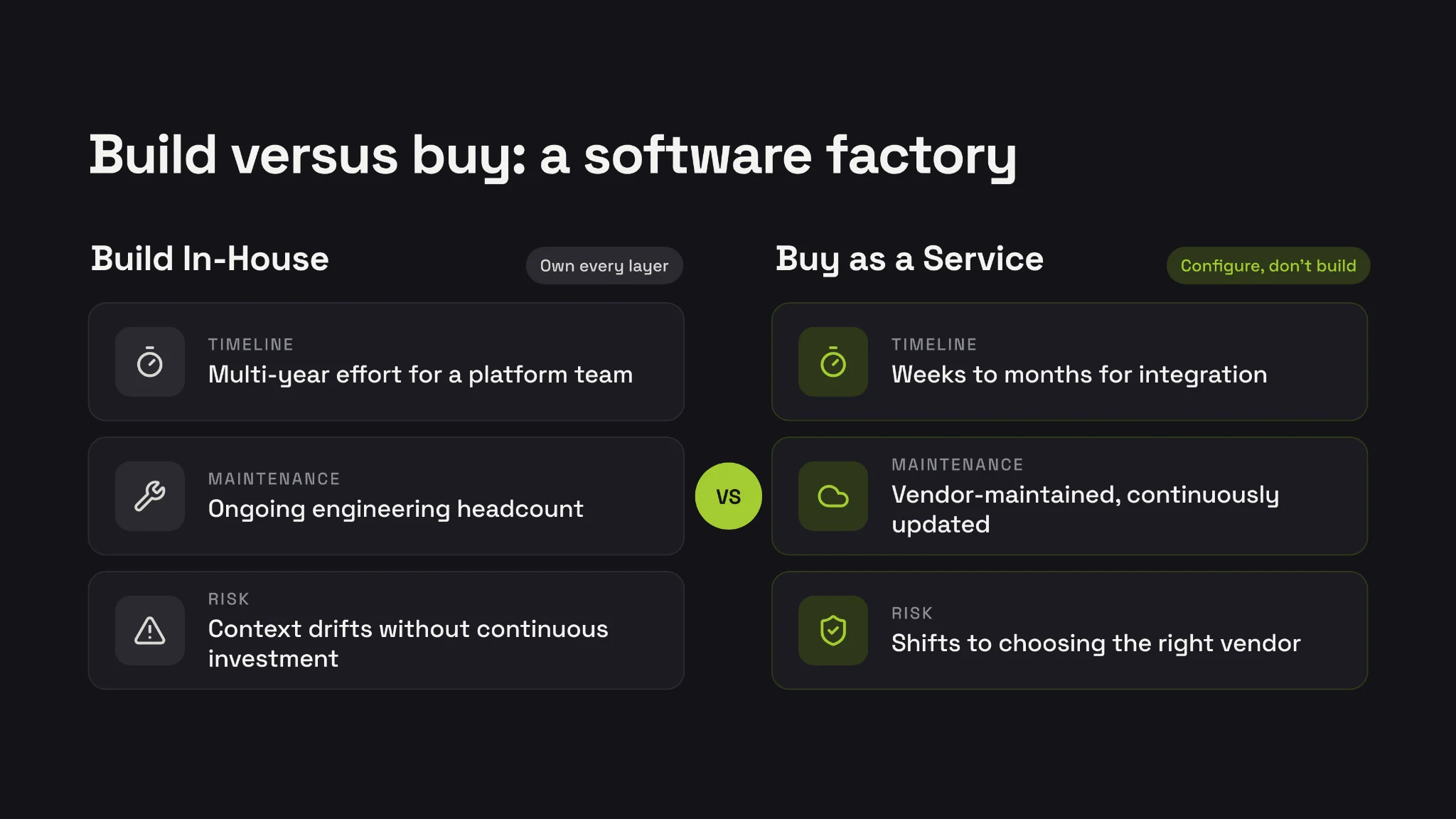
The manufacturer's team ran headfirst into the first two. Six months into their internal build, the context graph they'd scoped for their supply-chain planning platform was already drifting behind two new microservices nobody had remembered to register, and their governance checks still ran only in code review, after an agent had already generated changes based on outdated assumptions.
None of this means building in-house is always wrong. An organization with unique architecture or a strategic reason to own this capability may have good reasons to build it. But the decision should account for what the build costs over several years, not just what a working prototype costs to stand up.
How Does Software Factory as a Service Pricing Usually Work?
Pricing in this category is still settling, and most vendors quote it through sales rather than a public page. The models you'll typically run into:
- Per developer or per seat. Familiar from coding assistants, simple to budget, but it can understate cost if AI agents do much of the work.
- Per repository or codebase. Ties cost to the scope of what the factory manages, which suits modernization programs focused on a few large systems.
- Platform tiers. Bundles of capabilities (governance depth, integrations, audit features) priced by tier, common for enterprise contracts.
- Usage-based components. Some platforms meter agent runs, compute, or tokens on top of a base subscription.
The sticker price rarely covers the full cost. Before comparing quotes, ask each vendor:
- What does initial integration take? Weeks of your platform team's time is a real cost, even if it isn't on the invoice.
- Who maintains the context layer? If your team has to keep it current by hand, you're paying for a service and still running part of a build.
- Are coding assistant costs separate? Most factories sit above assistants, so assistant licenses usually remain a separate line item.
- What does it cost to leave? Ask whether specs, context, and audit records can be exported in a usable format.
The right comparison isn't vendor price against zero. It's vendor price against the fully loaded cost of the internal build: the manufacturer's 18 engineers for two years, plus the standing team after that.
What Should You Check Before Choosing a Software Factory as a Service Vendor?
The label gets applied loosely across the market. Before trusting a vendor's "software factory" claim, check for these six things:
- Context that updates automatically, not a one-time import or audit.
- Specifications that stay structured and connected to code, rather than static documents nobody references after kickoff.
- Governance that runs before code generation, not only in a review step after code already exists.
- Traceability from requirement to release, so an auditor can see who approved what and which tests cover it.
- No forced tool migration. A platform that requires replacing the coding assistants a team already uses is asking for two changes at once, and that adoption friction is a real, underrated cost.
- Data handling that passes your security review, including where code and context are stored and whether they're used to train models.
The same distinction shows up across the category, where coding agents, orchestration platforms, and context engines get blurred together under the same marketing language. When the manufacturer finally evaluated vendors, two of the four finalists failed the first check alone: their "context layer" turned out to be a one-time code scan with no ongoing sync.
How Does Opsera's Forge Deliver Software Factory as a Service?
Opsera positions Forge as a context-aware software factory, delivered as a managed platform rather than something an enterprise assembles from internal tooling. Forge is the orchestration layer above the models and coding assistants, such as Cursor, Copilot, and Claude, supplying the context, specification, and governance layers those tools don't cover, rather than asking a team to replace what it already uses.
Forge's Five-Stage Pipeline View
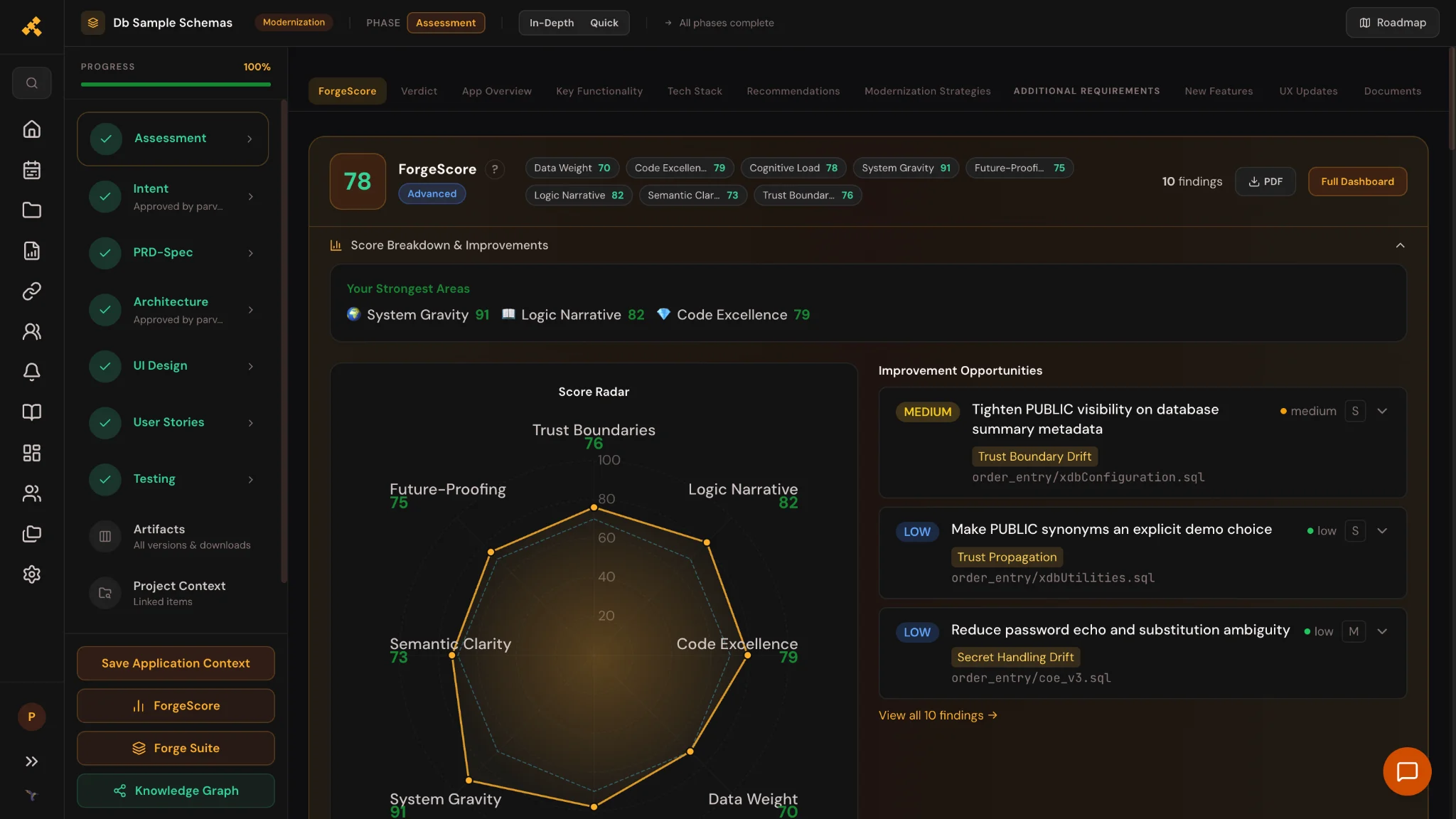
Forge's pipeline runs five stages that map onto what a managed service needs to cover end to end:
- Context, a continuously maintained knowledge graph of code, dependencies, data, and policy.
- Living Specs, requirements versioned and attached directly to the code they describe.
- Work Orders, requirements, architecture, and done-criteria packaged into something a human or an AI agent can execute against.
- Guarded Build, policy and security checks that run before generation and block architectural drift at the gate.
- Evidence, a traceability record linking every requirement to its tests and its approver.
A companion ForgeScore assessment rates a codebase across eight engineering dimensions before modernization work gets planned, giving "is this safe to touch" a concrete answer. Because Forge is delivered as a service, updates to governance rules and supported coding assistants roll out continuously, the same operating model that makes any SaaS category cheaper to keep current than its self-hosted equivalent.
How Do You Adopt a Software Factory as a Service, Step by Step?
The fastest way to lose confidence in a new platform is to roll it out everywhere at once. Staged adoption keeps risk low and gives you real numbers before you scale.
A Five-Step Adoption Roadmap
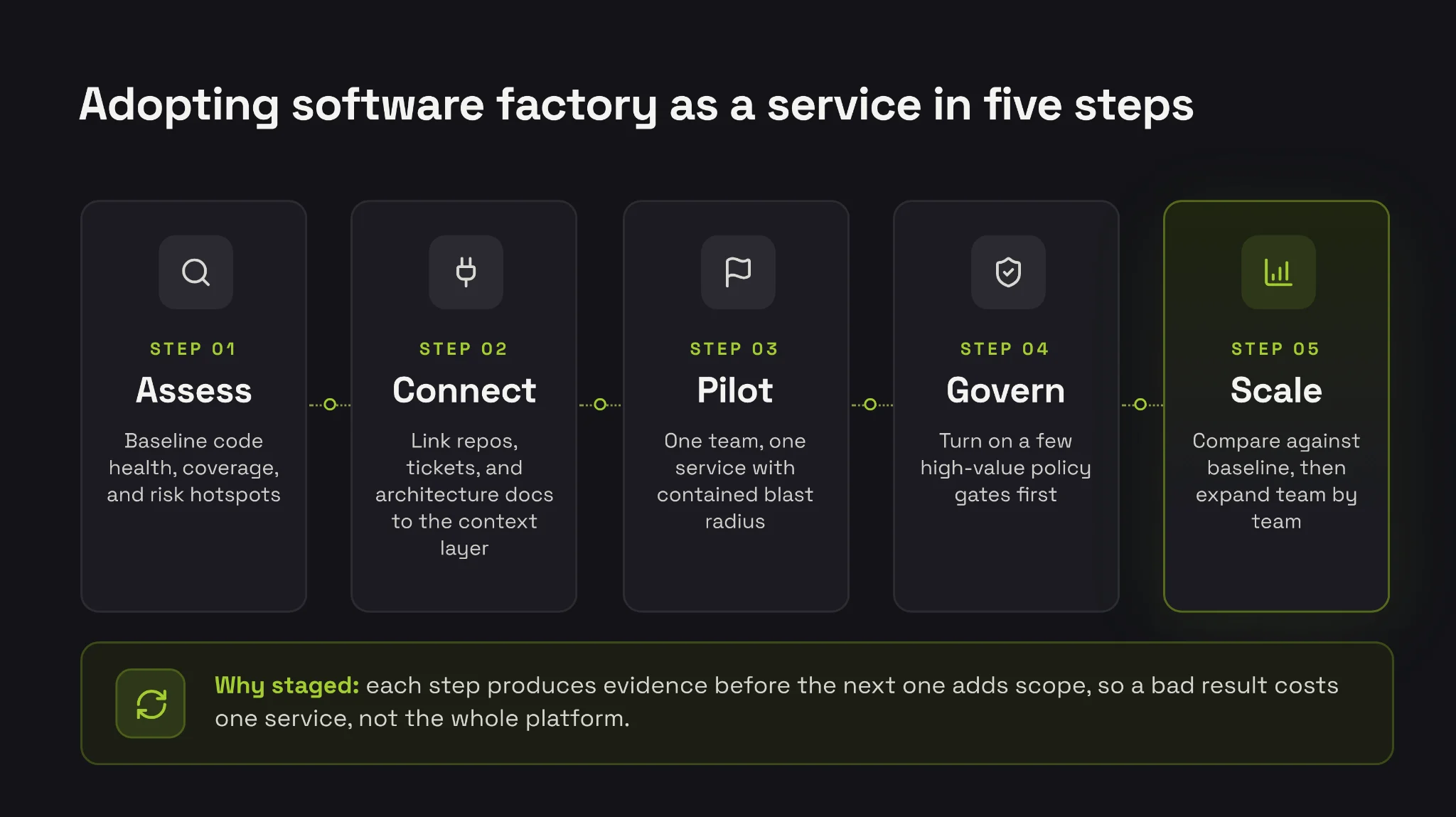
- Assess the codebase. Baseline code health, test coverage, and risk hotspots so you know which systems are safe to start with.
- Connect context. Link repositories, tickets, and architecture docs so the platform's context layer reflects how the system actually works today.
- Pilot one team and one service. Pick a service with real business value but a contained blast radius, and run it through the full pipeline.
- Turn on governance gates. Start with a few high-value policies (security, architectural boundaries) before adding more, so teams don't drown in false alarms.
- Measure, then scale. Compare cycle time, rework, and defect rates against the baseline, then expand to the next team with evidence in hand.
The manufacturer piloted on a single demand-forecasting service inside its supply-chain planning platform. That service was critical enough that leadership cared about the results, but isolated enough that a mistake wouldn't stall the whole platform.
What Mistakes Do Teams Make When Adopting a Software Factory as a Service?
Most failed rollouts trace back to the same handful of mistakes, and almost all of them come from treating the platform as a tool purchase instead of a workflow change:
- Buying for the demo, not the day-two workflow. Demos show execution, because it's visual. Ask to see a spec being updated after a requirement changes, and a governance gate blocking a bad change.
- Skipping the baseline. Without before-and-after numbers for cycle time and rework, the pilot ends in opinions instead of evidence.
- Starting with the hardest system. The legacy core with no tests is tempting, but it makes the platform look bad for reasons unrelated to the platform.
- Turning on every policy at once. Dozens of new gates on day one produce alert fatigue, and teams learn to click past warnings.
- Leaving review capacity unchanged. Faster execution with the same review staffing just moves the bottleneck.
- Treating context as a one-time import. If nobody owns keeping the context connected to new services, it drifts just like an internal build would.
The manufacturer nearly made the third mistake. Its first instinct was to pilot on the oldest module in the supply-chain planning platform, the one everyone wanted fixed. The platform lead pushed for the demand-forecasting service instead, on the logic that a pilot's first job is to produce a clean, believable result, and the hardest system can come second once the team trusts the numbers.
When Is Software Factory as a Service the Right Call?
The build-versus-buy decision follows the same logic it does in most SaaS categories, weighted by how differentiated your needs really are:
- Buy if your edge is in your product and domain expertise, not in how you manage delivery infrastructure.
- Buy if you need governance and audit trails soon, because a regulator or a security review won't wait two years for an internal build.
- Build if your architecture is so unusual that no vendor's context model can represent it.
- Build if owning delivery infrastructure is itself a strategic asset you plan to sell or reuse.
Context management, specification tooling, and governance enforcement are largely the same problem for most enterprises regardless of what they're building, which is exactly the kind of commodity infrastructure that's usually cheaper and faster to buy than to build well. The manufacturer ended up buying rather than finishing its internal build, and redirected the 18 engineers back onto the supply-chain planning product itself.
Evaluate a specific vendor the way you'd evaluate any infrastructure provider: check whether it covers the full pattern, confirm it works with the tools your teams already use, and ask directly how context stays current and how governance runs. Opsera's Forge is built around that full pattern, and Opsera's guide to the software factory covers how it works with the coding assistants a team has already standardized on.
Questions.
Is a software factory as a service the same as a coding assistant subscription?
No. A coding assistant speeds up one part of the work, writing code, for one developer at a time. Software factory as a service covers the whole system around that work: the context the code is built on, the specs it's built against, the governance it must pass, and the measurement that shows whether it worked.
How long does building a software factory in-house take compared to adopting a service?
Building one in-house is usually a multi-year effort for a well-resourced platform team, plus a standing team to keep the context layer current afterward. A managed service usually takes weeks to a few months to integrate, and most of that time goes into connecting repositories, tickets, and policies.
What's the biggest risk in choosing a software factory as a service vendor?
The biggest risk is buying a platform that only covers execution but is marketed as a complete factory. Ask the vendor to show context updating automatically after a code change, and a governance gate blocking a bad change before generation. If they can only demo code being written, keep looking.
Does adopting a software factory as a service mean replacing existing coding assistants?
It shouldn't. A well-designed service sits above the assistants your teams already use, such as Cursor, Copilot, or Claude, and supplies the context, specs, and governance those tools lack. Forcing a tool migration at the same time as a workflow change doubles the adoption risk.
Is software factory as a service only relevant for large enterprises?
No. The value tracks codebase complexity and regulatory pressure more than headcount, so a mid-sized team with a large legacy system or strict audit requirements can benefit as much as a much bigger organization.