Software Factory Compliance Tools: From Scanning To Audit Evidence
TL;DR
- A software factory compliance tool has to do four things at once: record which requirement is being enforced, apply the check at the right stage, keep evidence of the decision, and stop work that fails a gate.
- Scanners answer questions about code. Governance systems answer questions about requirements, policy, approvals, and traceability. Most compliance failures happen in the gap between the two.
- Requirement-to-Work-Order traceability, policy enforcement at artifact generation, security scanning with requirement context, and audit evidence tied to execution history are the four control layers that determine whether a factory's compliance claims hold up under review.
- Forge places these controls inside the SDLC itself rather than bolting them onto a pipeline after code exists, which changes where a violation becomes visible and who has to reconstruct it later.
- Choosing tooling starts with mapping each requirement to its enforcement point and system of record, not with picking the scanner with the longest feature list.
Why Software Factory Compliance Tools Need More Than Scanners
Software factory compliance tools sit between engineering policy and the artifacts that eventually reach production. The useful distinction isn't whether a tool performs a security scan. It's whether the factory records the requirement being enforced, applies the policy at the right point, preserves evidence of the decision, and stops or routes work when a control fails. Gartner projects that 90% of enterprise software engineers will use AI code assistants by 2028, up from under 14% in early 2024, and that shift changes what compliance tooling has to cover. Current software factory architectures combine security analysis, CI/CD controls, policy enforcement, and audit mechanisms rather than treating compliance as one pipeline stage.
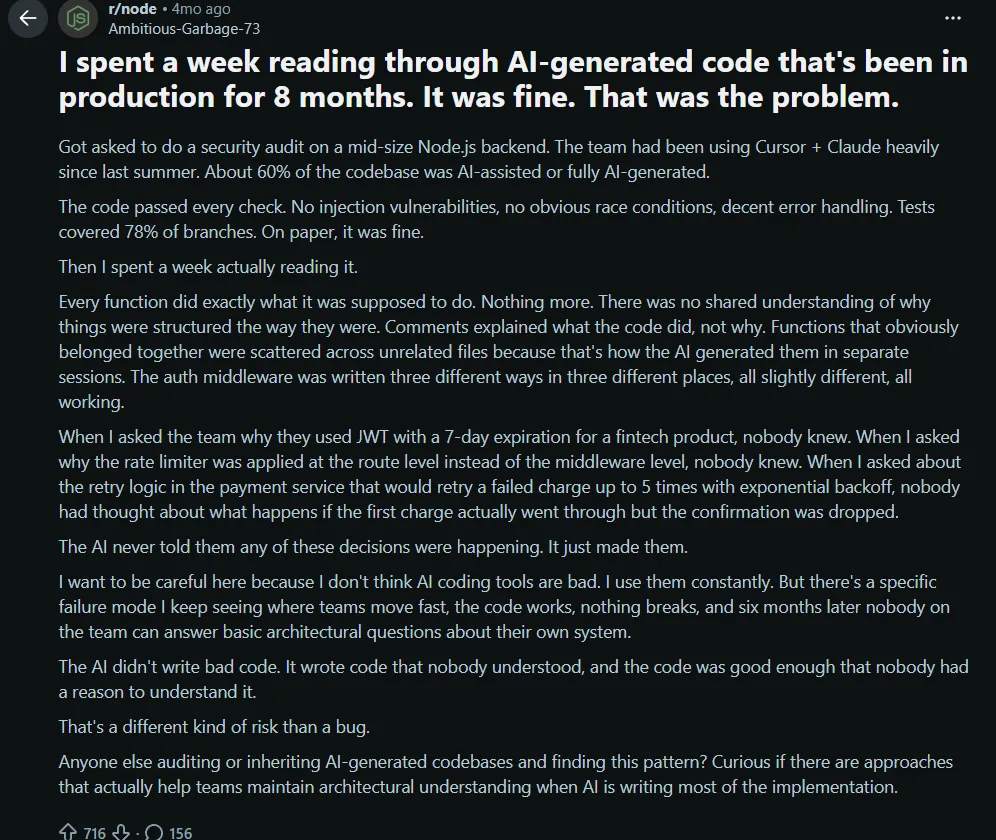
The failure shows up when requirements live in one system, architecture decisions in another, work items in Jira or Azure DevOps, scans in CI, and approval records somewhere else entirely. Engineers spend hours reconstructing why a change passed, which control applied, who signed off, and whether the deployed artifact still matches the approved requirement. A widely discussed 2026 Reddit thread in r/node describes engineers inheriting AI-assisted codebases that passed every test yet carried no shared rationale for the decisions baked into them, producing duplicated patterns and implementations nobody could confidently trace back to a requirement.
The structural problem is separation. AI-assisted development adds a second source of drift, because generated artifacts move through several stages before deployment while regulatory and internal policies still need deterministic checks and a named human at specific points. Forge's documented workflow connects intent, PRD, BRD, architecture, Work Orders, traceability, policy checks, security checks, and approval gates in one flow. The rest of this article uses those control layers to walk through seven categories of compliance tooling, what evidence each one produces, and where a platform like Forge changes the architecture by placing compliance rules next to the specification and execution model instead of after it.
Compliance Starts With Requirement-to-Work-Order Traceability
A control that can't point back to the requirement it enforces is hard to defend in an audit. What follows is the difference between a ticket number pasted into a commit message and a chain a reviewer can follow start to finish.
Requirements Lose Audit Value When Work Items Break Traceability
A compliance record becomes difficult to defend once a control requirement can't be traced to the code or work item implementing it. Conventional ticket-to-commit chains lose their architectural context as requirements move through planning, development, review, and deployment: a Jira ticket references a Confluence page that references a Slack thread, and by the time code ships, nobody can produce the chain without manual digging. A simple issue reference gives a reviewer a pointer. It doesn't give them the PRD, the architecture decision, or the security review that shaped the change.
Forge's Requirements Traceability Matrix works differently. Approved requirements link to PRD, architecture, and Work Orders as versioned artifacts, so a reviewer starting from REQ-041 can follow the same requirement through its architecture decision and into the Work Order that implemented it, rather than piecing the chain together from four separate systems.
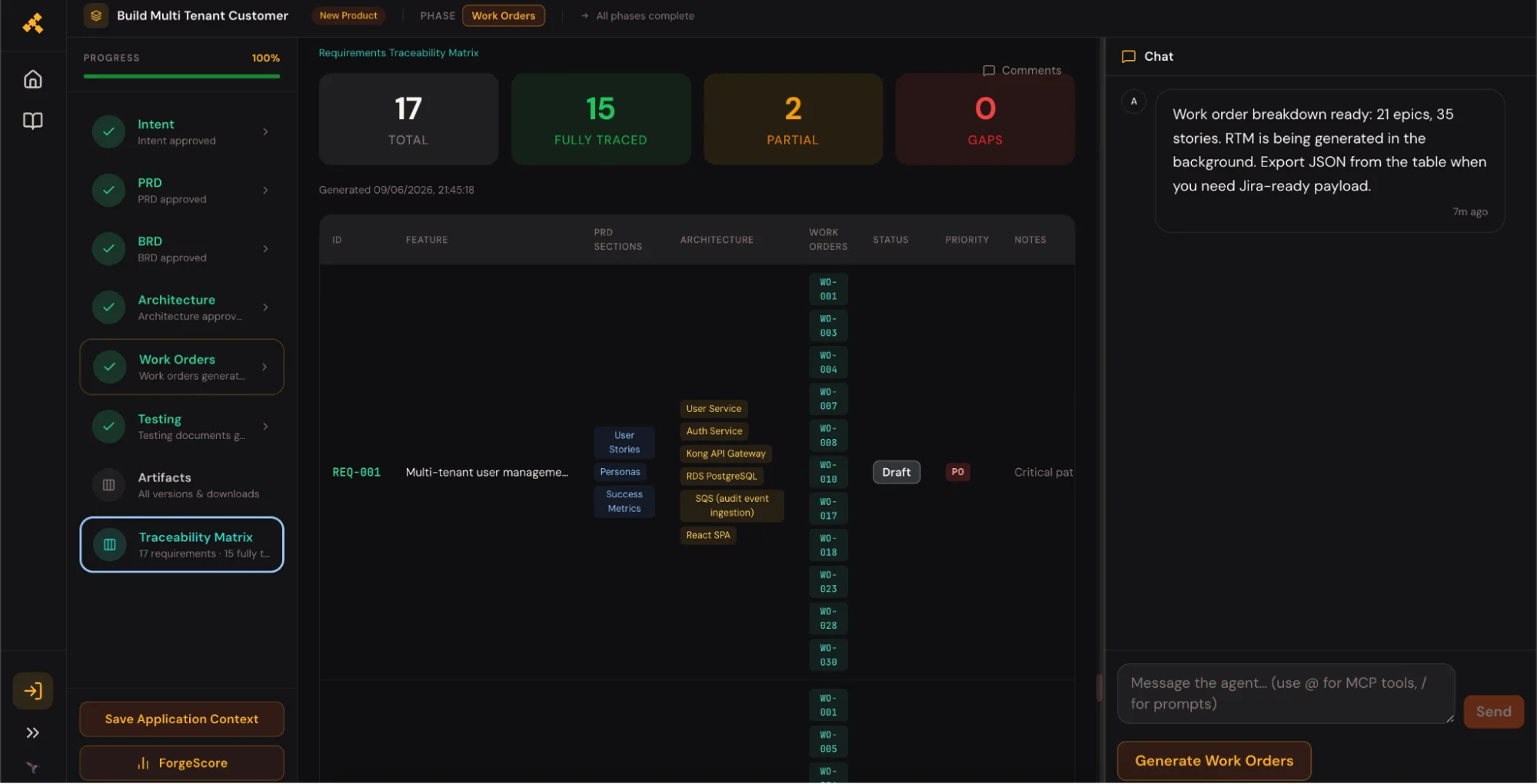
A dashboard view of Forge's traceability matrix, showing a requirement row linked to its architecture decision and generated Work Order, with status indicators for each stage. Look at how the matrix flags partially traced items rather than only showing completed ones, since that's what distinguishes an audit-ready trace from a cosmetic one.
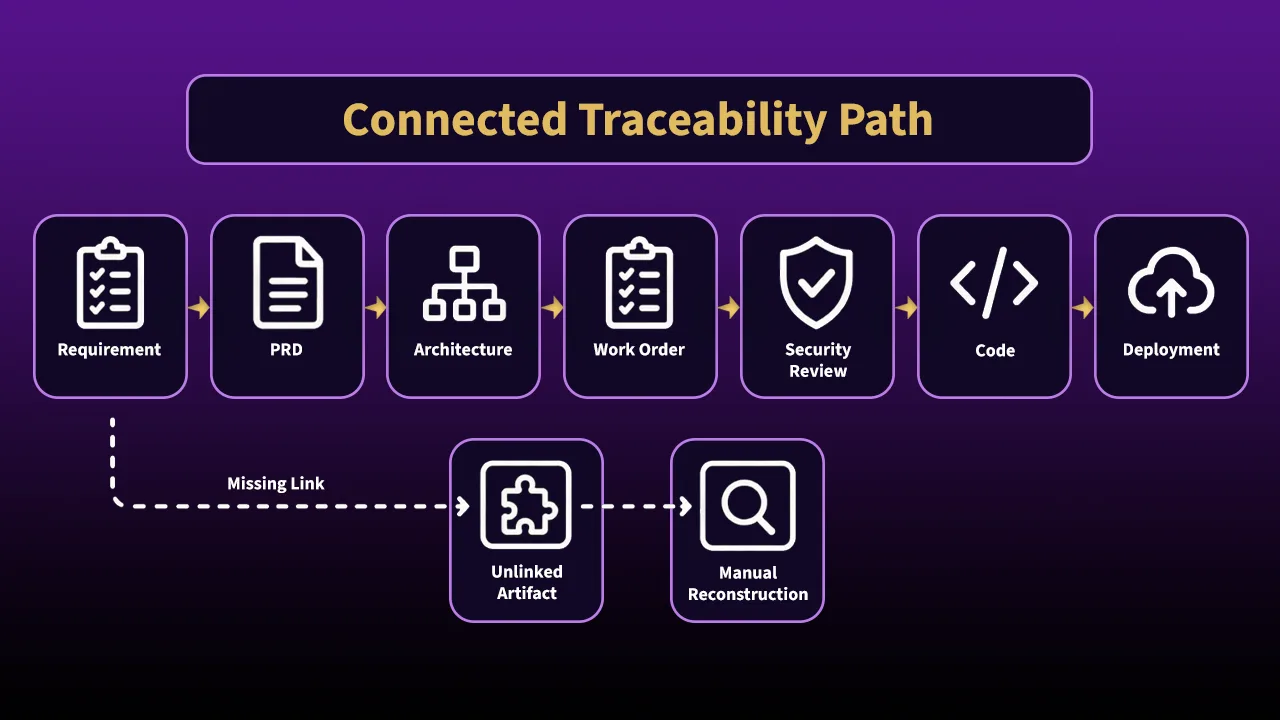
Focus first on the continuous path from Requirement to Deployment. The easiest state to misread is Unlinked Artifact, because the artifact can exist and pass technical checks while still lacking traceability.
Work Orders Need Checkable Acceptance Criteria
A Work Order that says "implement authentication" hands an execution agent and a human reviewer too much room to interpret intent differently. Explicit acceptance criteria turn a requirement into something both a coding agent and a reviewer can verify against, rather than something they each guess at independently. Forge's documented Work Order model generates epics and stories with acceptance criteria, dependencies, story points, and team assignment attached before any code gets written, and each Work Order carries a reference back to the specification and business requirement that authorized it.
Here's a representative structure for a governed Work Order, adapted from Forge's documentation of the format:
{
  "work_order_id": "WO-2026-0147",
  "intent_ref": "INTENT-42",
  "spec_ref": "FRD-NOTIFICATION-SVC-v1.2",
  "authorized_by": "platform-lead@company.com",
  "scope": {
    "component": "notification-service",
    "action": "implement_sms_email_dispatch",
    "constraints": [
      "must_use_approved_messaging_queue_adapter",
      "gdpr_opt_out_check_required_before_dispatch",
      "no_direct_payments_api_calls"
    ]
  },
  "traceability": {
    "business_requirement": "BR-CUST-NOTIF-001",
    "security_review": "SEC-REVIEW-2026-0312",
    "architecture_decision": "ADR-014"
  },
  "status": "approved"
}
Every field here is checkable. An agent knows exactly what it's authorized to touch, and a compliance reviewer can trace the change back to the requirement, the security review, and the architecture decision that permitted it, without opening four separate tools.
Risk Tiers Change How Much Evidence Each Work Order Needs
Treating every task as equally sensitive piles unnecessary review onto low-risk work while treating everything as low risk weakens governance where it matters. A batch reporting module and a payment-calculation change don't need the same review depth, and pretending otherwise either slows the factory to a crawl or waves through the work that deserves the closest look. Forge's modernization documentation shows this in practice at the portfolio level: applications get evaluated on business criticality, dependency complexity, and compliance exposure so that complex, high-value systems get denser review while lower-risk work moves faster. The same logic applies at Work Order granularity. A change touching payment card data or a regulated calculation warrants a security scan, a compliance checklist tied to the relevant framework, and named human sign-off. A copy change to an internal admin panel doesn't need the same ceremony, and forcing it through identical gates just teaches engineers to route around the process.
Policy Enforcement Has To Reach Artifact Generation
A scanner detects the artifact after it has left. It has no way to know why the architecture chose a particular data flow or dependency in the first place, which is the gap this section works through.
Policy Checks Fail When They Start After Architecture
A CI scanner catches what's in the generated code, but it can't reconstruct why the architecture selected a particular dependency or data flow. Checking source after generation is a different activity from applying policy while the PRD, BRD, and architecture artifacts are still being produced. Forge's documented policy enforcement runs during those earlier stages: every PRD, BRD, and architecture pass gets checked against the rules a team has enabled, and coverage is tracked as artifacts are generated rather than reconstructed afterward from a pile of pull requests.
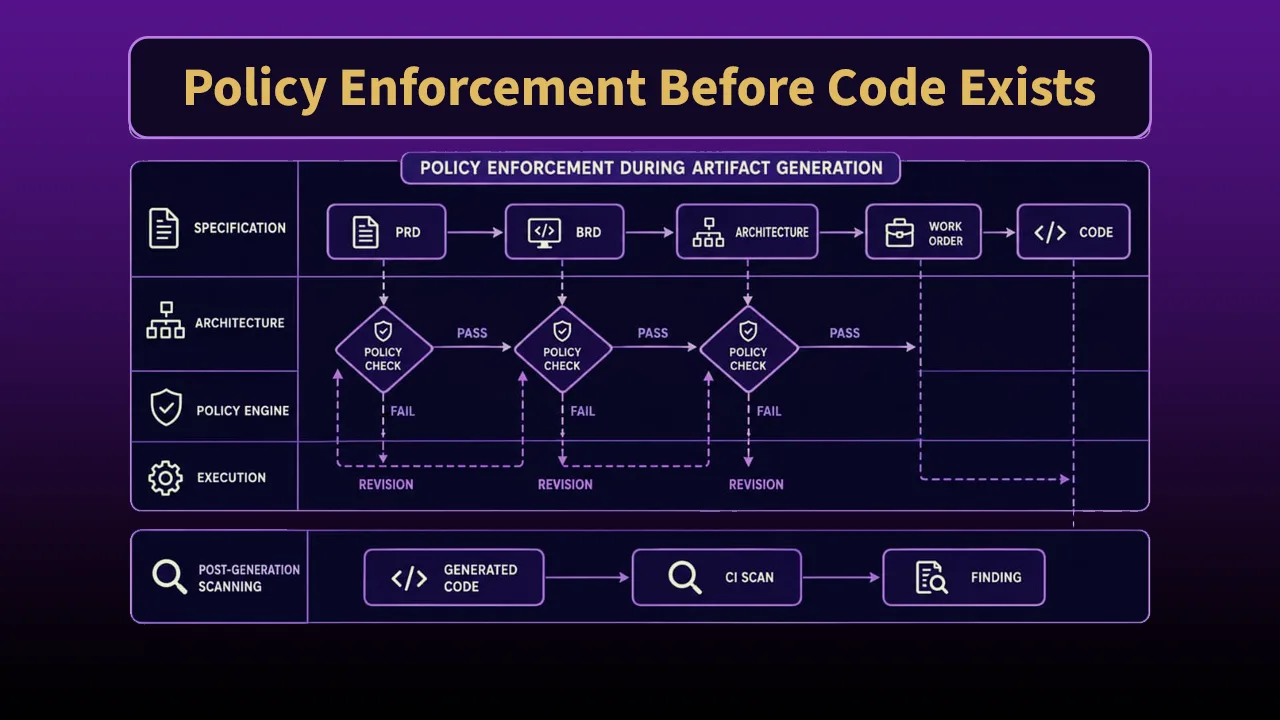
Look first at the three Policy Check points surrounding PRD, BRD, and Architecture. The easiest state to misread is FAIL, because the correct response is revision of the upstream artifact rather than promotion of the generated code.
Compliance Rules Need A Defined Enforcement Point
A policy with no clear enforcement point turns into advisory text that different repositories interpret in different ways. Two teams reading the same OWASP guideline will implement it two different ways unless the enforcement point is explicit and shared. Forge's documented policy categories cover OWASP rules, coding standards, and compliance frameworks that teams toggle by category, and coverage during artifact generation changes when a violation becomes visible: instead of a finding showing up three sprints later in a pen test, it shows up while the architecture document is still a draft.
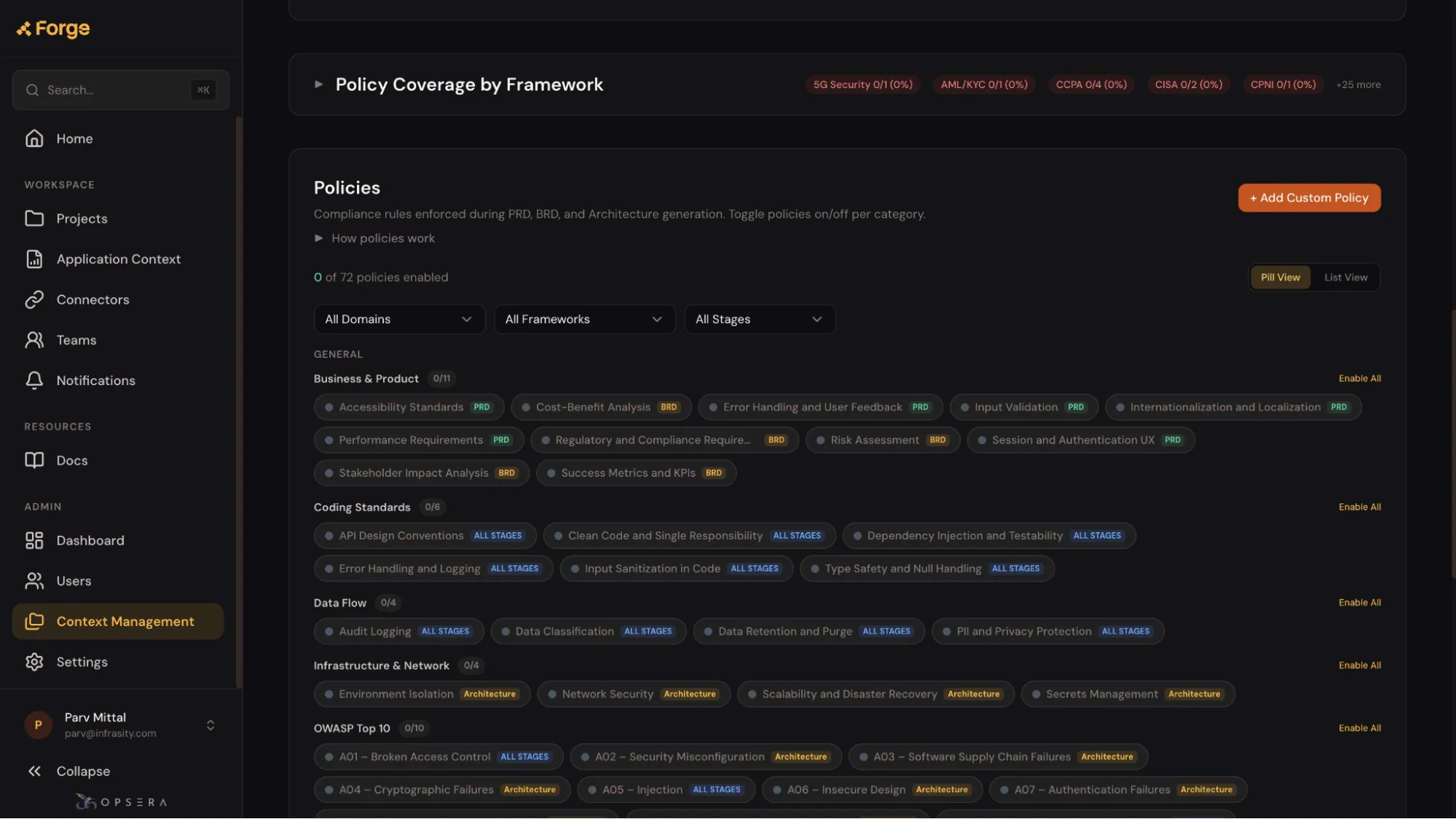
A toggle panel from Forge showing OWASP, coding standards, and compliance framework policy categories that a team can enable or disable, with a coverage indicator next to each enabled category. Look at how coverage is tracked per category rather than as a single pass-fail flag, since that granularity is what lets a team see exactly which policy family a given artifact still needs to satisfy.
Human Approval Still Matters At Controlled Handoffs
Automation doesn't remove every governance decision, particularly at a boundary where a change crosses an organizational or risk line that a policy engine isn't positioned to judge. Forge places approval gates between Intent, PRD, BRD, Architecture, and Work Orders, and the documented behavior is that the next stage waits for a named human to sign off before it runs. That's a meaningfully different failure mode than a pipeline that fires a Slack notification and proceeds regardless of whether anyone read it.
Security Scanning Needs Context From The Factory
A finding tied only to a file and a line number tells a reviewer what's wrong, not why the change exists or what it was supposed to do, which is the problem the next three sections take apart.
SAST Alone Doesn't Explain Why A Change Exists
A vulnerability finding with a file path and a line number leaves a reviewer without the requirement or the architectural reasoning behind the change that introduced it. Conventional scan output stops there. Forge's documented flow runs security checks alongside generated artifacts and keeps the resulting work connected to the same traceability structure that tracks requirements and Work Orders, so a finding arrives with a reference to the requirement it's attached to rather than as an orphaned ticket in a scanner dashboard.
Dependency And Secret Findings Need Pipeline Gates
A security finding becomes a governance control only once the pipeline defines what happens after it appears. A dashboard full of unresolved SCA alerts isn't a control; it's a backlog. Forge's documented coverage spans SAST, SCA, container scanning, secret detection, and compliance checks, with gates that block promotion when a finding exceeds a defined severity. A representative gate sequence from Forge's documentation, built around a COBOL-to-Java migration Work Order, shows the pattern:
gates:
  - step: ai_translation
    produces: java_translation_draft
  - step: security_scan
    requires: java_translation_draft
    tool: SAST
    blocks_on: CVE_severity > MEDIUM
  - step: regression_validation
    requires: security_scan_passed
    pass_threshold: 100%
  - step: compliance_review
    requires: regression_validation_passed
    reviewer: compliance_team
  - step: architecture_approval
    requires: compliance_review_passed
    approver: lead_architect
Nothing in that sequence proceeds until the prior gate clears. A CVE above medium severity stops the artifact at the security_scan step rather than letting it reach a human reviewer who might miss it in a long diff.
Security Checks Must Cover Generated And Legacy Code
A factory that only governs new repositories leaves modernization work exposed to the exact review gap it was supposed to close. Forge's ForgeScore applies across both new builds and existing codebases, producing an eight-dimension health assessment covering security exposure, architecture health, code quality, modernization readiness, dependency complexity, technical debt, compliance readiness, and AI readiness. On one documented COBOL payments module, the assessment surfaced 14 high-severity CVEs and 3 unpatched critical ones alongside a compliance score reflecting incomplete PCI audit trails, all inside a single scorecard rather than three separate reports that a team has to reconcile manually.
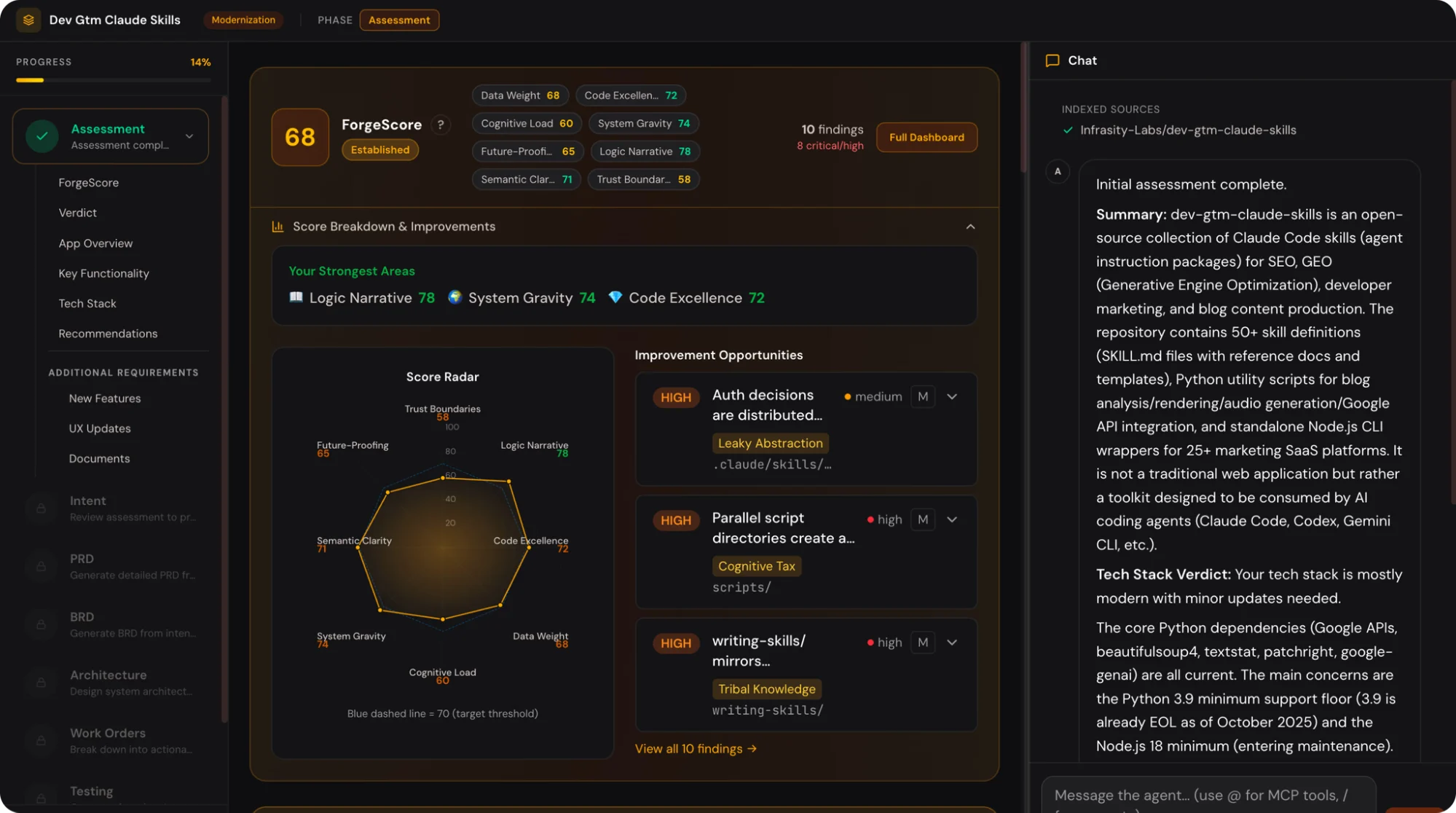
A ForgeScore scorecard for a legacy payments module, showing eight scored dimensions including security, architecture, and compliance readiness, each with a numeric score and a one-line explanation of the gap. Look at how the compliance dimension calls out a specific missing control, PCI tokenization, rather than a generic percentage, because that specificity is what turns a score into an actionable finding.
Audit Evidence Depends On Execution History
An audit trail built from commit timestamps alone leaves out the planning decisions and approvals that explain why those commits happened, and that gap is what the next three sections address.
Audit Trails Break When Agent Actions Lack Context
Agent-generated changes produce more than commits. They produce planning decisions, Work Orders, generated artifacts, validation results, and approvals, and an audit record needs those relationships intact rather than a flat, timestamped commit list. Forge's documented requirement-to-deployment traceability keeps the relationships between these artifacts rather than collapsing them into a Git log, so an auditor asking why a change happened gets an answer instead of a commit message written at 11 pm before a release.
Approval Records Need To Stay With The Artifact
A separate approval system creates a reconciliation problem the moment a reviewer needs to prove which artifact or architecture version they signed off on. Forge's stage-based approval model keeps decisions, agent actions, and code changes recorded together across the lifecycle, so the approval for an architecture version lives next to the version itself rather than in a separate change-management tool that has to be cross-referenced by date and hope.
Compliance Evidence Should Follow The Work Order
Compliance evidence gets easier to inspect when a reviewer can start from a requirement and follow the chain into implementation and validation without switching tools. Forge's RTM and Work Order model support that path directly: pull a requirement ID, follow it to the Work Order, follow that to the security scan and approval that cleared it. Contrast that with a collection of disconnected scanner dashboards, where the same question requires a reviewer to manually stitch together four exports and hope the timestamps line up.
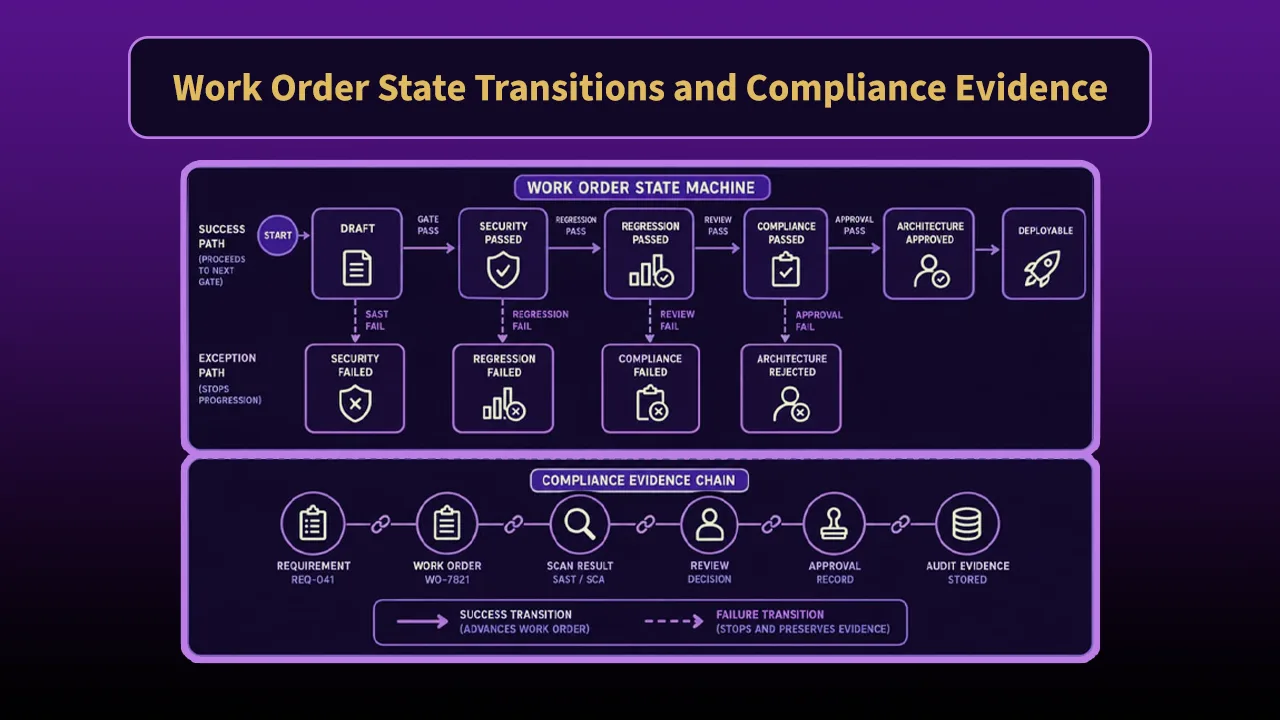
Start with the Work Order state and follow the green or primary path toward Deployable. The easiest state to misread is Compliance Failed, because failure should stop progression and preserve the evidence needed for review rather than disappear into a scanner backlog.
Software Factory Tool Selection Depends On Control Coverage
Security scanners and governance platforms answer different questions, and confusing the two is where most tool-selection mistakes start, which is what the closing sections work through before the article lands on a decision.
A Scanner Cannot Replace A Governance Control Plane
Security scanners answer questions about code, dependencies, secrets, or containers. Governance systems answer questions about requirements, policy, approvals, and traceability. SAST and SCA platforms, policy-as-code systems, compliance evidence platforms, CI/CD controls, and full software factory platforms sit in different lanes, and no single category performs every function the others do. A team that buys a best-in-class SCA tool and calls its compliance program complete still has no answer for who approved the architecture that the scanned code implements.
Tool Sprawl Creates A Second Compliance Problem
Every additional compliance system adds another configuration surface, another integration, another identity boundary, and another evidence format that has to be reconciled with the rest. One analysis of DevOps tool sprawl describes teams running dozens of disconnected products across source control, CI/CD, security, and reporting, where individual tools solve their piece well but nobody can agree on the authoritative source once a question spans more than one of them. Every added scanner has to prove it's closing a gap the factory doesn't already cover, not just adding another dashboard nobody checks.
Forge Fits When Compliance Belongs In The SDLC Control Plane
Forge's documented model combines Living Specifications, Work Orders, traceability, policy enforcement, security checks, and approval gates rather than positioning compliance as a standalone scanner bolted onto the end of a pipeline. That architecture fits teams whose compliance gap is structural: requirements, policy, and evidence living in disconnected systems that nobody can reconcile without manual work. It fits less well as a replacement for a specialized control a team already runs well, a dedicated secrets manager or an established SCA tool with deep language coverage still earns its place inside the pipeline Forge governs. The distinction is between replacing a specialized security control and providing the control plane that makes every control's output traceable to a requirement.
Choosing Software Factory Compliance Tools By Control Coverage
The decision comes down to mapping, not shopping. Every compliance requirement a team is trying to satisfy needs an enforcement point, an evidence source, an approval boundary, and a system of record before anyone decides whether the gap calls for another specialized tool or a factory-level control plane. A requirement with no enforcement point is advisory. An enforcement point with no evidence source can't survive an audit. An evidence source with no system of record leaves reviewers stitching together exports by hand. Teams that do this mapping first usually find they need fewer new tools than the vendor conversations suggested, because the gap was never a missing scanner category; it was a missing connection between the controls already in place.
What This Means For Teams Building A Compliance Stack
Developers need to keep the requirement, Work Order, architecture decision, security checks, approvals, and deployed artifact connected throughout execution. A SAST or SCA result identifies a code or dependency problem, but the compliance record also needs to show which requirement authorized the change, which Work Order implemented it, and which review cleared it.
The article's practical decision is therefore between adding another point control and fixing disconnected governance. If a security check is missing, add the specialized scanner or policy control; if existing checks produce separate evidence that engineers must reconcile manually, the missing piece is the control layer connecting requirements, execution, findings, and approvals.
Questions.
What tools are used in a software factory for compliance?
A software factory typically combines policy-as-code engines, SAST/SCA/secret scanners, requirements traceability tooling, and approval workflow systems. The distinguishing factor isn't the tool list, it's whether these pieces share a common requirement and evidence trail rather than operating as disconnected point solutions.
How do software factories handle security and compliance?
Governed factories run policy checks and security scans during artifact generation, not only after code ships. Each result attaches to the requirement and the Work Order that produced it, and approval gates block promotion until a named reviewer or automated check clears each stage.
How do you maintain compliance in an AI software factory?
Maintain compliance by keeping every AI-generated artifact traceable to an approved specification and Work Order, running policy and security checks at generation time, and requiring human sign-off at defined risk boundaries rather than only at final release.
What should a DevSecOps software factory automate for compliance?
Automate policy checks against PRD/architecture artifacts, dependency and secret scanning tied to Work Orders, evidence collection linking requirements to deployed code, and routing that blocks promotion on failed gates. Leave risk judgment calls and cross-boundary approvals to named humans.