Between 10% and 10x: What Airbnb's Agentic Coding Story Teaches Us
Airbnb went from near zero to 97% weekly agentic AI adoption in about a year. Read alongside our enterprise benchmark of 937 Forge projects, the two stories rhyme: context, not the model, is what moves teams from 10% gains toward 10x.
I just came across this talk on agentic coding at Airbnb. I've been heads-down on our State of the AI SDLC report looking back at 2026, and what a year it has been. Teams everywhere are transforming and adjusting to a new normal built around AI coding assistants.
Reading it alongside the enterprise benchmark we published earlier this year, I kept noticing how much the two stories rhyme.
Does AI really make developers more productive?
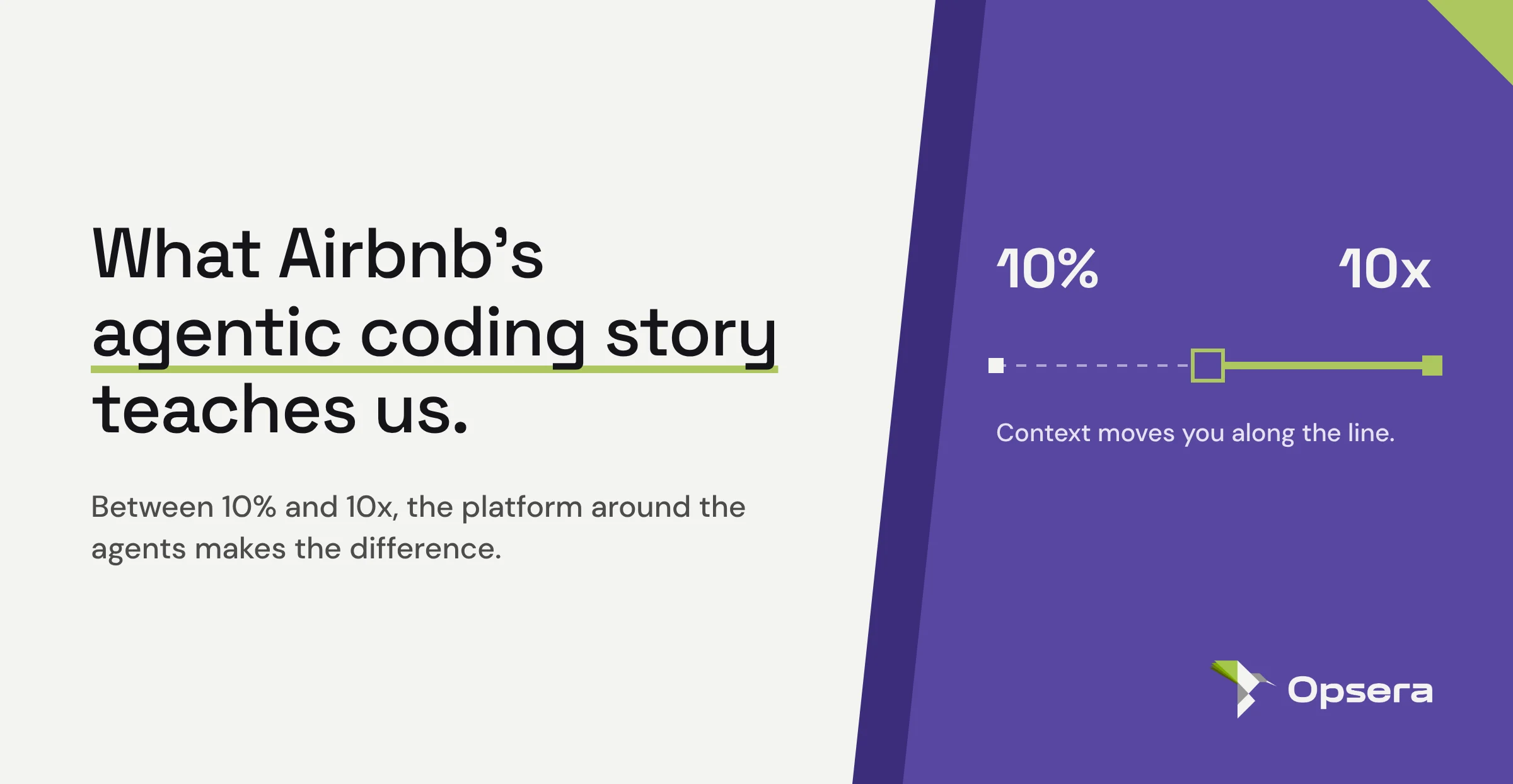
The debate is far from settled. Some research puts AI gains at around 10%, not 10x, and Airbnb's talk calls "AI has minimal impact on productivity" a myth. Their data tells a much bigger story:
- Near zero to 97% weekly agentic AI adoption in about a year, without mandates
- 59% of code AI-authored, against a 27% industry average
- PR throughput up 65% from two years ago
- 6.2 hours saved per engineer per week on average
- Developers in agentic sessions more than four hours a day now shipping well above the industry p90, while everyone else hovers just below it
The tools are the same for everyone. What differs is how deeply the work is set up for them.
Why context matters more than the model
Even Airbnb names "context graph and harness quality" as an open challenge. Our benchmark of 937 Forge projects points to the same thing: agents waste most of their effort rediscovering the codebase and redoing work, not writing code.
Forge does that discovery once. It turns intent into requirements, an architecture, and an ordered backlog of work orders, then hands every agent the same scoped context and definition of done. In our model, that cuts delivery time 70–85% against a standard 10-hour-per-story-point baseline. Somewhere between 10% and 10x is where the real conversation is, and I think context is what moves you along that line.
Why migrations are the proving ground for agentic AI
Airbnb was using agentic AI for migrations early, with a simple loop: target, validate, transform, re-validate, and retry until it passes. Migrations are repetitive, well-defined, and easy to verify, which makes them the perfect proving ground. It's also the problem we built Forge for. From our benchmark:
- Projects ranging from .NET monoliths to cloud-native microservices, commercial databases to PostgreSQL, and end-of-life .NET Core to .NET 8
- An average of eight checkable acceptance criteria on every work order. That's Airbnb's validate step, written down before any code exists
- Rework down from 3.2 tries per task to 1.3 (modeled)
Airbnb built its migration tooling in-house. Forge brings that same discipline to teams without an internal platform team.
Does AI-generated code hurt quality?
Not at Airbnb. Their code quality sentiment, June 2025 to March 2026:
- Code maintainability up from 78 to 83
- Change confidence steady, 77 to 76
- 85% say AI has had a positive or neutral effect on code quality
Forge builds the guardrails into the work itself. Every work order stays traceable back to a requirement, missing tests are generated before commit, and the commit is blocked until every acceptance criterion passes. Security, dependency, and secret scans are gated in the pipeline instead of bolted on at the end.
What comes after agentic: async and multi-agent work
Airbnb describes a progression from chat, to agentic, to async. Their next big bet, AirChat Remote, exists because managing many agents at once is still hard, and they call multi-agent orchestration "nascent."
Because Forge plans the whole initiative up front, work can run in parallel across 100+ work orders, with autonomous agents draining the backlog while humans review against clear criteria. And like Airbnb's AirChat CLI, Forge is agent- and model-agnostic. Claude Code, Cursor, Copilot, Devin, and others all get the same context, so teams can put their strongest model on high-risk work and a cheaper one on scaffolding. In our model, supplying context once instead of in every prompt cuts token spend per work order by about 75%.
AI coding tools aren't just for coders anymore
AirChat's weekly active users now outnumber Airbnb's PR authors almost two to one. Product, finance, and data teams are building their own tools on an internal SDK, and simple ones can be stood up in about two hours. This is where the "beyond code" conversation gets really interesting.
From horse-drawn carriages to race cars
I loved Airbnb's image of moving from horse-drawn carriages to cars. The real shift isn't doing the same work faster; it's rethinking how the work gets done. At Airbnb, a 10-page PRD, mocks, and a prototype collapsed into a 2-page brief and a working prototype. In Forge, a team states its intent and gets the PRD, architecture, and an ordered backlog before a line of code is written. We've been talking a lot about building race cars with AI, and this talk is a good reminder of why.
But the image made me think about something else, too. The first cars didn't change the world on their own. They needed paved roads, traffic signals, gas stations, and rules everyone agreed to follow. Without them, a faster engine just meant getting stuck in the mud sooner. AI coding is at the same moment. Agents are the engines, and they keep getting faster, but most teams are still driving them on dirt tracks: scattered context, manual reviews, pipelines and security checks that were never built for this volume of change. Airbnb paved its own roads with AirChat, an internal SDK, a plugin marketplace, and migration tooling. Most companies can't build all of that themselves, and that's the part we care about most. Forge is the race car, and the software factory around it is the road: shared context, gated quality and security checks, traceability, and pipelines that carry AI-generated work safely into production.
What this means for engineering leaders
Airbnb's story shows what's possible when a company invests in the platform around its AI tools, not just the tools themselves. Most teams don't have an internal platform team to build that. Our benchmark suggests the biggest lever is the same either way: give agents the plan and the context up front, and the gains in speed, quality, and cost move together.
You can dig into the methodology behind our numbers in the full enterprise benchmark. If you'd like to see what context-first AI delivery looks like on your own work, try Forge. And watch this space for our State of the AI SDLC report, coming soon.