Legacy Modernization: From One-Time Migration to Outcome-Driven Program
Most modernization programs are scoped like a single event: pick a system, migrate it, close the ticket. This piece looks at what that costs, what the field evidence shows, where one-time migrations break down, and what running modernization as an ongoing program looks like in practice.
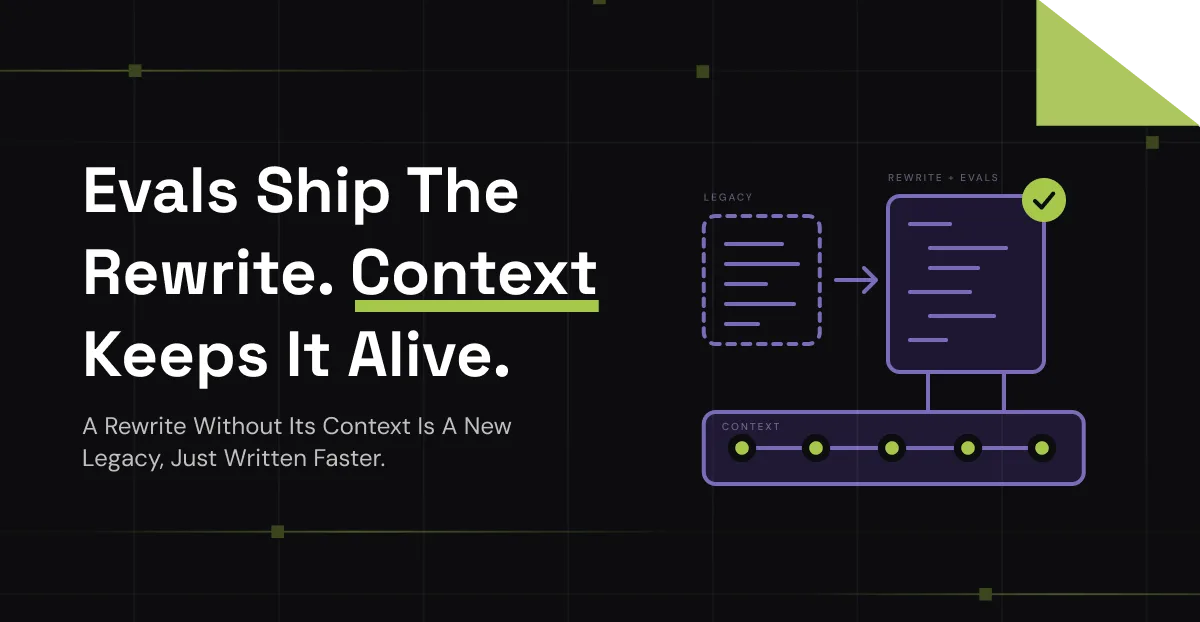
Most modernization programs are still scoped like a single event. Pick the legacy system, migrate it, close the ticket, move budget somewhere else. That worked fine when the constraint was engineering headcount and a migration genuinely took years to plan and run.
It stops working the moment a product manager, not just an engineering team, is the one deciding what gets modernized and what "done" actually means for a system nobody fully documented in the first place.
This piece looks at four things:
- why treating modernization as a one-time migration quietly recreates the exact problem it was meant to solve,
- what the field evidence from real modernization work actually shows,
- where most one-time migration efforts break down structurally,
- and what running modernization as an outcome-driven program looks like in practice, including where Forge fits.
What treating modernization as a one-time migration actually costs you
A migration has a start date and an end date. The system it touches doesn't stop changing on the end date.
New features get layered on. New compliance rules land. The people who understood the original logic move to other teams, or leave the company entirely. Three things tend to happen once a modernization effort gets scoped as a single project instead of an ongoing program.
Institutional knowledge gets lost twice instead of once. The first loss happens when the legacy system's original context erodes before anyone modernizes it. The second, quieter loss happens right after the migration ships, when nobody writes down why the new system was built the way it was either.
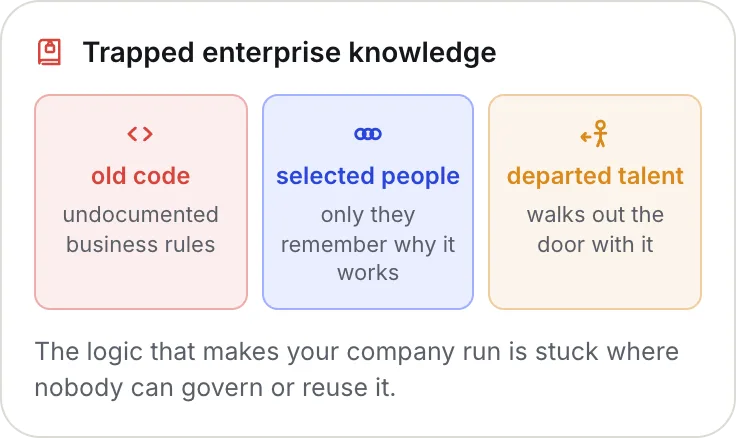
The spec stops matching what shipped almost immediately. A one-time migration plan usually gets approved once, at the start, and never checked against again as the build evolves. By the time it ships, the gap between plan and product just gets treated as normal.
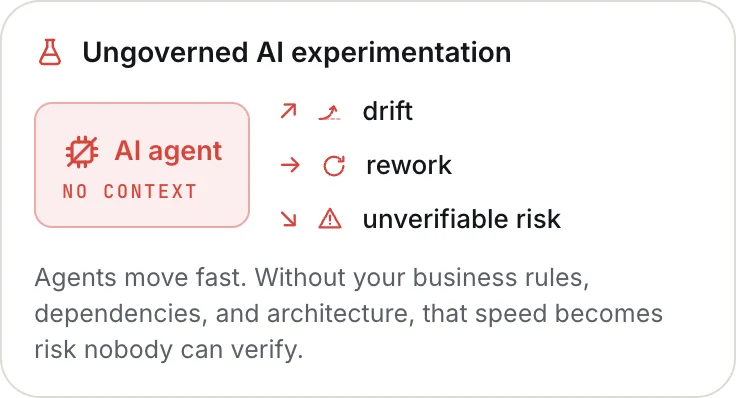
Judgment gets asked of one person, over and over, with no system behind them. Without a persistent, governed system of record, every call on whether an AI-generated change is safe to ship falls on whoever happens to be running the project that week.
A compliance product manager in fintech described the first two of these directly. Four months into a new domain and running seven live PRDs in a single week, she pointed to a gap that was organizational as much as personal.
Her team hadn't had the time or capacity to build a consolidated knowledge base yet. So new hires like her leaned on senior product managers for months of hand holding, just to understand why a feature worked the way it did.
On the harder problem underneath that one, judgment, she was even more direct:
"I don't have the knowledge or the right judgment or intuition to determine if this output is good enough."
That's not a confidence problem. That's a governance gap a one-time migration project has no mechanism to close, because the project ends before anyone has to answer for it twice.
The data behind why the problem keeps returning
You'd think that once a modernization project finishes, the underlying cost problem finishes with it. The research says otherwise.
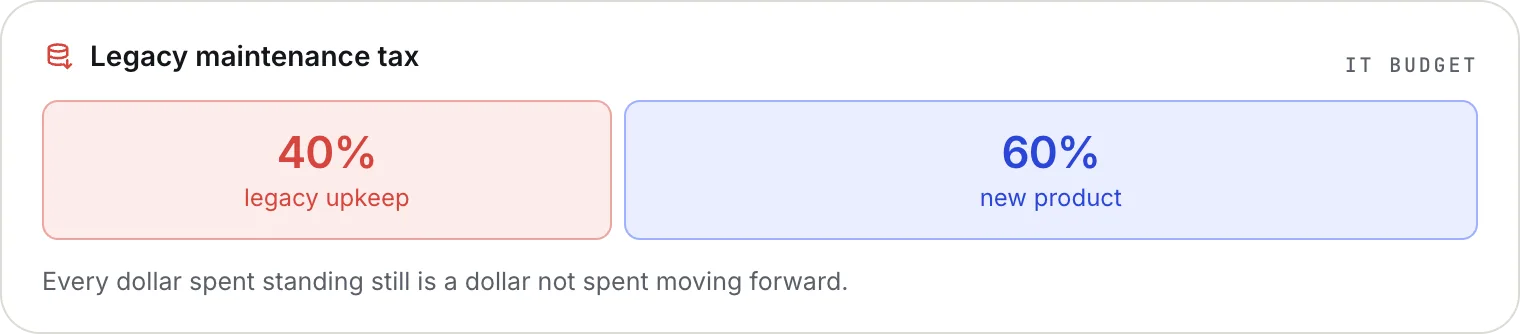
- The maintenance tax compounds. McKinsey reports organizations pay an additional 10 to 20 percent per project to deal with technical debt, and 30 percent of CIOs say more than a fifth of their new-product technology budget gets diverted to tech-debt issues instead of new work.
- The adoption curve is closing fast. Gartnerprojects 90 percent of enterprises will be using AI-augmented modernization by 2029. Organizations still treating it as a one-off project are on a shrinking timeline before that becomes the industry default they're competing against.
- Modernizing well correlates directly with AI ROI. Organizations that modernize are roughly three times more likely to achieve clear AI ROI, and 93 percent of enterprise leaders name updating software as the single most important factor in improving their AI capability, per Cloudflare's research.
- The pattern shows up the same way in the field. Across a recent set of hands-on modernization builds we'll walk through below, the teams that scoped their work as a single, narrow migration finished. The teams that treated the same exercise as proving out a repeatable program walked away with something they could run again on the next legacy system.
Why most one-time migration efforts underdeliver
Given how well documented the compounding cost of legacy systems already is, you'd expect one well-run migration to close the gap for good. In practice, most one-time efforts underdeliver. The reason traces back to how the work gets scoped from the start. Our post on the anchor problem looks at why legacy systems hold teams in place in the first place.
Gap 1: Migrations freeze context at a single point in time
A migration plan is usually a snapshot. Someone interviews the few people who still understand the legacy system, writes down what they say, and treats that document as finished the moment the code ships.
Six months later a new compliance requirement lands, or a new engineer joins. And the only record of the original intent is a document nobody has opened since kickoff.
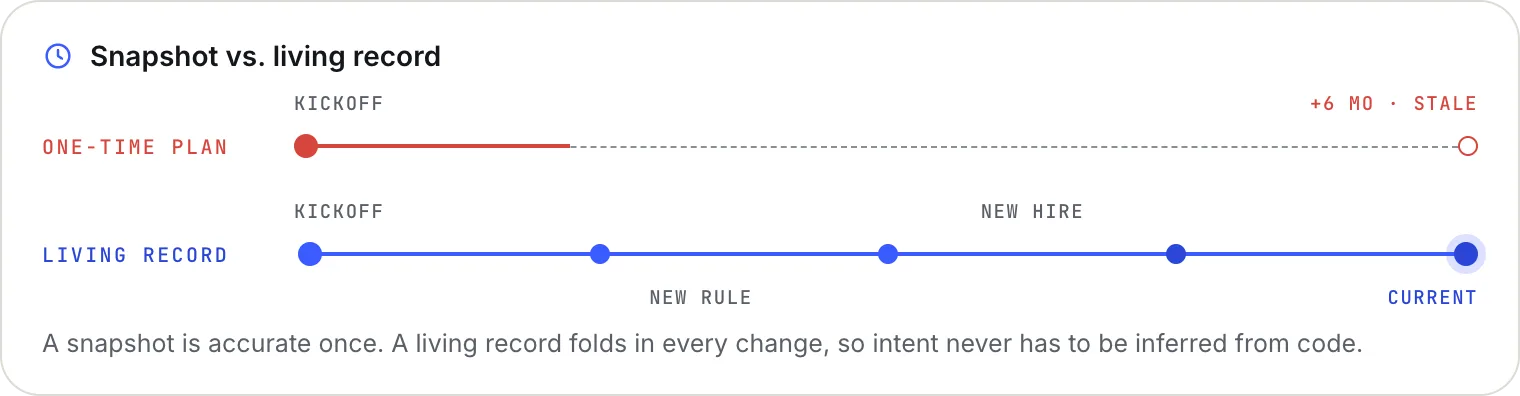
Without a living, versioned record of the actual business rules, teams fall back into the same pattern that caused the problem the first time. An AI agent or a new hire infers intent from whatever code is sitting in front of them, reproducing any inconsistencies that were already there instead of correcting them.
Gap 2: Without enforcement, program discipline erodes under the next deadline
The second failure mode is treating governance as a one-time checklist instead of a standing gate. If checking a change against the original spec is optional and shipping on schedule isn't, the check loses almost every time a deadline tightens.
Who benefits when modernization is run as a program
Running modernization as an outcome-driven program changes what different roles get out of the work, not just how long it takes.
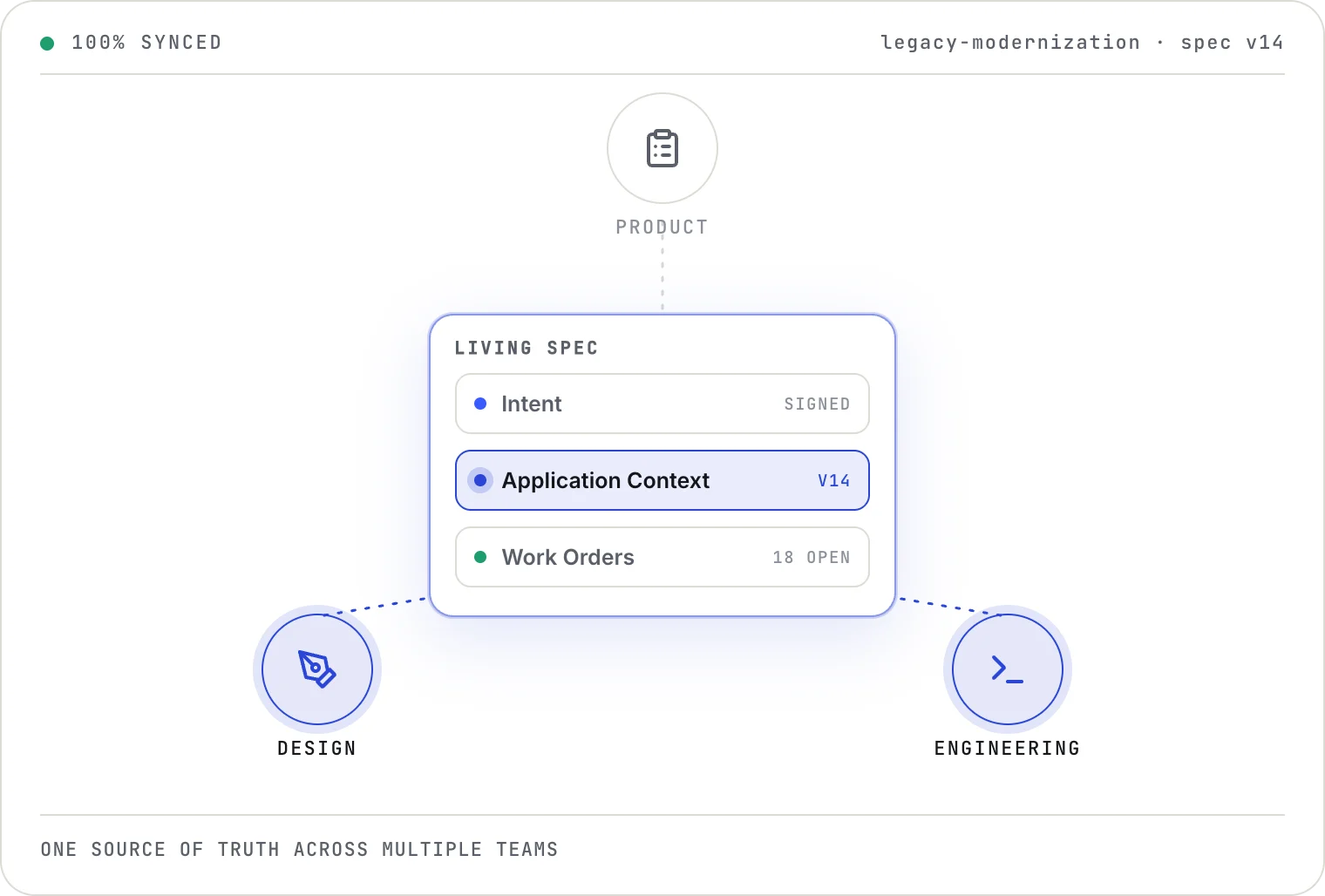
- Product managers get a persistent record of why a system behaves the way it does, so the next feature decision doesn't depend on finding the one senior colleague who remembers.
- Engineering leaders get a spec that stays checked against the code as it evolves, instead of a plan that was accurate on day one and quietly wrong by the second sprint.
- Security and compliance teams get changes checked against policy before code ships, rather than finding issues in a review three weeks after launch.
- Business stakeholders get a system that keeps compounding in value with every cycle, instead of resetting to zero context the next time something needs to change.
What program-driven modernization looks like in practice
Program-driven modernization isn't measured by whether a migration technically completed. It's measured by whether:
- The business rules in the legacy system are captured as a structured, cited record, not a summary paragraph nobody can verify against the original source.
- Every plan flags its own contradictions before code gets written against it, instead of relying on a human to catch the mismatch later.
- Governance runs inline, as a property of the workflow itself, rather than a review step someone has to remember to perform.
- The record stays useful after the migration ships, so the next change builds on what's already known instead of starting over.
Forge's approach to program-driven modernization: four core capabilities
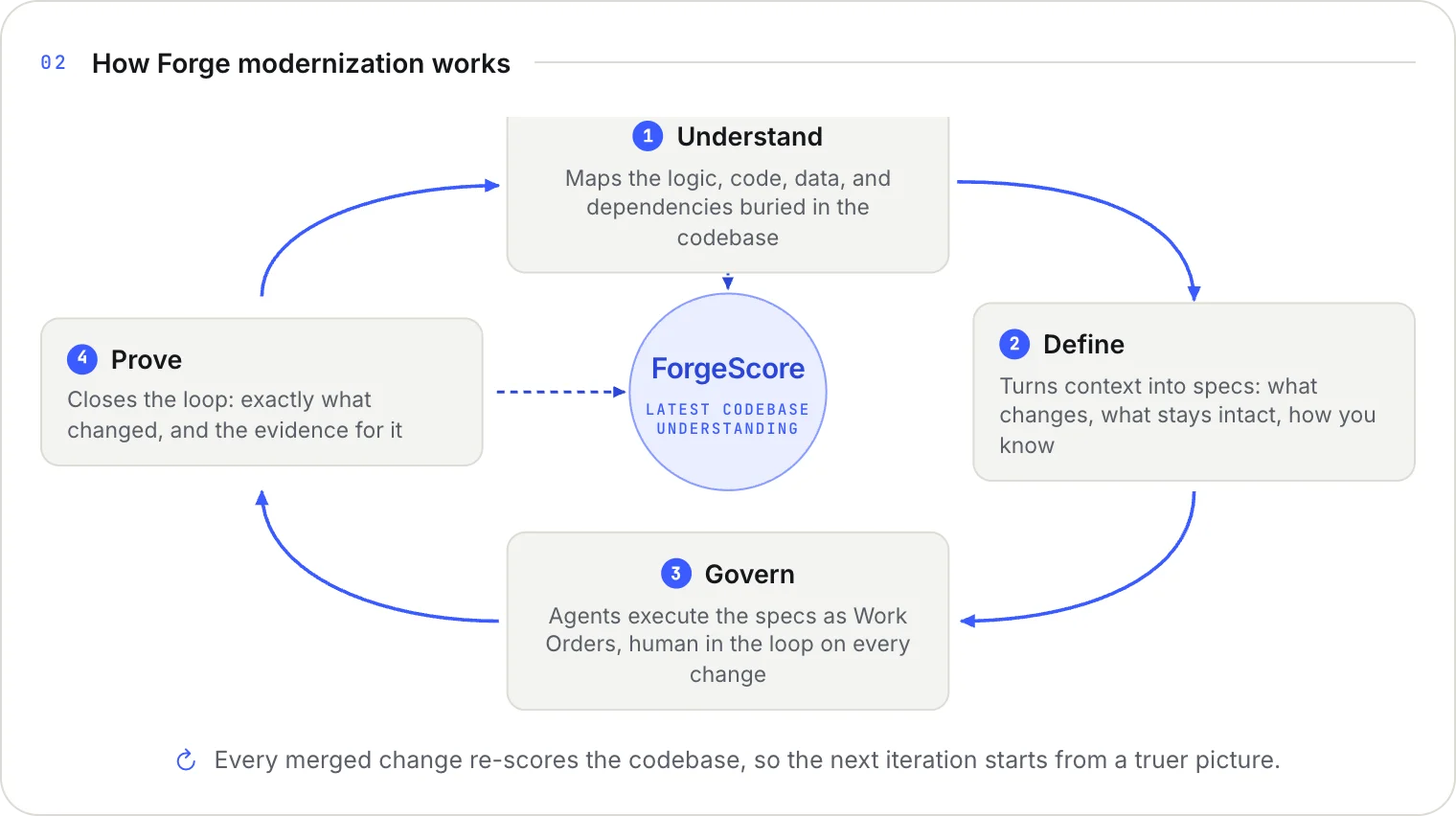
Forge treats a legacy system's business rules as a living record to be recovered and maintained. Not a one-time documentation exercise filed away once a migration ships. For the code-level view, see our guide to legacy code modernization without breaking business logic.
That record gets built and kept current in four connected stages: map the system, score it, govern the work against it, then keep all three current as the system keeps changing.
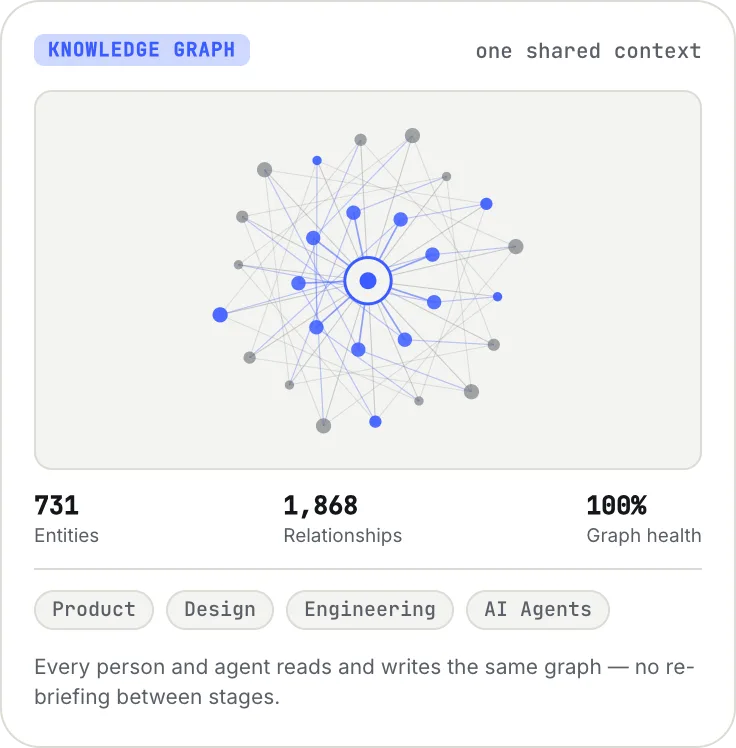
Centralized knowledge graph
Before Forge scores anything or writes a single spec, it builds a knowledge graph of the actual repo. It maps the code's dependencies, data flows, architecture, and the business rules buried inside it into one connected structure, instead of a folder of disconnected files nobody has fully read end to end.
This is what makes everything downstream possible. A knowledge graph, not a folder of code, is what lets an assessment or a spec reason about how one part of the system actually affects another, instead of looking at each file in isolation.
ForgeScore
With that graph in place, Forge scores application health across eight dimensions: System Gravity, Semantic Clarity, Logic Narrative, Code Excellence, Cognitive Load, Data Weight, Trust Boundaries, and Future Proofing. That identifies what to fix, why it matters, and where to invest first.

Instead of a manual architecture review that pulls senior engineers off other priorities for weeks, ForgeScore produces a baseline in minutes, because it's reasoning over a graph the system already built rather than starting from scratch.
Living Spec and Work Orders
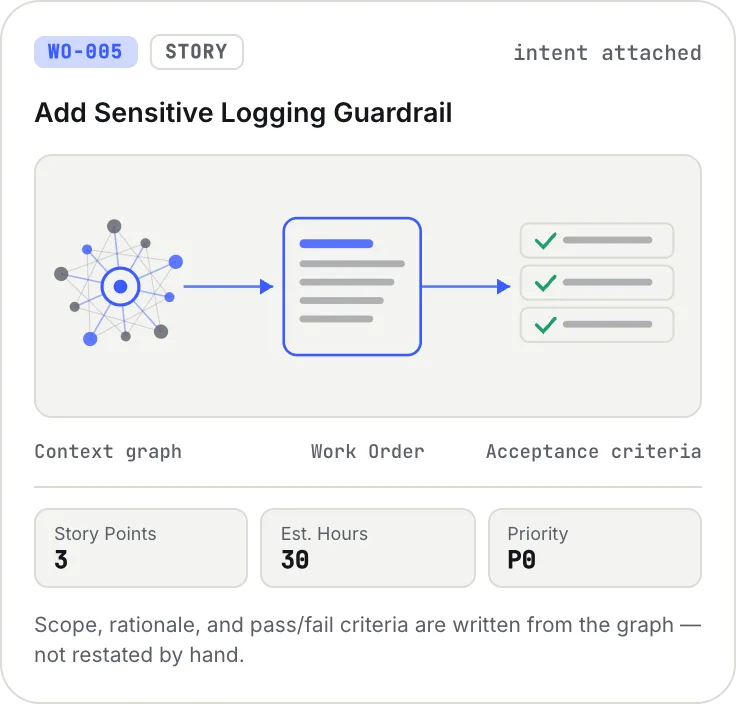
From that same graph, Forge reconstructs business logic and ties every recovered rule back to its source in the code. It marks explicit assumptions where the original system is genuinely silent, rather than guessing.
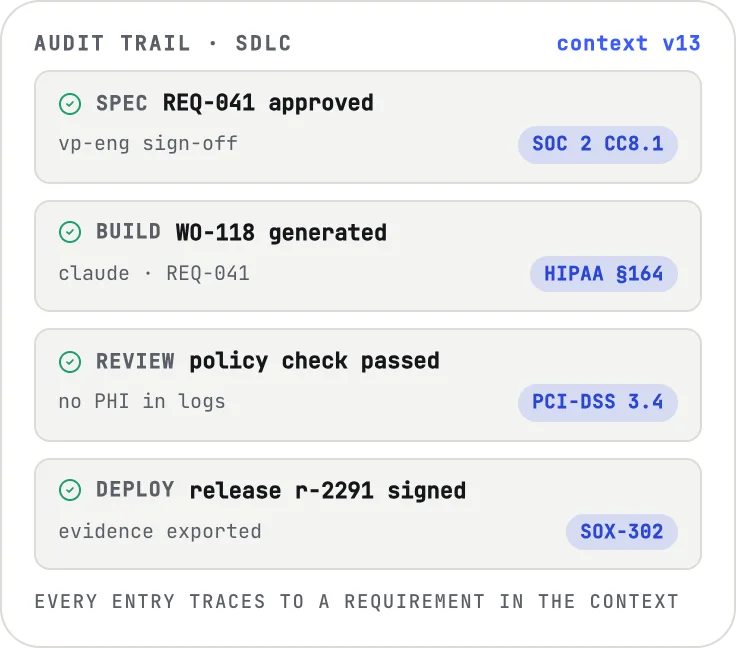
That reconstructed spec becomes what agents actually build from. Every agentic action gets authorized through a Work Order, a human-auditable license tied back to a specific approved intention and, ultimately, back to a specific node in the knowledge graph it came from.
Governed continuity
Modernization doesn't end when the new system ships, and neither does the graph. Every subsequent change, a new feature, a new compliance rule, a new integration, gets folded back into the same knowledge graph instead of starting a fresh, disconnected record.
That means ForgeScore, the Living Spec, and every future Work Order are reasoning over an always-current map of the system, not the snapshot that was accurate on the day of the original migration. The context compounds instead of resetting.
Proof from the field
At a recent enterprise hackathon, four teams modernized real legacy systems in a single day. The pattern above showed up consistently, every time.
VistA: recovering a 40 year old state machine instead of guessing at it
One team pointed Forge at the VistA electronic health record system, the 40 year old codebase that still runs US veteran hospitals. Forge built a knowledge graph of the consult tracking module first, then recovered the workflow's actual state machine from it instead of guessing.
Of the 27 rules recovered, most were reproduced directly from the legacy MUMPS source with line-level citations. A few were derived, and a small number were flagged as explicit assumptions where the source stayed silent.
That same recovery process surfaced a genuine 40 year old bug, which the team chose to preserve rather than "fix," because a nightly batch job quietly depended on the exact behavior in question.
CaseFlow: catching a stack contradiction before it cost a sprint
A second team, modernizing a CRM's case management module, started the same way: Forge mapped the repo before running a ForgeScore assessment on top of that graph. It surfaced a maintainability grade of D, over 280 layer violations, and several end-of-life dependencies before a single line of new code got written.
When their own requirements briefly contradicted the chosen tech stack, the system flagged the mismatch instead of quietly picking one. That turned a potential rework cycle into a single clarifying message.
ShipGate: catching a gap in its own governance logic
A third team, building a release-governance tool, caught a scoping gap in their own intent stage. Early on, Forge nearly scoped the backend API out of the tool's own governed path, which would have shipped a governance product with no real governance in it. One message in the plan closed the gap before it became a problem in production.
Core Returns: replacing untracked handoffs with one shared platform
A fourth team modernized a fragmented, multi-department core returns process into a single tracked platform, replacing untracked email and phone handoffs with one shared record.
None of these four were framed as a finished migration. Each was framed, and built, as proof of a program that could run again on the next system, because the graph underneath each one didn't stop updating once the demo ended.
Forge capabilities at a glance
| Capability | What it does | Technical mechanism |
|---|---|---|
| Centralized knowledge graph | Maps the legacy repo into one connected structure before any assessment or spec work begins | Builds a graph of code dependencies, data flows, architecture, and business rules across the repo |
| ForgeScore | Scores legacy application health before modernization starts | Assesses 8 dimensions by reasoning over the knowledge graph |
| Living Spec and Work Orders | Recovers business logic and authorizes every agentic change | Reconstructs rules from the knowledge graph with source citations, flags assumptions explicitly, gates every change through a human-auditable Work Order |
| Governed continuity | Keeps the graph and the spec accurate after the migration ships | Folds every subsequent change back into the same knowledge graph, so the next cycle inherits real, current context |
Key benefits
- Minutes, not weeks, for a technical baseline. ForgeScore replaces manual architecture reviews that typically pull senior engineers off other priorities for weeks, because it reasons over a graph instead of starting from a blank read of the codebase.
- Business logic preserved before code is touched. Legacy-to-intent reconstruction captures institutional knowledge before it's lost to attrition or quietly rewritten away.
- A record that survives past the migration date. The knowledge graph and the spec stay checked against the live system instead of going stale the moment the project closes.
- Governance that runs inline. Work Orders make every agentic change traceable to a specific human intention, rather than relying on a review board to catch problems afterward.
Trade-offs to consider
- Requires upfront investment in the assessment. Getting the benefit out of a program-driven approach depends on letting Forge build the knowledge graph and recover the spec first. That's real work before the payoff shows up.
- A change in how modernization gets scoped, not just a new tool. Moving from a single migration project to an ongoing program changes how a team plans and budgets for modernization, not just what software they use.
- Best suited to systems worth the assessment. For a small, low-complexity legacy system, a full knowledge graph and 8-dimension ForgeScore assessment may be more rigor than the system currently needs.
- Program discipline depends on adoption. The graph and the living spec only stay accurate if teams actually route new changes back through them, so partial adoption limits how complete the record stays.
Is this approach right for your organization?
This approach tends to fit best for organizations with the following characteristics.
- Regulated industries facing compliance timelines, HIPAA, SOC 2, PCI, or similar, where an audit finding after the fact costs more than a governed process up front.
- Systems where the people who understand the original business logic are a small, aging group, or have already left.
- Teams running multiple modernization or new-build initiatives in parallel, where a shared, persistent record matters more than any single project's plan.
- Product and engineering organizations where a PM is expected to validate ideas or ship prototypes without a dedicated engineering slot for every effort.
It may be less of a fit in the following situations.
- A single, low-stakes legacy system with no near-term compliance exposure and no plan for further changes.
- Teams not yet running AI-assisted development at all, since a meaningful part of the value comes from governing that specific kind of work.
- Organizations fully committed to a project-by-project modernization budget with no interest in an ongoing, shared system of record.
How program-driven modernization compares to the alternatives
| Approach | Where it falls short | Program-driven approach |
|---|---|---|
| Hire more PMs or engineers | Adds people re-explaining context to each other, which grows headcount without closing the underlying knowledge gap | Captures business logic in a shared knowledge graph instead of relying on more people to remember it |
| Point a generic AI assistant at the legacy code | Produces fast, confident output with no memory between sessions and nothing checking it against architecture or compliance | Checks every proposed change against a persistent, versioned spec built from a graph of the actual system |
| Run modernization as a single migration project | Solves the one system it targeted and leaves the organization exposed again the moment the next system needs to change | Keeps the knowledge graph and governance layer running as ongoing infrastructure that carries forward to the next initiative |
| Build the governance in house | Takes years of engineering investment to stand up a policy engine and audit trail before a single feature ships | Delivers a knowledge graph, an assessment, and a governed Work Order system without a multi-year build |
The bottom line: from one-time migration to outcome-driven program
The organizations getting durable value out of modernization aren't the ones running the single best migration. They're the ones who stopped treating the plan as a document filed away once code ships, and started treating it as a living record, anchored in an actual map of the system, that has to survive the next change, the next hire, and the next audit.
That's the shift from a one-time migration to an outcome-driven program. A knowledge graph and a spec that keep getting checked instead of a snapshot that goes stale at kickoff. A system that gets a little smarter and a little safer every time someone builds on top of it.
Frequently asked questions
What is the difference between a modernization project and a modernization program?
A project has a fixed scope and an end date, after which the plan gets treated as finished. A program keeps the knowledge graph, spec, and governance layer running after the initial work ships, so the next change is checked against a record that's still accurate, not one written once at the start.
What is the knowledge graph, and why does Forge build it before anything else?
It's a connected map of the repo's dependencies, data flows, architecture, and business rules, built before any scoring or spec work starts. Every later step, ForgeScore, the Living Spec, and Work Orders, reasons over that graph instead of a static folder of files, which is what lets Forge catch relationships a file-by-file review would miss.
How does ForgeScore fit into an outcome-driven modernization program?
ForgeScore assesses a legacy system across eight dimensions (System Gravity, Semantic Clarity, Logic Narrative, Code Excellence, Cognitive Load, Data Weight, Trust Boundaries, and Future Proofing) by reasoning over the knowledge graph Forge already built. That produces a baseline in minutes instead of a multi-week manual review.
Does moving to a program-driven model mean starting over on modernization work already underway?
No. Forge is built to construct the knowledge graph and recover a Living Spec directly from an existing codebase and its existing history of changes, rather than requiring a team to freeze work and restart from a blank spec.
What happens to the knowledge graph and the spec after the modernized system ships?
They keep updating. Every subsequent change gets folded back into the same graph under Governed Continuity, so the next modernization cycle, or the next new feature, inherits a current picture of the system instead of the snapshot that was accurate on launch day.
See the software factory on your own code. Bring an application you want to build or modernize, and our engineers will walk you through it.