The Voice of the Builders: What Product Managers Say the Job Became
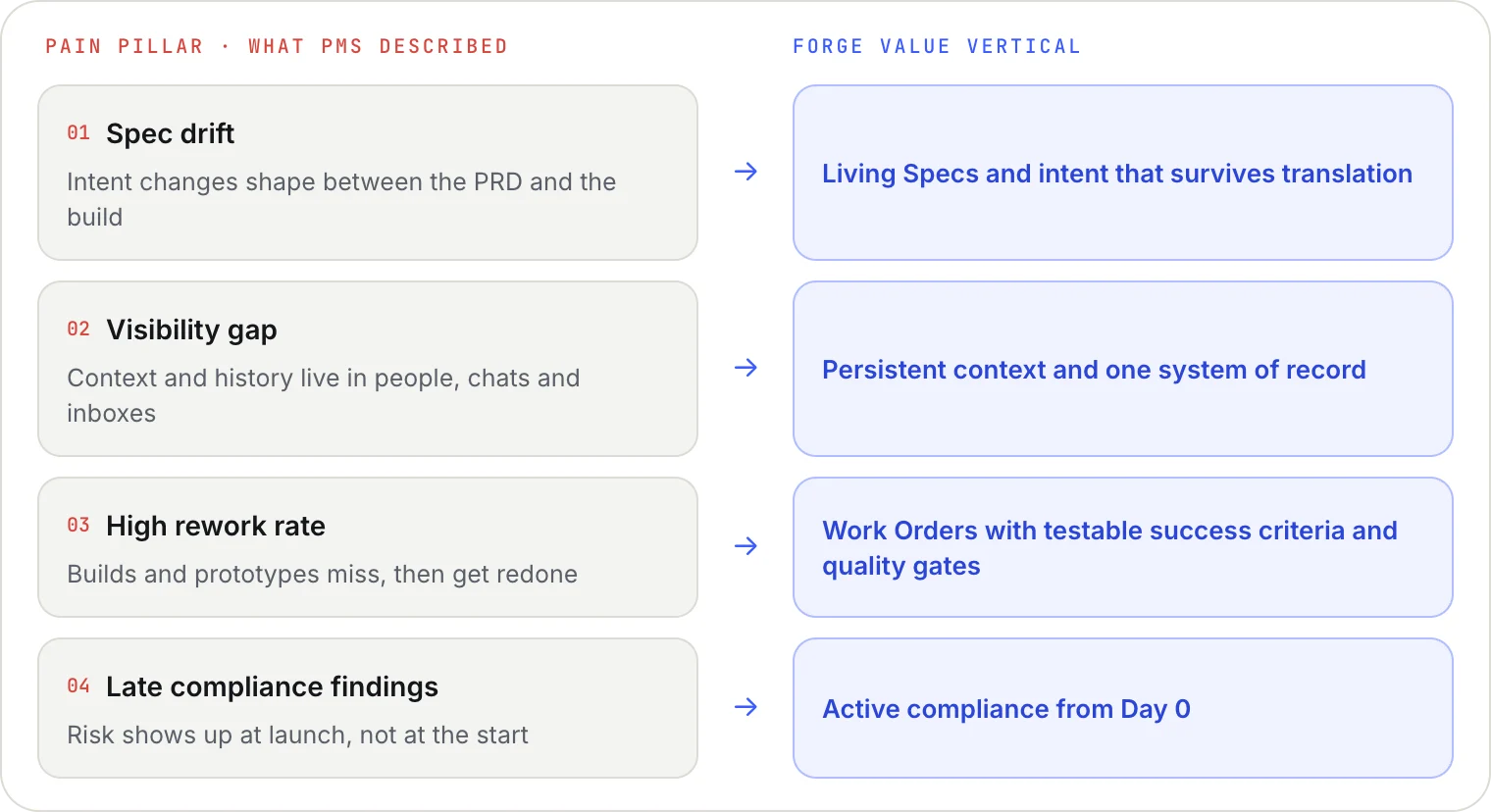
We asked working product managers what breaks when building gets cheap. Four problems kept surfacing: spec drift, the visibility gap, high rework and late compliance findings.
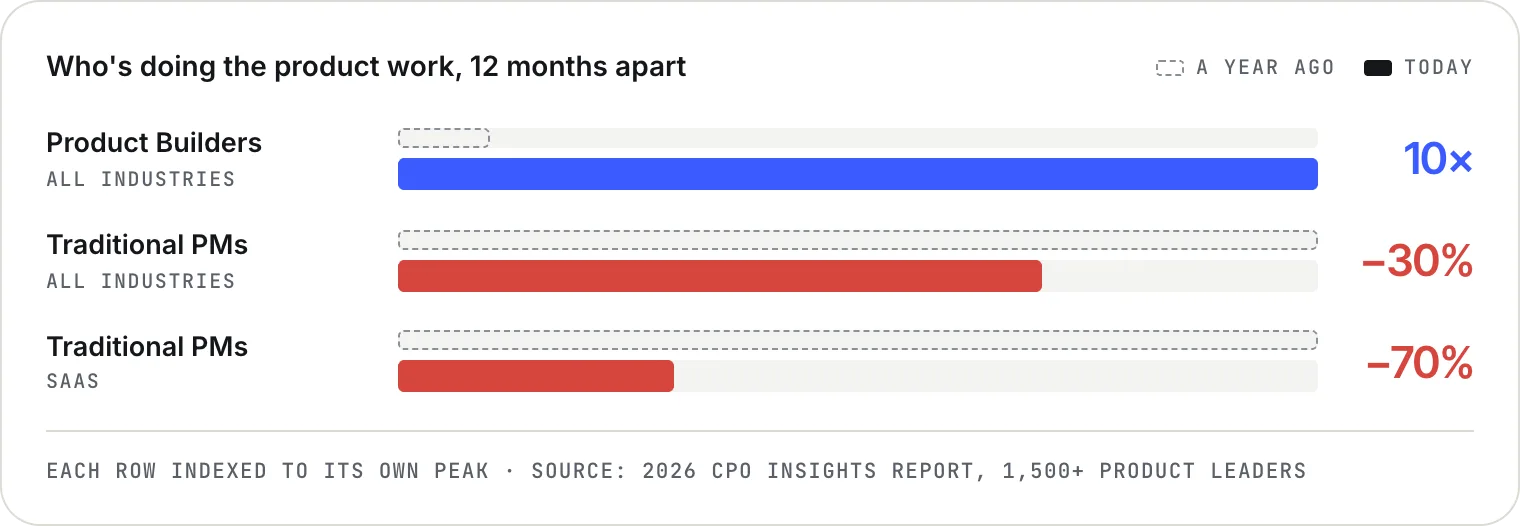
In the last year, the number of Product Builders grew 10x while traditional PMs shrank 30% across industries, and by as much as 70% in SaaS. That's from the 2026 CPO Insights Report, which surveyed more than 1,500 product leaders.
Same report, bolder claim: the PM role as we know it is obsolete by 2030. We think that's half right. The title may fade, but the person who owns the problem and ships the answer isn't going anywhere.
This piece looks at four things working PMs told us break when building gets cheap:
- spec drift, when intent changes shape between the PRD and the build,
- the visibility gap, when context lives in people, chats and inboxes,
- a high rework rate, even when AI writes the code,
- late compliance findings, when risk shows up at launch instead of at the start.
What 2025 to 2026 did to product management
Building got cheap. Everything that was built around that scarcity, the roadmap debates, the handoffs, the pod ratios, started to wobble.
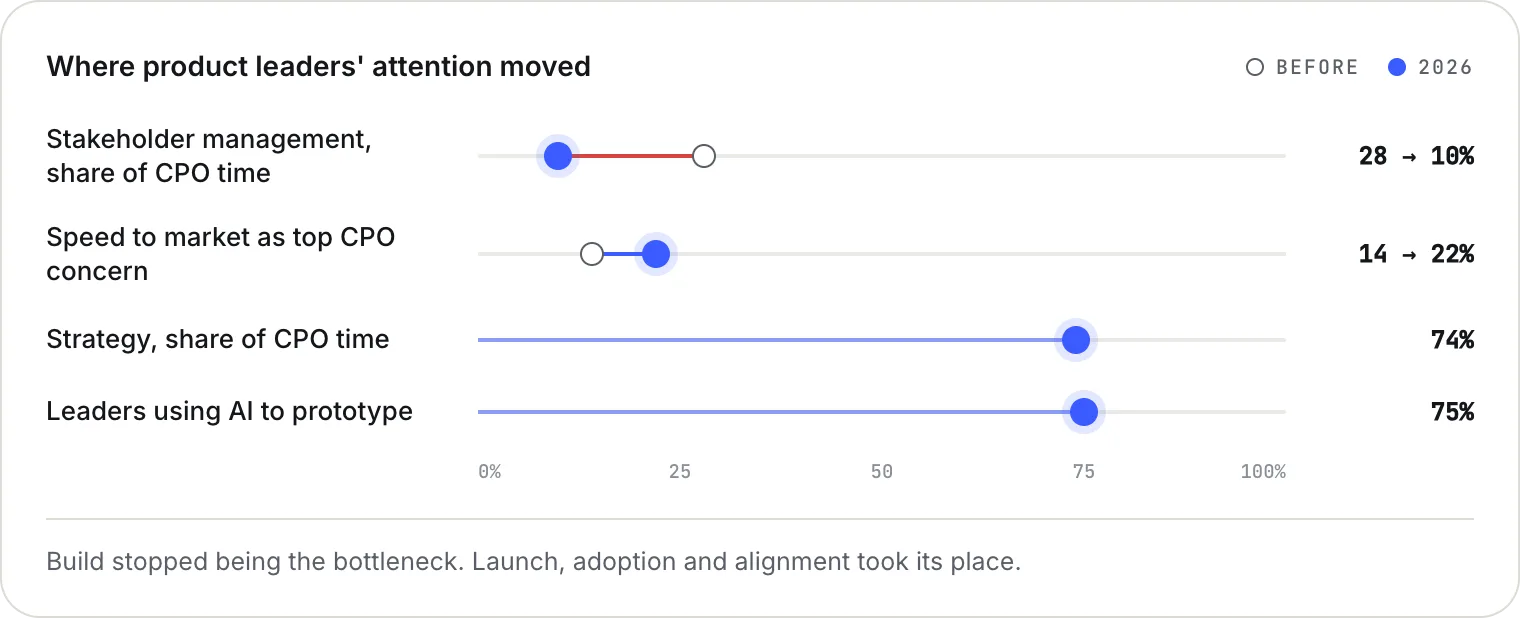
- Prototyping became the default. Three out of four product leaders now use AI to speed up prototyping and exploration.
- The bottleneck moved. Speed to market is the top CPO concern, up from 14% to 22%, and products now stall at launch, adoption and alignment instead of build.
- Leaders left the meeting room. CPOs report stakeholder management dropping from 28% of their time to 10%, while strategy climbed to 74%.
- The middle got squeezed. Userpilot's 2026 research shows PM postings up 14% year over year as of May 2026, yet the role is dividing in two and the middle is thinning.
- Big employers noticed. LinkedIn turned its APM program into a Product Builder program that trains product, design and engineering skills together.
Here's our read on 2027 and beyond. The Builder becomes the unit of a product team, one person spanning product, design, frontend and backend. The PM who prototypes becomes the norm, and the PM who only writes tickets becomes rare.
The hard part won't be building. It'll be keeping what gets built aligned, governed and true to intent.
Four problems PMs kept running into
So we sat down with working PMs and asked what actually breaks. Four problems kept surfacing, and Forge is built to address each one.
What is spec drift, and why do PRDs change shape?
Spec drift is the gap that opens between what a PRD says and what actually gets built. It happens when a new owner reshapes the plan, when a prototype leaves details out, or when someone pushes past the rules. The PMs below saw all three, and each one paid for it in time.
Staff Product Manager, Growth
AI Creative Media
"I wrote out this whole PRD... and then this other PM took over and she kinda redid it."
- The original plan. They wrote a full PRD for a homepage personalization test, showing different example templates to people who want marketing ads versus people who want to make a movie.
- The handoff. When they shifted roles, another PM took over the feature and simplified it so a test could run faster.
- The tradeoff. They understand the reasoning, but worry the leaner version won't show enough impact to decide whether personalization deserves more investment. The time they spent on the original PRD is the cost, and they said so plainly.
Contrast: Compared with Shawn Yao later in this section, who deliberately writes less so there's less to redo, this PM wrote a full PRD and watched a new owner cut it down.
Principal Product Manager, Compliance
Fintech
"Day to day I will get comments from my engineers saying my PRD is rated 56."
- The gate. Engineers run every PRD through an internal scoring tool, and work only moves to code at 60 percent or higher.
- The volume. With AI and a connected knowledge base, they now produce up to 10 PRDs in parallel each week, up from two or three.
- The wobble. The scoring tool is new, so ratings vary, and the PM ends up tweaking wording to fit the tool.
- The stakes. Engineers now query the PRD directly to generate code, so the document is the spec in a very literal sense.
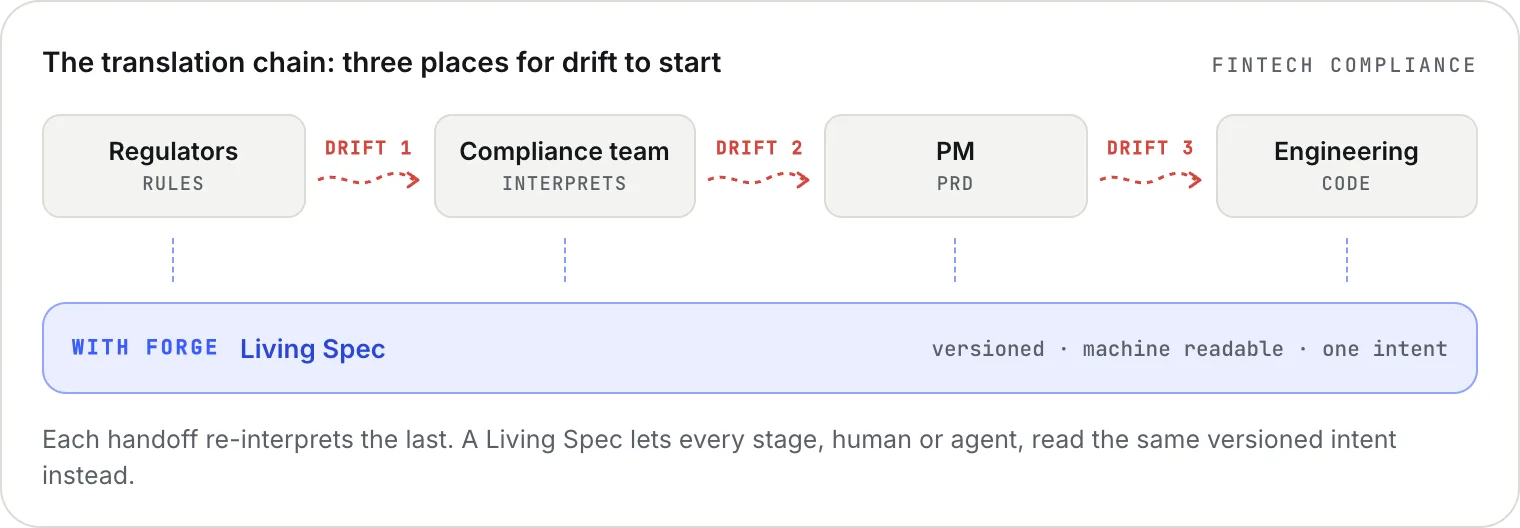
- The translation chain. A compliance team interprets regulators, the PM turns that into product requirements, and engineering builds it, which gives drift three places to start.
Shawn Yao
Product Manager, UGC · Dolby
"Next week on the alignment meeting, this thing that I thought would look a certain way looks a little bit different."
- A goal, not a template. He starts his docs from the outcome, such as who five target creators are and what journey they should experience, instead of a standard requirements template.
- Under prescribing on purpose. He hands the technical how to the tech lead and leaves design calls to designers, so there's less to drift.
- How he reads surprises. If something looks a little different, he treats it as the designer's or engineer's call, unless it breaks a promise made to partners.
- AI, line by line. He built a personal skill that has AI write one line at a time, so he shapes the doc instead of editing a full draft that's wrong in five places.
Yating Zhuang
Product Manager · TikTok Shop
"That happens a lot. For the initial PRD or prototype there's a gap in details I didn't think about."
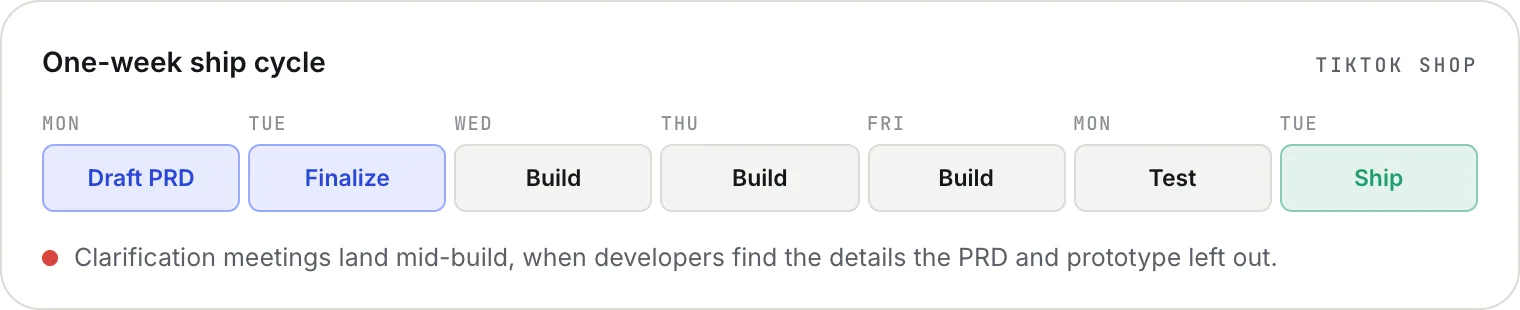
- A weekly clock. Her team plans and drafts the PRD on Monday, finalizes on Tuesday, builds Wednesday to Friday, tests the next Monday and ships on Tuesday.
- Two deliverables. She hands engineering a PRD and a prototype, built with internal AI agents in about five minutes.
- The gap. Even with both, developers come back with questions like "there are three options, which do you want?" and a clarification meeting follows.
Contrast: Compared with Shawn Yao, who hands engineering a doc and leaves the how to them, she hands over a doc and a working prototype and still gets questions.
Angel Jin
Product Manager, Ads and Voice & Music Intelligence · TikTok
"There have been times when by the time it's shipped, the PRD has changed so much as we continue to renegotiate the requirements that it's quite far from what the original idea was."
- Requirements get renegotiated. As the team debates what's feasible and what's compliant, the PRD keeps moving until it can land far from the original idea.
- Even after "ready to build." Once a PRD is commissioned, the end product can still change in how edge cases are handled.
- Where the surprises come from. Engineering may say something is hard to store, such as keeping information after a user leaves the feed, or that Android and iOS behave differently in ways the PM didn't know.
- When they surface. Often during QA, and the team adapts the design instead of redesigning it.
Jonathan Goodlow
Staff Technical Product Manager · Shield AI
"The specific person on this specific team decided, I'm gonna push this into the build anyway... and what happens? It broke."
- How ideas move. He pitches improvements on products already in motion, drafts a doc, hands it to UX, then to engineering, with program management keeping Jira tickets aligned.
- The break. Someone pushed into the build after the cutoff date and against the rules, even though the rules had been shared on paper and in meetings. Their hardware needed the application to run, so nobody could test for several hours, and the team restored a week old build to keep work going.
- The pressure behind it. He says the environment rewarded something new and shiny, and people wanted gold stars and promotions.
- The real fix. They held two workshops and tightened the rules, but what worked was rotating build ownership so every team took a turn holding the build.
- The result. With a small team of three or four engineers serving an org of several hundred, the rotation made everyone care, and it never happened again.
How Forge keeps a spec from drifting
- Living Specs. Versioned, machine readable PRD, BRD, architecture and Work Orders, so agents inherit full intent and context instead of starting from a blank slate.
- Intent that survives translation. Raw intent becomes a permanent system of record that people and agents both read.
- Guardrails on every agent action. Work Orders authorize each action, so an off plan push meets the same gate as everyone else's.
- The outcome. Forge cites zero architectural drift.
For the longer version of this argument, read Forge's post on why spec and context matter more than the model.
What is the visibility gap, and why does context stay locked in people?
The visibility gap is what happens when the history, reasoning and status of a product decision live in people, chats and inboxes instead of one shared system. New hires can't find the why, changes travel by message, and problems surface only after they've spread. These PMs described it from four different angles.
Field interviews · Visibility gap
Principal Product Manager, Compliance
Fintech
"There's a lot of background missing in terms of domain knowledge and also the history of why we implement a feature."
- New to the domain. About four months in, they lacked the history behind why features work the way they do.
- No shared record. The org hadn't had time to build a consolidated knowledge base, so long tenured senior PMs did the hand holding across a time zone gap.
- Status slips. Juggling seven to ten requests means constant context switching and decision fatigue, so they have AI send a daily summary of the top five priorities and follow ups.
- The rebuild. Each product domain is consolidating old PRDs and wikis into its own knowledge base, updated with AI, then merged into a central chatbot.
- The first payoff. The most welcomed use so far is a customer facing FAQ that cuts the load on support.
Shawn Yao
Product Manager, UGC · Dolby
"I don't often feel the need to go in and keep adjusting the PRD... you can just reference that in an email or a team's chat."
- Changes travel in chat. He thinks of the PRD like a slide deck that gets everyone up to speed, and smaller changes move through email or team chat. A fundamental pivot gets a new PRD.
- Two speeds of review. Engineers comment on the doc asynchronously, and larger docs get walked through in a meeting.
- Where it breaks. He says collaboration collapses when engineering and product have different goals, not when a doc is stale.
Contrast: Compared with the growth PM below, who posts progress in a weekly channel and tries test builds along the way, Shawn lets conversation carry the changes, and he admits he treats PRDs as less of a living document than he probably should.
Staff Product Manager, Growth
AI Creative Media
"Some engineers would literally share their progress in our group chat every week... you just kind of play with it along the way."
- Weekly progress. On teams that do this well, engineers post what they've wired up and share test builds each week, and the PM tries them early against the requirements before formal QA.
- Changes get announced. When they tweak the PRD, they tell everyone involved through the feature's group chat.
- Everything is recorded. Every meeting is transcribed and Slack and docs are searchable, so their AI can crawl all of it to draft a PRD.
- Data on tap. Their AI is connected to the company's data, so funnel drop offs and usage come back without manual analysis.
Angel Jin
Product Manager, Ads and Voice & Music Intelligence · TikTok
"At TikTok my visibility into it is very low."
"It kind of does feel like a black box where someone might quote you 20 days after you've handed off a PRD and then every day you're just asking if we're still on track. And at the end of the 20 days, you're like, we're not on track. And then I ask why."
- A 20 day black box. After handoff, an engineer might quote about 20 days, and the PM spends that time asking every day whether the work is still on track.
- The reveal. The answer that it isn't on track comes at the end, and only then does the PM find out why.
- Partial information. Engineers sometimes present two options with tradeoffs but leave out a big one, so the PM picks A and later learns from another engineer about its huge downside.
Contrast: Compared with the growth PM above, whose engineers share progress every week, Angel says engineers at past companies would show partial progress if pushed, but at TikTok it feels like a black box.
Jonathan Goodlow
Staff Technical Product Manager · Shield AI
"By the time I got into the office there was already some panic setting in."
- A time zone gap. His engineers were on the East Coast and he was on the West Coast, so the alarm had already spread before he arrived.
- The same broken build. The build story from the spec drift section is also a visibility story, because the trouble was already spreading by the time he saw it.
- Limited sight. He also works around classified data he can't access himself, so he relies on approved enterprise AI tools and colleagues with clearance.
Tam Tran
Technology Manager · Uber
"I have to gain access and visibility to a lot of processes and teams and people, team and system and AI, whatever, in the enterprise setting."
- Access before answers. In a large enterprise, Tam first has to get access to the processes, teams, systems and AI tools involved before seeing what's going on.
- Scale makes it worse. The more people, systems and AI agents that touch the work, the harder it is to piece together the full picture from one seat.
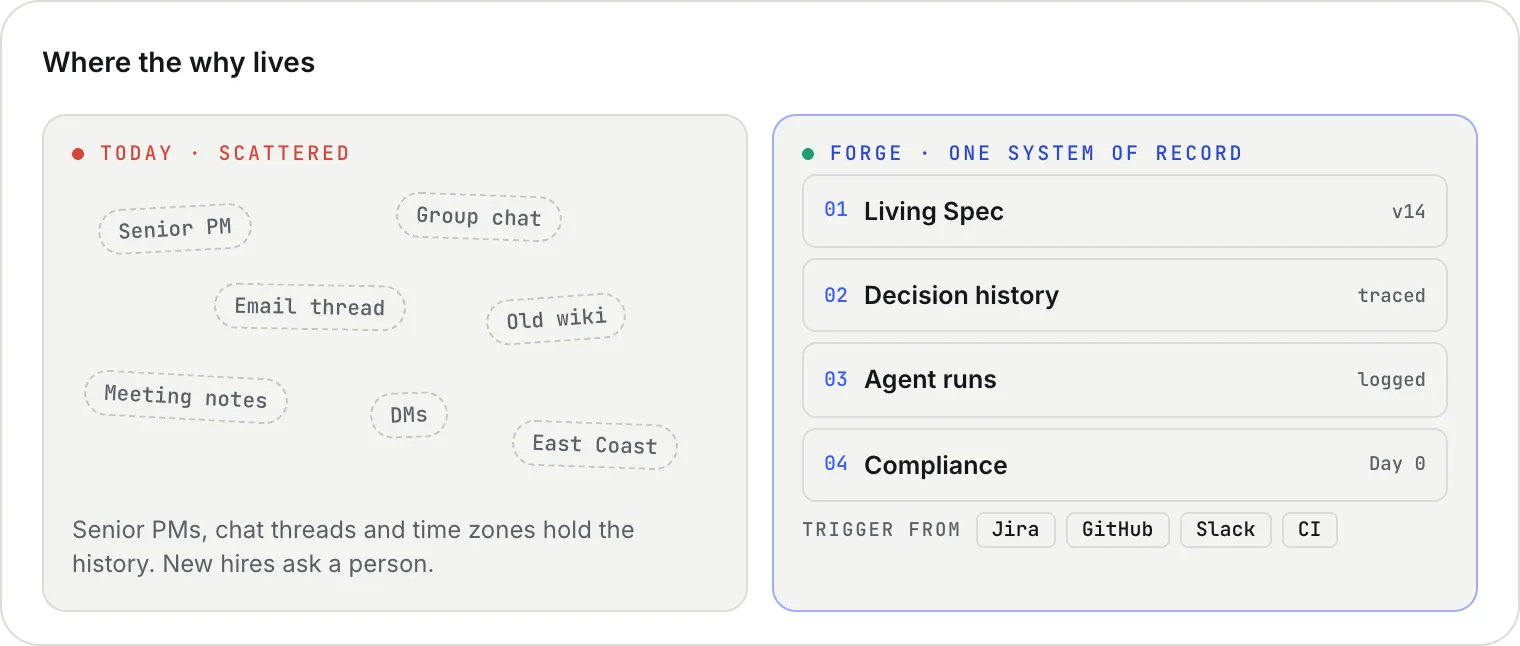
How Forge closes the visibility gap
- Context without an expiration date. Specs, agent runs and compliance sit in one system of record, and projects resume exactly where they left off.
- Govern from anywhere. Trigger Forge from Jira, GitHub, Slack and CI, so visibility lives where the team already works.
- An unbroken project history. Transparent Work Orders trace every decision from the first prompt to deployment.
- Legacy knowledge restored. Forgemaps a legacy codebase in minutes, so the why stops depending on tenure.
What causes a high rework rate, even when AI writes the code?
A high rework rate means teams build something, learn it was wrong or off spec, and build it again. In these interviews the cause was rarely careless engineering. It was a plan that wasn't the right thing to build, a prototype that took endless prompting, or AI output nobody had the judgment to check.
Field interviews · High rework rate
Shawn Yao
Product Manager, UGC · Dolby
"We just figure out that this is not exactly the best thing that we want to build. And that falls more on my responsibility."
- Where rework really comes from. He says the gap is rarely that engineers built something different from the spec. More often the team ships an SDK or library and learns it wasn't the best thing to build.
- He owns it. Since he told them what to build, he counts it as his miss, not the engineers'.
- Moving targets. Partners change requests, users say one thing and then another, and business priorities shift.
- Why small steps help. Greenfield products reward lean iteration and finding the real minimum, so a change costs less.
Yating Zhuang
Product Manager · TikTok Shop
"It takes a lot of my time to fine tune back and forth."
- Prompt loops. She tries different versions of a prompt across ChatGPT and Gemini to get a prototype close to what's in her head, and a part that was close often changes again in the next version.
- A two week fix window. Depending on scope, corrections land in the same sprint or the next, so a miss costs about two weeks at most.
- The research bottleneck. Her team runs a two week user feedback cycle, and recruiting, interviewing and summarizing make it a very long pipeline. Useful feedback that doesn't fit the sprint goes to the backlog, and sometimes gets missed.
Contrast: Compared with the fintech PM below, who can generate plenty but can't judge the result, her problem is the opposite. She knows what she wants, and it takes many tries to get the tool to produce it.
Principal Product Manager, Compliance
Fintech
"I don't have the knowledge or the right judgment or intuition to determine if this output is good enough."
- A judgment gap. AI can write a lot, but this PM can't tell whether an implementation will work or be the most efficient and elegant one.
- No end to end run. They haven't shipped anything to production themselves and say they don't have the confidence.
- Testing what they can. They do a lot of acceptance testing and use AI to critique or create design mockups.
- Decision fatigue. Running seven requests at once means constant switching, and looking back, they say a number of early decisions could have been better.
Angel Jin
Product Manager, Ads and Voice & Music Intelligence · TikTok
"There was a lot of work being redone on that team just because we didn't really have a solid source of truth as to what was working and what wasn't."
- No source of truth. The team had no experimentation platform, so results looked different depending on which data scientist you asked.
- Redone months later. Six months on, another data scientist would point out a missed assumption, and the analysis had to be done again.
- Why it happened. Their measurement pipeline started as a quick proof of concept and was never moved onto the company's experimentation platform, so adopting it later meant reworking the data pipelines.
- How they coped. They used AI to check their own understanding and sharpen points to challenge, but say the real fix was a platform that measures impact accurately.
Jonathan Goodlow
Staff Technical Product Manager · Shield AI
"It disabled all development for hours during the next work day."
- The broken build again. The rework cost of the build story from the spec drift section is the clearest example here, and he says even a few hours of lost work is a big deal on a team that large.
- Proof of concept, not production. He says vibe coding is great for a proof of concept and for handing something tangible to UX and engineering, but not for production.
- Where AI backfires. He notes that teams who cut headcount for AI end up spending time debugging generated code, and he'd rather see companies use it to build more.
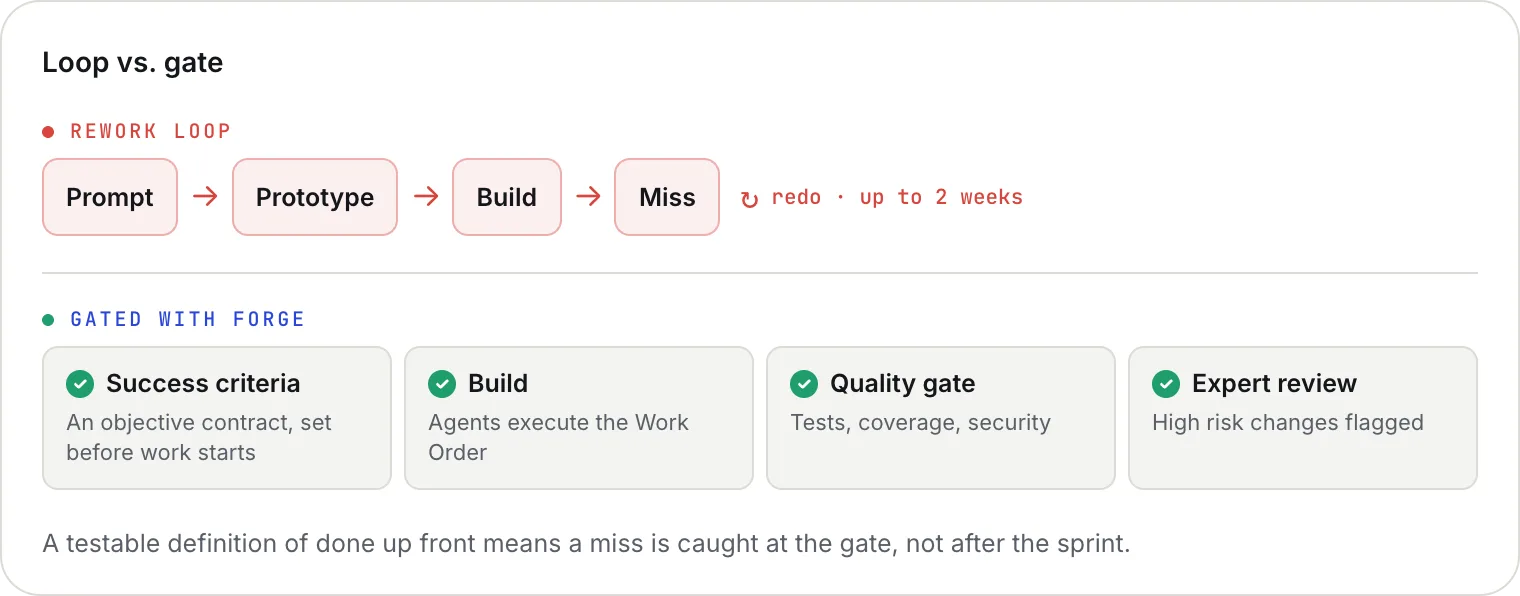
How Forge cuts down the rework
- A testable definition of done. Every change starts with explicit success criteria, an objective contract and not a vague instruction.
- Quality before release. Automated tests, coverage, and security checks run on every change before it ships.
- Risk routed to experts. High risk changes are flagged and sent to expert review, which is the judgment step one PM said they're missing.
- The outcome. Forge cites 66% less rework and 83% faster delivery.
Why do compliance findings show up so late?
Compliance findings show up late when risk review starts after the design is set, usually because the rules are unclear, the teams are separate, or the pressure is to ship. These PMs say meeting the floor is easy. The harder part is finding known risks early enough to design around them.
Field interviews · Late compliance findings
Staff Product Manager, Growth
AI Creative Media
"We build features specifically for compliance for some of our customers... we can audit if these AI generations used any copyrighted stuff."
- Compliance as a product. Their company builds tools so enterprise customers can audit whether AI generations used copyrighted material.
- Baked into the PRD. They say PMs should account for compliance in the PRD, though how far that goes depends on company size.
- Small versus large. Smaller companies move faster and worry less about every edge case, while a much larger past employer put every feature through legal and policy review with forms to fill out.
Contrast: Compared with Shawn Yao, who leaves legal questions to in house experts until go to market on greenfield work, this PM says compliance belongs in the PRD from the start.
Angel Jin
Product Manager, Ads and Voice & Music Intelligence · TikTok
"If you've gone through all of that with a designer and finalize the PRD, and compliance tells you you can't do it, now you wasted a lot of time."
- Talk to legal early. As soon as there's a PRD, they take it to legal to make sure they aren't wasting everyone's time.
- What's at stake. In ads measurement it's data protection, minimum sample sizes so advertisers can't trace responses to users, state and EU rules, and not targeting users under 18.
- The music example. A long audio idea would have broken label contracts that limit music to short videos, so launching it would have violated the licenses.
Contrast: Compared with Jonathan Goodlow below, who writes known risks down for research early, Angel takes the PRD to legal as soon as it exists and keeps casual conversations going in parallel so no work gets invalidated later.
Principal Product Manager, Compliance
Fintech
"A lot of the decisions, if I revisit when I just started, could have been done better."
- The chain. A compliance team interprets regulators, the PM translates that into a product solution, and engineering implements it.
- AI as translator. When guidance is vague, they use AI to turn it into requirements that engineering can build.
- Careful data access. Compliance data includes sensitive customer information, so it sits behind heightened security controls and controlled permissions.
- No serious fallout yet. Thin context hasn't caused serious compliance consequences, but they'd make several early decisions differently, and their org is building a consolidated knowledge base so newer PMs aren't guessing.
Jonathan Goodlow
Staff Technical Product Manager · Shield AI
"I know that we have heat issues right now... going one step beyond that and identifying those issues on paper."
- The product. Experimental wearable hardware with lasers, radios and batteries, where users could get burns, irritation or headaches.
- Floor versus finish. Meeting compliance was enough to start testing, but he thinks a PM should go a step beyond it.
- The PM as glue. He holds information from hardware engineers, UX and hardware design in one place, since no one else does.
- Feeding research. He passes known risks to UX research so tests ask about heat, discomfort and how the material feels on skin.
- The slow lane. Government customers and bureaucracy stretch his product timelines, so surfacing risk early saves headaches during and after compliance.
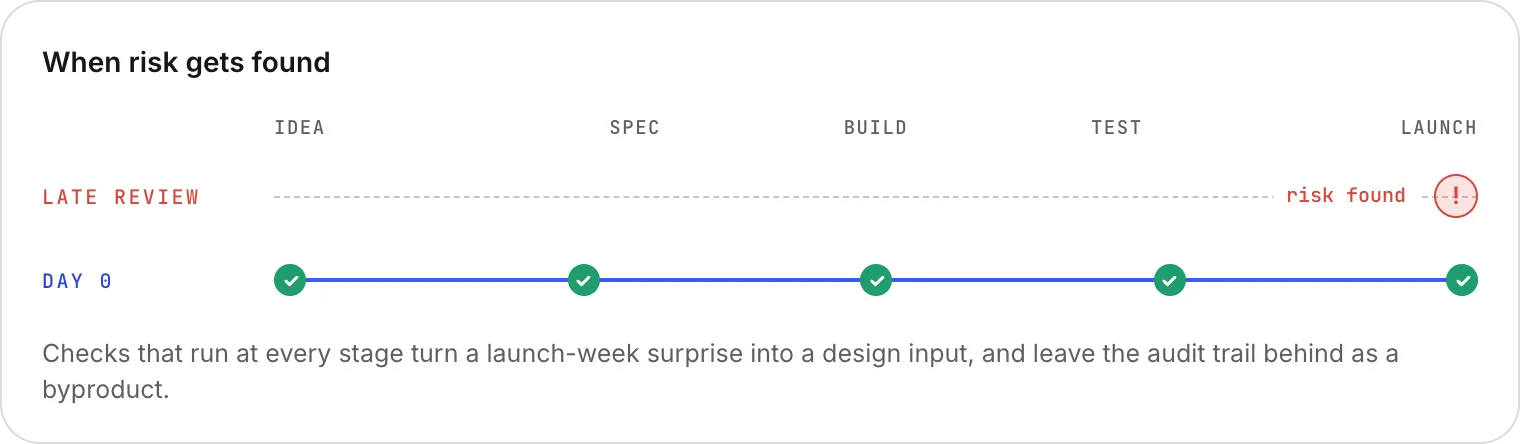
How Forge catches compliance issues sooner
- Active compliance from Day 0. Checks run through the build, not the week before launch.
- Auditable by design. Every change ties back to a business requirement, so the audit trail is already there.
- Security and compliance gates. Automated checks run before anything ships.
The pattern behind the four pillars
Spec drift, the visibility gap, rework and late compliance look like four problems. They're one problem seen from four angles. Intent and context don't travel with the work.
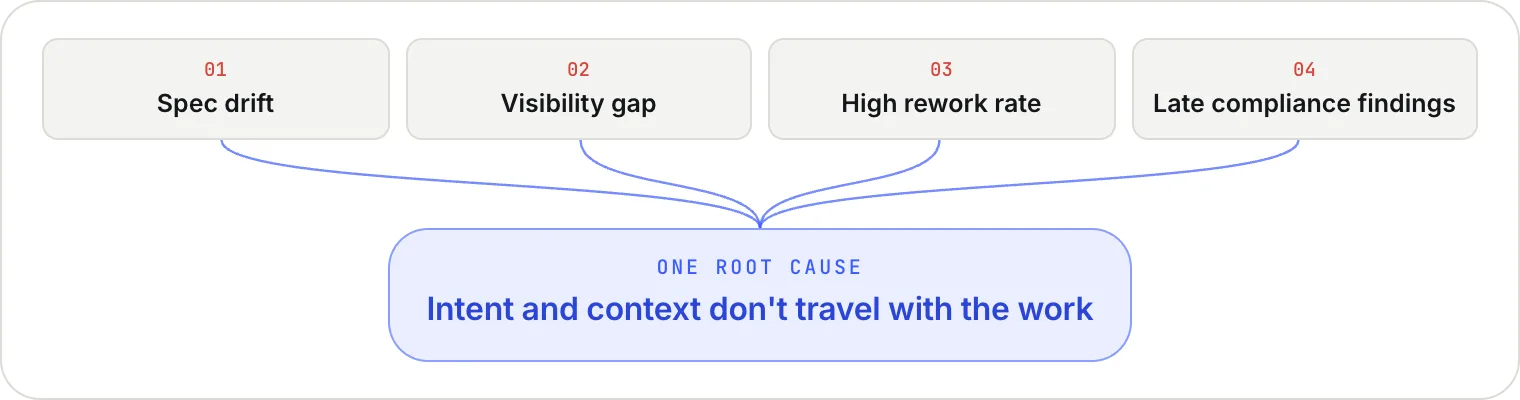
The PMs we talked to were candid about it. Prototypes are already standard, AI drafts most of the paperwork, and the human still owns the last stretch of judgment. What's missing is a system that carries the spec, the history and the rules along with the speed.
Why this gets sharper in 2027
Go back to the research at the top. Builders are becoming the unit of a product team, and the bottleneck has moved from building to launching and aligning.
That makes each pillar worse, not better. One Builder now makes more decisions with fewer reviewers, so a drifting spec, a hidden reason or a late compliance surprise travels further before anyone catches it.
- Fewer handoffs, higher stakes. When one person spans product, design and code, there's less friction to slow a bad call down.
- Faster prototypes, faster mistakes. A demo built in minutes carries the same missing details as a PRD written in days.
- More agents, more actions to govern. Every agent run needs an owner, a reason and a record.
Four questions to ask before your next build
- Spec drift. If a new owner picks this up tomorrow, will the original intent survive?
- Visibility gap. Can someone find out why a decision was made without pinging a person?
- High rework rate. Does every change have a testable definition of done before work starts?
- Late compliance findings. Are the known risks written down at the start, not discovered at launch?
If you can't answer yes to all four, the speed you gained is borrowed.
How Forge answers all four together
Forge is built around one idea. Speed without governance just ships debt faster. It's the same thinking behind intent driven development in a software factory.
- A Living Spec carries intent, architecture and Work Orders from idea to production, so drift has nowhere to start.
- Persistent context keeps specs, agent runs and compliance in one system of record, so the why stays visible.
- Testable Work Orders and quality gates define done up front and check every change before it ships.
- Active compliance from Day 0 makes the audit trail a byproduct of the build.
Builders can ship faster than ever, but speed only helps when the intent behind the work goes with it. Forge keeps the spec, the history and the compliance rules attached to every build, so the problems these PMs described have less room to start. If you want to see how that would work for your own team, book a demo.
Questions.
What is spec drift?
Spec drift is the gap that opens between what a PRD says and what actually gets built. It happens when a new owner reshapes the plan, when a prototype leaves details out, or when someone pushes past the rules.
What is the visibility gap in product development?
The visibility gap is what happens when the history, reasoning and status of a product decision live in people, chats and inboxes instead of one shared system. New hires can’t find the why, and problems surface only after they’ve spread.
Why is rework still high when AI writes the code?
In these interviews the cause was rarely careless engineering. It was a plan that wasn’t the right thing to build, a prototype that took endless prompting, or AI output nobody had the judgment to check.
Why do compliance findings show up so late?
Risk review usually starts after the design is set, because the rules are unclear, the teams are separate, or the pressure is to ship. Finding known risks early enough to design around them is the harder part.
How does Forge address all four problems?
A Living Spec carries intent from idea to production, persistent context keeps the why in one system of record, testable Work Orders and quality gates define done up front, and active compliance from Day 0 makes the audit trail a byproduct of the build.