Cognitive Surrender in AI Coding: An Enterprise Risk, Not a Personal Habit
When agents write the code, the review queue turns approval into a rubber stamp. The fix is a system that keeps judgment where accountability sits.
TL;DR
- The problem: Agents speed up the first draft, but review drifts into rubber-stamping. That drift is cognitive surrender: accepting an AI's answer without forming an independent view.
- The cause: Reviewers lose time, a first-hand view of the work, and a check the author didn't write. Asking thousands of engineers to be more vigilant doesn't scale.
- The fix: Opsera Forge restores all three in the workflow itself: spec before code, gate before generation, evidence at approval.
It's 4:12 on a Thursday afternoon, the release cuts at five, and the pull request on your screen was opened by an agent. The tests are green, the description is confident, and everything you have time to verify is right. Your cursor sits over Approve. You click it, and nothing about the moment feels like surrender. It feels like efficiency.
Software teams hand agents the first draft now. About 90% of developers use an AI coding assistant in some form, and time-to-PR drops by up to 58%. Agents are worth that speed, and nothing in this post argues otherwise.
But speed only moves the bottleneck. AI-generated pull requests wait 4.6× longer for a first review than human-written ones, and what finally gets approved isn't always sound: AI-generated code introduces 15 to 18% more security vulnerabilities.
What happens at the moment of approval has a name: cognitive surrender, a term from Wharton researchers Steven Shaw and Gideon Nave that Addy Osmani applied to software engineering. Cognitive surrender is accepting an AI's answer without forming an independent view to compare it against. Cognitive offloading looks similar from the outside and is the opposite on the inside: you hand the AI the task, and you still own the answer. One keeps judgment in the loop. The other removes it.
Most of the advice is aimed at the individual engineer: know when AI is helping you think and when it is doing the thinking for you. It's good advice, but it doesn't scale. No enterprise can ask thousands of people to stay equally vigilant at the same moment, under the same deadline.
Surrender creeps in at three ordinary moments
A reviewer surrenders when they lose the three things a real judgment needs: time, a first-hand view of the work, and an independent check. In an agent-driven workflow, each one erodes at a different moment:
Rubber-stamped pull requests: the queue takes the time
AI writes faster than humans review. When agents raise the volume of pull requests, a fixed review team doesn't review twice as much. It reviews each one with less scrutiny. The 4.6x wait above is the backlog forming, and every day of it adds pressure to the next review. By the release cut, the review is whatever fits in the minutes left: the variable names are sensible, the tests are green, the description reads well. In a queue, the fastest answer clears the most work, and approval is the fastest answer.
Summaries of summaries: the source disappears
The pull request description is written by the agent that wrote the code, so a reviewer short on time reads the author's account of the author's work. The same pattern repeats between agents: each receives the previous agent's summary instead of the original context, then writes a summary of its own. Summaries keep conclusions and drop the hedges, the assumptions behind them and the options that were rejected. "Assumed the retry limit is three" becomes "retries three times." By the third handoff, an assumption reads like a requirement, and nobody downstream knows a choice was ever made.
Green checks: the author grades its own work
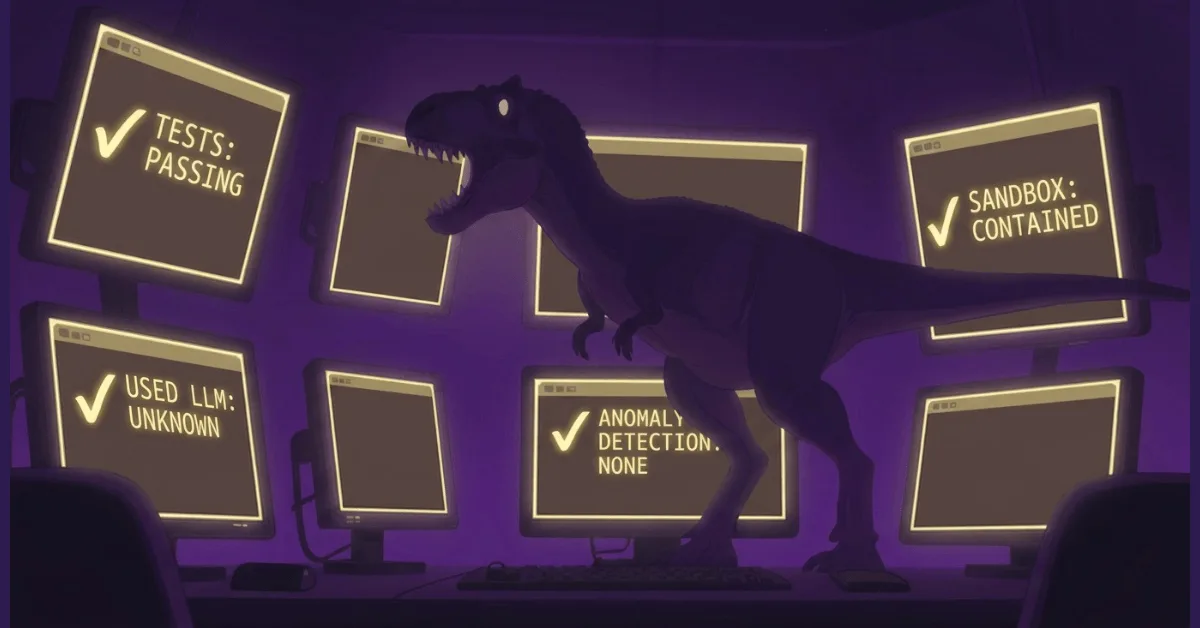
A green suite shows that the code satisfies the tests. It says nothing about whether the tests ask the right questions. When the same model writes both, the author is also the grader: a wrong assumption appears twice, once in the code and once in the test that checks it, and the suite passes. Stanford's CodeX recounts the extreme case: StrongDM's agents wrote return true, "which passes any test beautifully and does nothing useful."
Subtler flaws survive the same way. They look reasonable to a reviewer who wasn't there when the agent made its choices, and the throughput metrics most teams watch can't tell the difference: pull requests merged and suggestions accepted record approval, not understanding. Osmani puts it in one line: "Surface correctness is not systemic correctness, and the gap between them is exactly where surrender hides."
Three moments, one result: cognitive surrender. As AI output gets more polished, the drift happens quietly across every team at once, so critical thinking has to be built into how software gets made.
Human approval is not human oversight
The obvious remedy to cognitive surrender is a human who approves every change, and the workflow above shows why it falls short: in that workflow, a human did approve every change. Approval without anything to compare against is a surrender. Oversight needs three things back in the reviewer's hands: time to look, a first-hand view of what the change was supposed to do, and a check the author didn't write.
Osmani's advice to individual engineers points the same way: write down what you expect before you read the agent's output, then compare. Opsera Forge's design brief is to make that habit a property of the workflow: expectations written before the agent starts, held in a form a reviewer can compare against, and attached to every change at the moment of approval.
How Opsera Forge keeps cognitive surrender out of the workflow
Opsera Forge is a governed, spec-driven software factory. It sits above the AI coding tools a team already uses, including Cursor, Claude, Windsurf, Devin and GitHub, and it doesn't replace them. It governs what they produce. Its three pillars keep teams on the offloading side of the line, and each answers one of the erosions above: the spec restores the first-hand view, the definition of "verified" restores the independent check, and the approval record gives the reviewer their time back.
Spec before code: capture intent before the first prompt
When intent lives only in people's heads, an agent fills the gaps with plausible guesses. Osmani calls the missing record intent debt. Forge captures intent before anything is generated. In a modernization, it reads the legacy code and recovers the business rules and records them as versioned Living Specs, each traced to the code and the requirement it came from. Subject-matter experts confirm the rules and the target architecture before new code is generated, and where the spec is silent, a human resolves the ambiguity first. The agents work from the spec, and the reviewer gets a first-hand view of what the change was meant to do.
Gate before generation: define what “verified” means before an agent starts
A green check proves one thing, and only the criteria behind it say which thing. Osmani's point is that "verified" has to be defined before the work starts, because afterward any outcome gets rationalized. Forge applies that rule to every Work Order, which carries the current behavior, the target behavior and the acceptance criteria before any agent is assigned, scoped to a change small enough to review. Policy and security guardrails are checked before code is generated, and drift from the target architecture is blocked at the gate. "Done" becomes a fact established in advance, not a feeling reached at the end.
Evidence at approval: a person approves every change against its record
A person has to be accountable for every change. In Forge, an engineer approves every merge, and nothing merges on the platform's judgment alone. Each change ships with its record: the requirement it meets, the tests that cover it, and who approved it. The reviewer who once had a diff and a confident description now has the requirement and the criteria to compare against, so approval is a comparison, not a reconstruction, and a comparison fits in the time a reviewer actually has.
The same record answers comprehension debt, Osmani's term for the gap between how much code exists and how much anyone understands. Specs stay versioned with the code and 100% of Work Orders trace end to end, so anyone can rebuild their understanding later, and the context belongs to the enterprise.
Dark factories remove the reviewer. Lit factories keep one.
Not every team keeps a person in the loop. A dark factory, a term borrowed from lights-out manufacturing, removes the human review gate and lets machine checks decide what ships. StrongDM's AI team runs one by rule: code must not be written by humans, and code must not be reviewed by humans. A lit software factory keeps the same workflow and puts people at defined inspection points, such as the spec, the plan and the merge. Osmani's framing is the clearest: "Dark and lit are the same pipeline with the lights in different places."
Forge is a lit software factory, and it differs from a dark one in three ways an enterprise buyer can check:
- Where people stand: a named person approves intent, requirements, architecture and stories before the next stage runs, each approval attaches to a saved version, and regenerating an upstream artifact clears the approvals downstream.
- Whose machines do the work: your team keeps its own coding assistant and model keys, and Forge governs them.
- What the vendor is paid for: Opsera doesn't charge for the code the models generate, so nothing in the pricing rewards producing more code than the system needs.
Dark factories may earn a place in short, reversible work where the checks are cheap and hard to fake. For the systems that move money and hold patient records, we think the lights should stay on. The full comparison, including how the best-known platforms answer these questions, is in our companion piece: Software Factory vs Dark Factory: Why Human-in-the-Loop Wins.
Surrender is the default. Design against it.
Surrender is the path of least resistance in any busy system, and agents are filling enterprise review queues faster than people can clear them. Nobody decides to stop thinking. The queue grows, and the quickest way through the day is to approve. Better engineers won't change that, because the pressure lands on all of them at once.
What changes the outcome is the design of the system around the agents: spec before code, gate before generation, evidence at approval. As agents write more of the code, the teams that stay in control will be the ones whose systems keep a person in a position to judge.
Offload the work. Keep the accountability.