When the Fix Becomes the Failure?
What the November outages say about patching, legacy systems, and the growing gap between change velocity and operational understanding.
Every fix is a change to a production system, and a fix that is right for the code can still be wrong for the business.
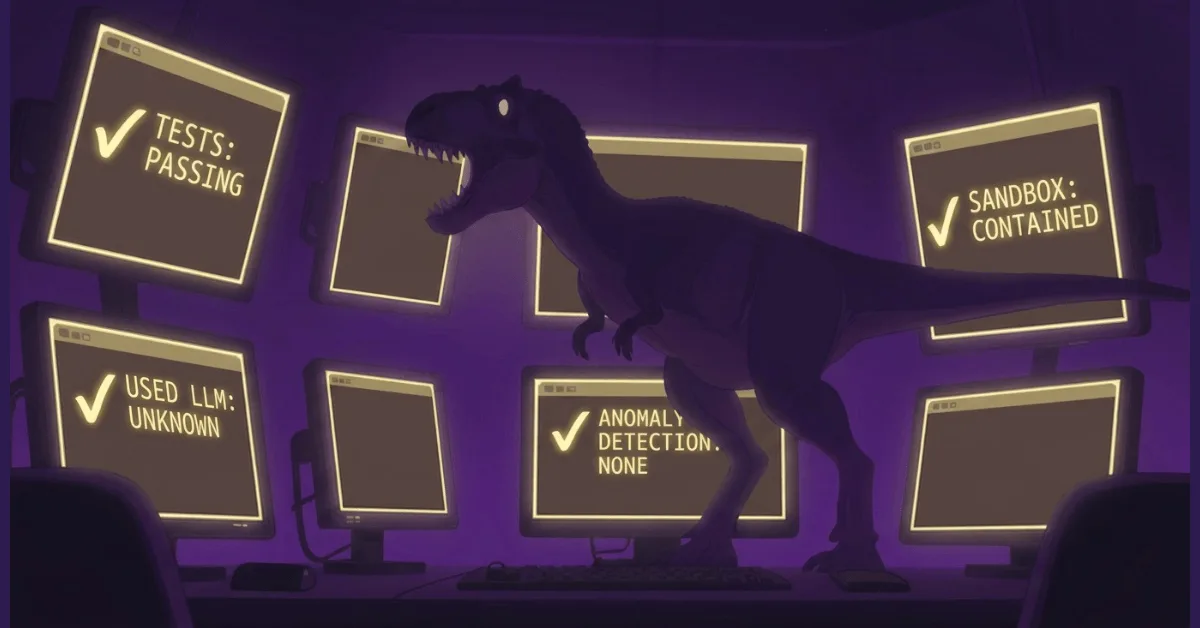
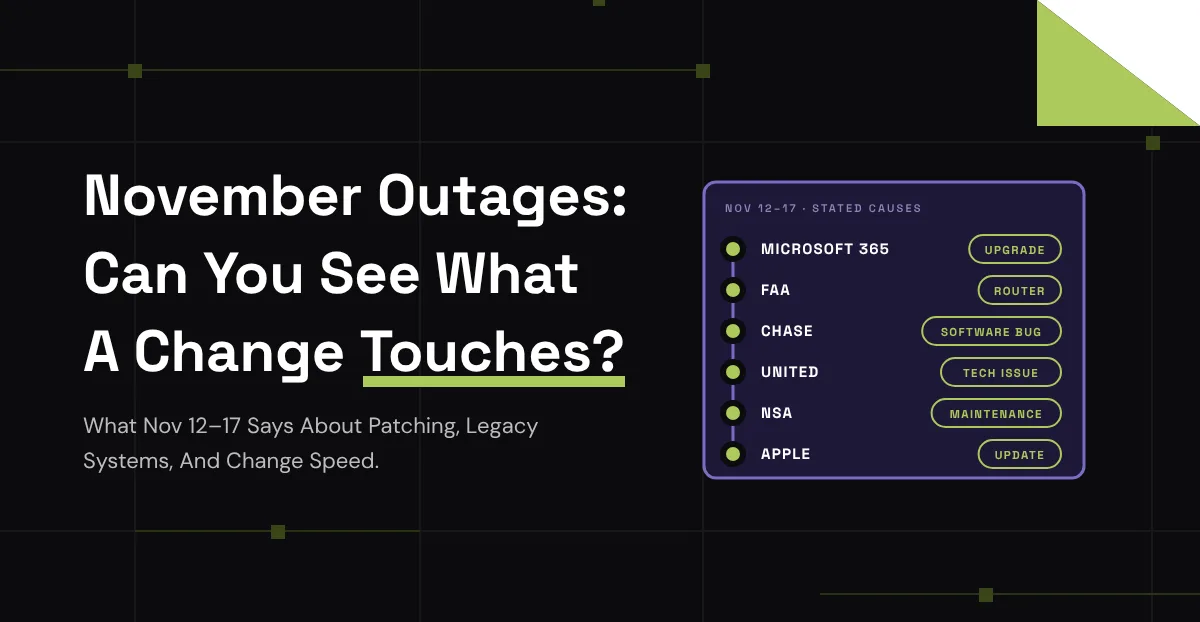
Between November 12 and 17, Microsoft 365, the Federal Aviation Administration (FAA), JPMorgan Chase, United Airlines, the National Security Agency (NSA) and Apple all reported outages. Downdetector logged about 6.4 million U.S. reports in a single week across the Microsoft, FAA, Chase and Apple incidents, roughly four times a typical week. Director of National Intelligence Jay Clayton told the House Homeland Security Committee that these were “separate service outages associated with maintenance and technical changes,” not a coordinated or state-sponsored attack.
The causes organizations have given are changes too: a network-capacity upgrade at Microsoft, a router installed during a network upgrade work at an FAA site in Arkansas, a software bug at Chase, scheduled maintenance at the NSA, an internal update at Apple.
I won’t guess at root causes, and they aren’t public in full. What I will say is that the pressure to change production systems quickly is rising. AI tools are surfacing vulnerabilities faster than ever, attackers have the same tools. In a mid-2026 survey of 316 senior executives and risk managers, Gartner found AI-enabled discovery of cyber vulnerabilities to be the top emerging risk. That pressure meets systems many teams cannot fully see into. So the question that holds up whatever the final reports say is simple: can you see what a change will touch before it ships?
A Fix Can Be Right for the Code and Wrong for the Business
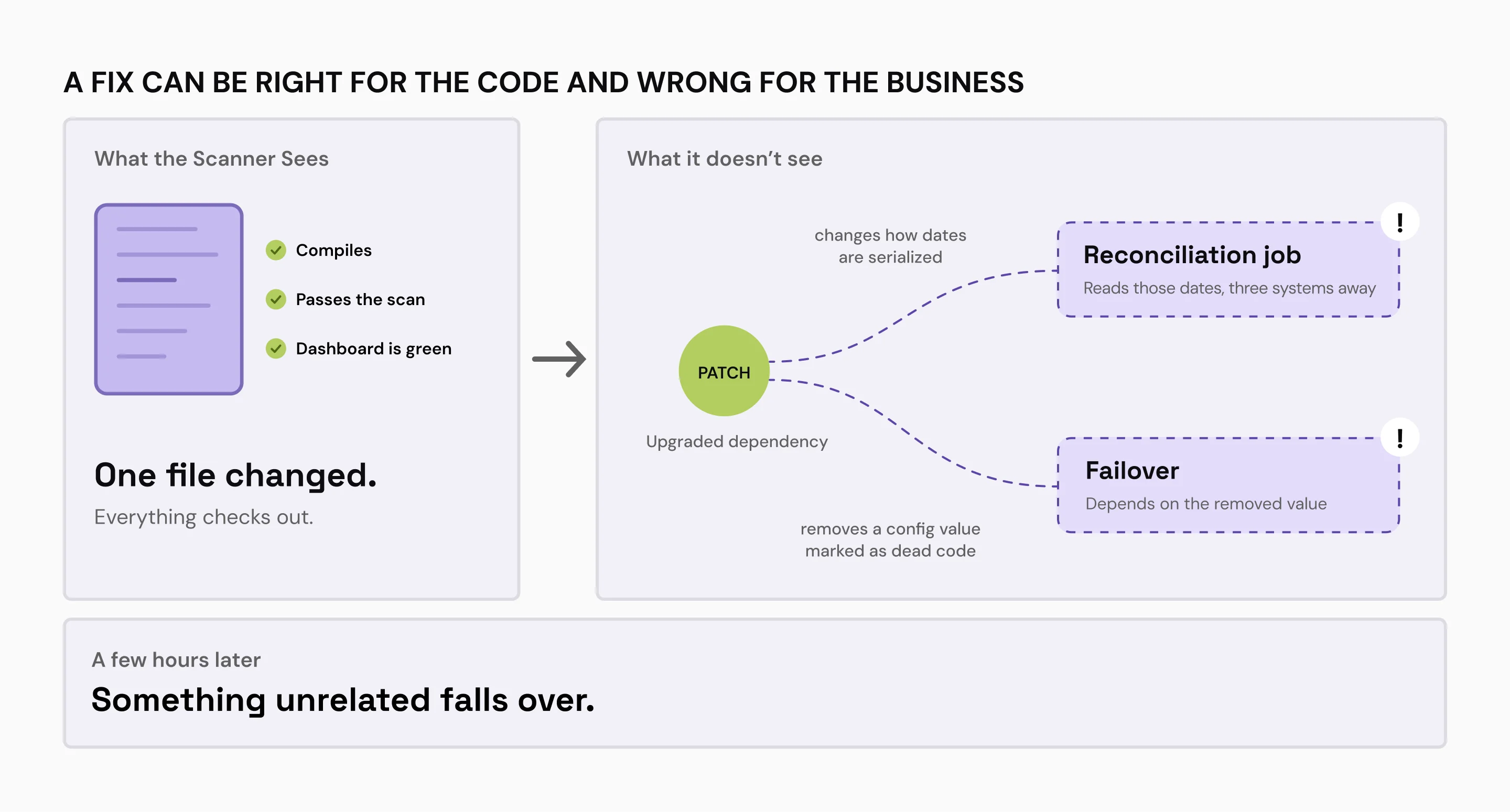
I see this pattern in enterprise teams all the time. AI is good at finding the vulnerabilities and writing patches. Give a model a flagged dependency and it will upgrade it, clean up the code around it, and hand you something that compiles and passes the scanner. What it doesn’t know is everything outside that file. It doesn’t know the upgrade changes how dates are serialized, and that a reconciliation job three systems away reads those dates. It doesn’t know the config value it removed as dead code is the one your failover depends on. Nobody gave it that context, so it couldn’t have known.
I don’t think the answer is to keep AI away from production code. That ship has sailed, and the attackers aren’t waiting for us. The problem is that we’ve let AI change production systems with almost no context and very little human judgment around them. The tools sped up the writing. They didn’t speed up the understanding. Opsera’s 2026 AI Coding Impact Benchmark found AI-generated pull requests wait 4.6× longer for review than human-written ones. The queue forms where someone has to work out what a change touches. When leadership says “patch it tonight,” the understanding is what gets skipped.
That gap is widest in legacy systems, where nobody fully understands what depends on what:
Legacy Systems Are the Riskiest Place to Change Anything
Transportation Secretary Sean Duffy described the aviation version after the FAA ground stop, explaining how hard it is to modernize air traffic control while keeping the current system running: “We use 1980s technology, 1990s software, to use 1970s radar that we don’t make parts for anymore.” Nathan Calvin of Encode said the outages show how much critical infrastructure runs on vulnerable legacy software.
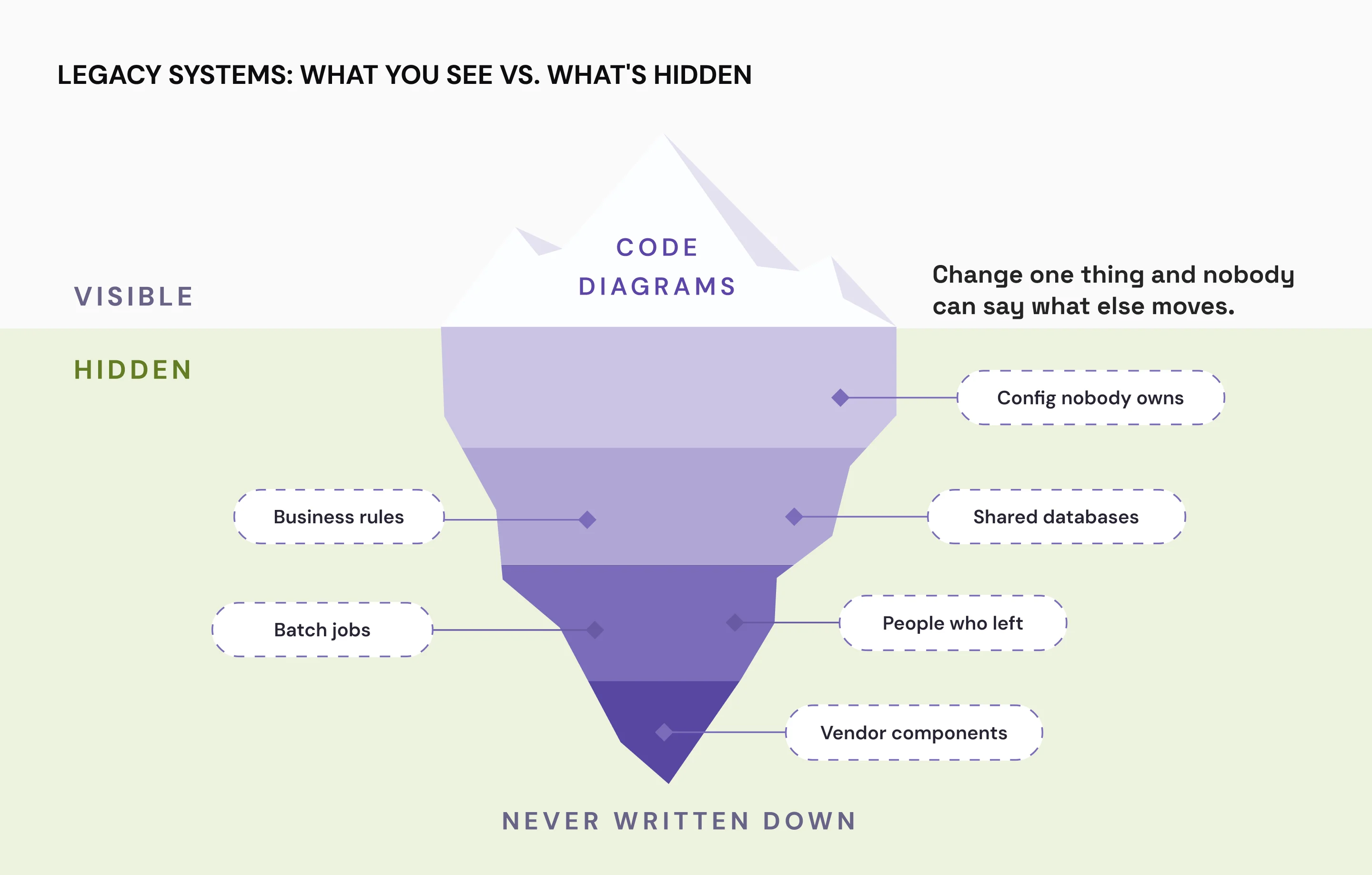
The risk starts with what was never written down. In a legacy estate, business rules live in code nobody has read in years, in configuration nobody owns, and in the heads of people who have moved on. Dependencies run through batch jobs, shared databases and vendor-bundled components that no diagram shows. Change one thing and nobody can say what else moves.
Your tools can’t fill that gap. A flaw in the runtime itself, like PHP, can pass every scan of your own code clean. Sometimes there is no patch to apply either: the PHP2Shell vulnerabilities left older PHP versions without an official fix, which leaves isolation or an upgrade as the options. An upgrade is a change to something you can’t see into.
A change to a legacy system is a change you can’t preview, can’t fully test, and sometimes can’t patch the normal way.
How to Patch Legacy Systems Safely and Modernize Behind the Fix
Whatever tools you run, six practices hold.
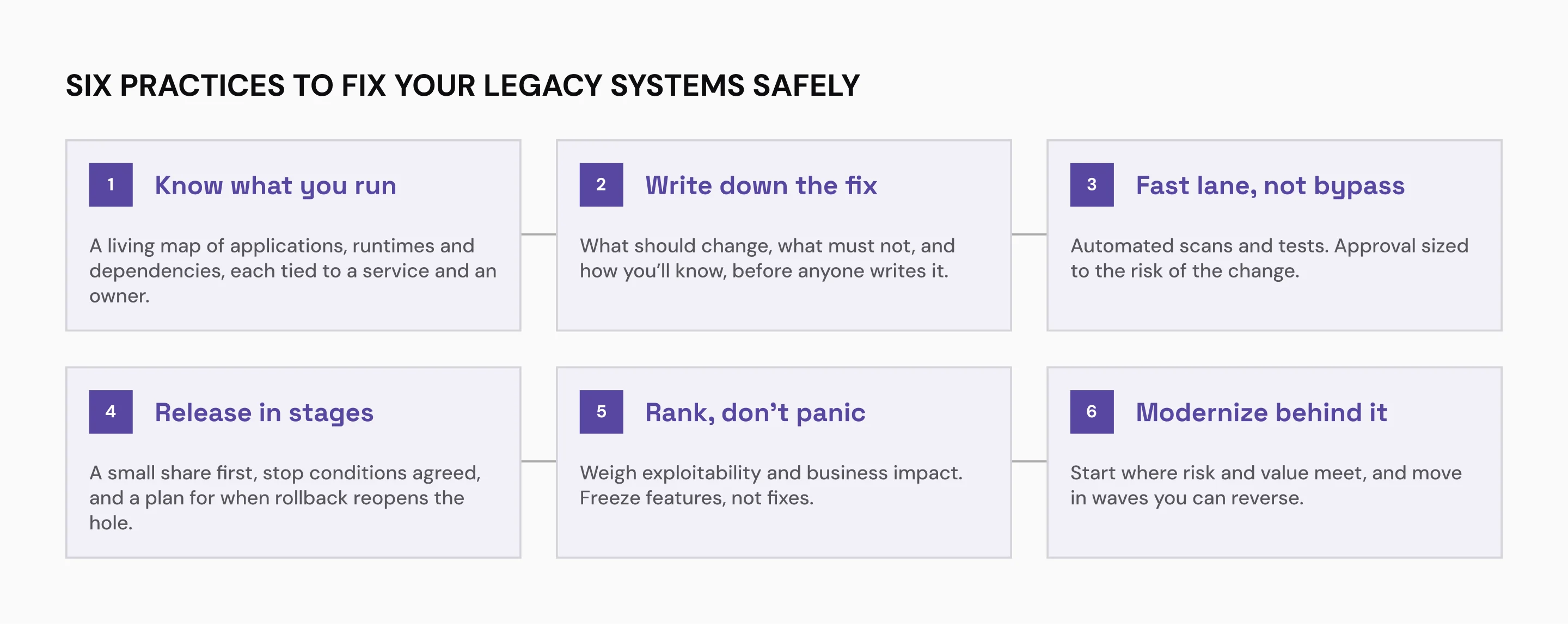
Know what you run and what depends on it. Keep a living map of applications, runtimes, dependencies and credentials, each tied to the business service it supports and to an owner. Include containers, CI configuration and vendor-bundled software, and read business rules from the code itself so legacy knowledge stops living in people’s heads. When the next disclosure lands, the first question is where the flaw runs and what depends on it. A map answers that. An audit starts a project.
Write down what the fix must do before anyone writes it. What should change, what must not, and how you’ll know. Without that, “the scan is clean” becomes the definition of done. Give AI agents the same context and check every change against it (related reading: Closing the Security Gap in AI Modernization).
Give security fixes a fast lane, not a bypass. Scans, tests and policy checks run automatically. An accountable person approves in proportion to the risk, because a one-line dependency bump and a change to your payments path shouldn’t clear the same gate. Treat maintenance, upgrades and recovery tests as production changes too. Track AI-written changes on their own: how often they fail, need rework or cause incidents. And trace every incident back to its change, even one made months ago.
Release in stages, and plan for rollback reopening the hole. Start with a small share of traffic and agree in advance what makes you stop. If rolling back would restore the vulnerability, have an alternative ready: isolate the system, apply a compensating control, or roll forward with a corrected fix. Test recovery before you need it. A plan that has never been exercised is an assumption.
Rank, don’t panic. Weigh exploitability and business impact, because not every finding ships tonight. Freeze features, not fixes. Isolation buys time, and it doesn’t replace the fix.
Modernize behind every patch. Each emergency fix on legacy code shows you what to modernize next. Start where security risk and business value meet, capture the business rules first, then move in waves you can reverse, from framework upgrades to language conversions to database migrations. Baseline each application’s health and report to your board against a framework like the NIST Cybersecurity Framework.
Forge Gives Context, Specs and Governance for Every Change
Forge is Opsera’s AI-native software factory for modernizing legacy systems and building new software with governance built in. It sits above the AI coding tools you already use and governs what they produce.
AI agents are only as good as the context and instructions they’re given, and legacy systems are where that context is thinnest. So Forge helps capture hidden legacy knowledge and turn it into modern advantage through three pillars.
- Context: Forge reads the code, maps business rules, data flows and dependencies, and keeps the map current. Teams see which applications an upgrade will hit before it ships.
- Spec-driven delivery: Before any agent changes anything, the finding becomes a specification and a set of work orders: what changes, what stays intact, and how it gets validated. Agents build and test against them.
- Governance: Built-in guardrails, human-in-the-loop approvals on every change, human or AI.
The ForgeScore gives readiness score for every application in the estate, so you start where risk and business value meet, and Forge modernizes in planned stages. The next disclosure becomes a routine change, not a weekend war room.
Change Is Constant. Control Is What Gives You the Edge.
You can’t see everything inside a legacy estate on day one, and the next disclosure is coming either way. A fix becomes the failure when nobody can see what it touches.
So here is a test for your team. Before the next fix ships, can your team say what it will touch, and who decides it goes out? If not, every fix is a gamble.
We don’t need less AI in engineering. We need AI that knows what it’s touching, and people who decide what ships.
See how Forge maps legacy code and governs every change. Schedule a Demo