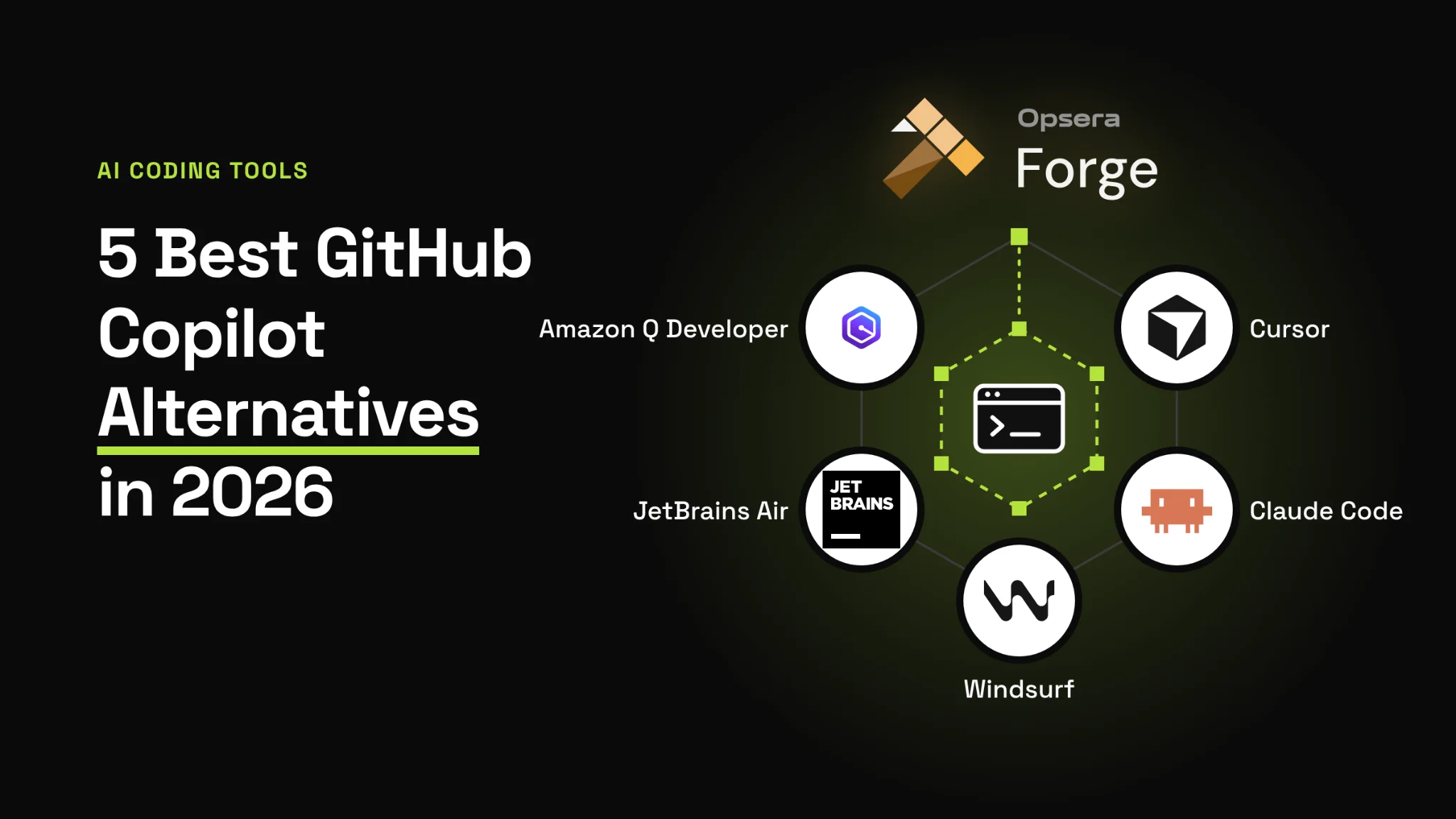
5 Best GitHub Copilot Alternatives in 2026
TL;DR:
- GitHub Copilot had 20 million users as of July 2025, per Microsoft's Q4 FY25 earnings call, and since 1 June 2026 it bills every plan through usage-based AI Credits, with Business at $19 and Enterprise at $39 per user per month.
- Cursor, now part of SpaceX, has been sold alongside Grok in The X Subscription since 12 October 2026, with plans from a free tier to a $200 Ultra plan and Grok model usage included, per Cursor's pricing page.
- Windsurf was acquired by Cognition, maker of the Devin agent, in July 2025, after a planned $3 billion OpenAI deal fell through and Google hired its CEO in a separate $2.4 billion licensing deal.
- Deployment model, cloud-hosted versus self-hosted, now separates the field as sharply as feature capability does, especially for teams in regulated industries.
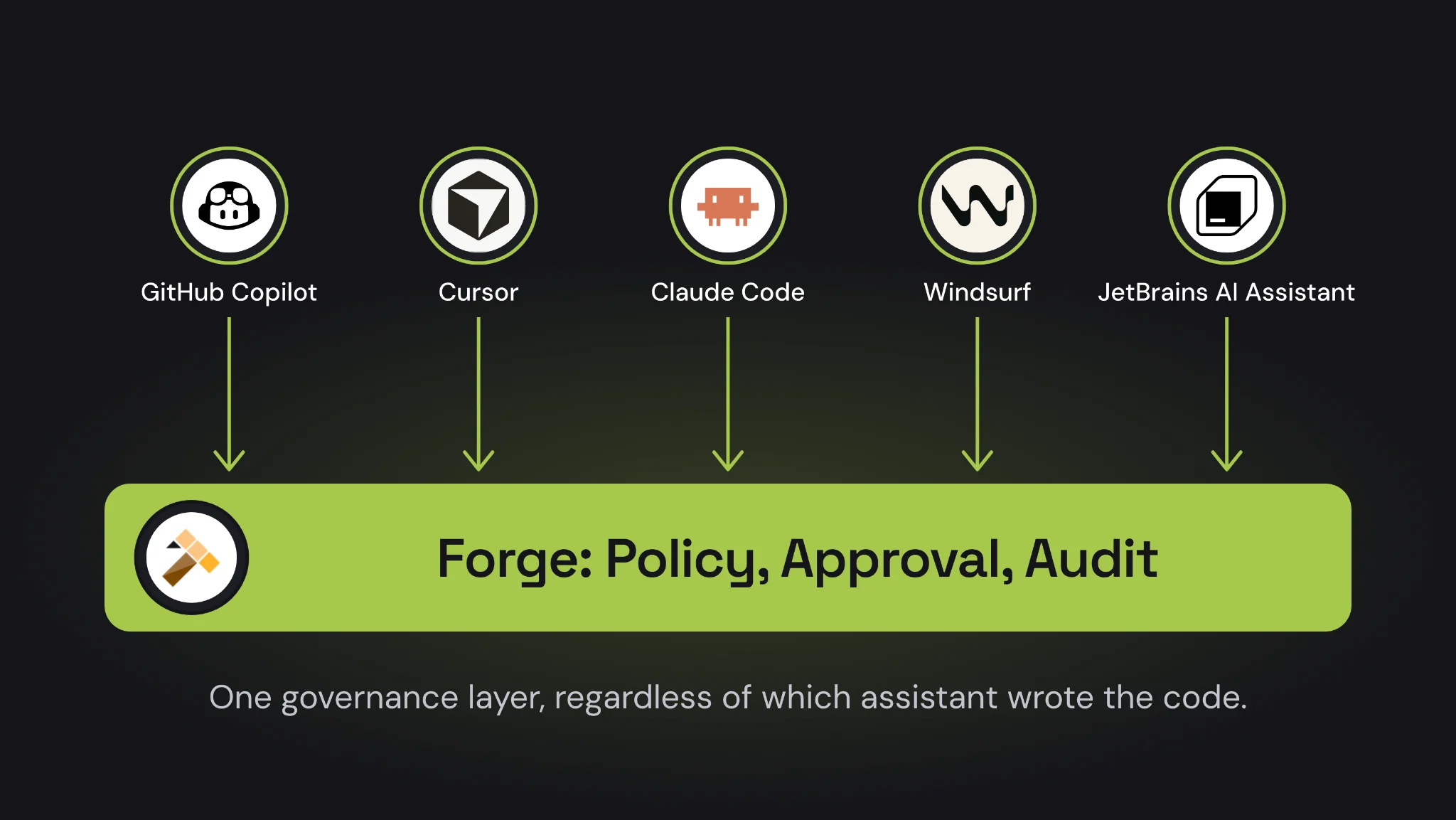
- Forge, Opsera's orchestration layer, is not an alternative to any of these tools. It sits above whichever assistant and model a team picks, adding specs, guardrails, and an audit trail on top, so it pairs with these assistants rather than replacing them.
What Is GitHub Copilot?
A code-completion tool finishes the line you're typing. Copilot does that and, increasingly, plans and executes changes across multiple files as an agent, a shift that's pushed it well past its original autocomplete positioning. It became the default on-ramp into AI-assisted coding for a huge share of enterprise developers largely because it already lived inside the GitHub workflow most teams were using, and that install-base advantage shows in the numbers: Microsoft said on its Q4 FY25 earnings call in July 2025 that Copilot had 20 million users.
That default status is being tested in 2026 on two fronts: pricing and competition. On 1 June 2026, GitHub moved every Copilot plan to usage-based billing with GitHub AI Credits. Plan prices stayed the same, with Pro at $10 a month, Pro+ at $39, Business at $19 per user per month, and Enterprise at $39 per user per month, and each plan includes that amount in monthly credits, with chat, agent mode, and code review drawing them down at each model's API rates. Meanwhile, dedicated agentic IDEs like Cursor have pulled in enough enterprise budget to show that this is no longer a market where the incumbent wins by default.
Why Look for GitHub Copilot Alternatives?
Three pressures are pushing enterprise teams to re-evaluate. The first is cost: AI Credits turned a simple per-seat multiplication into a usage-forecasting exercise, since heavy agent use can run past the included credits. The second is a genuine capability gap that's closed enough that Copilot no longer wins by default against dedicated agentic IDEs, which enterprise engineering budgets are increasingly moving toward. The third is governance: Copilot's own enterprise controls don't reach past Copilot itself, a gap that only grows once a second assistant enters the picture, which is increasingly the norm rather than the exception.
1. Cursor
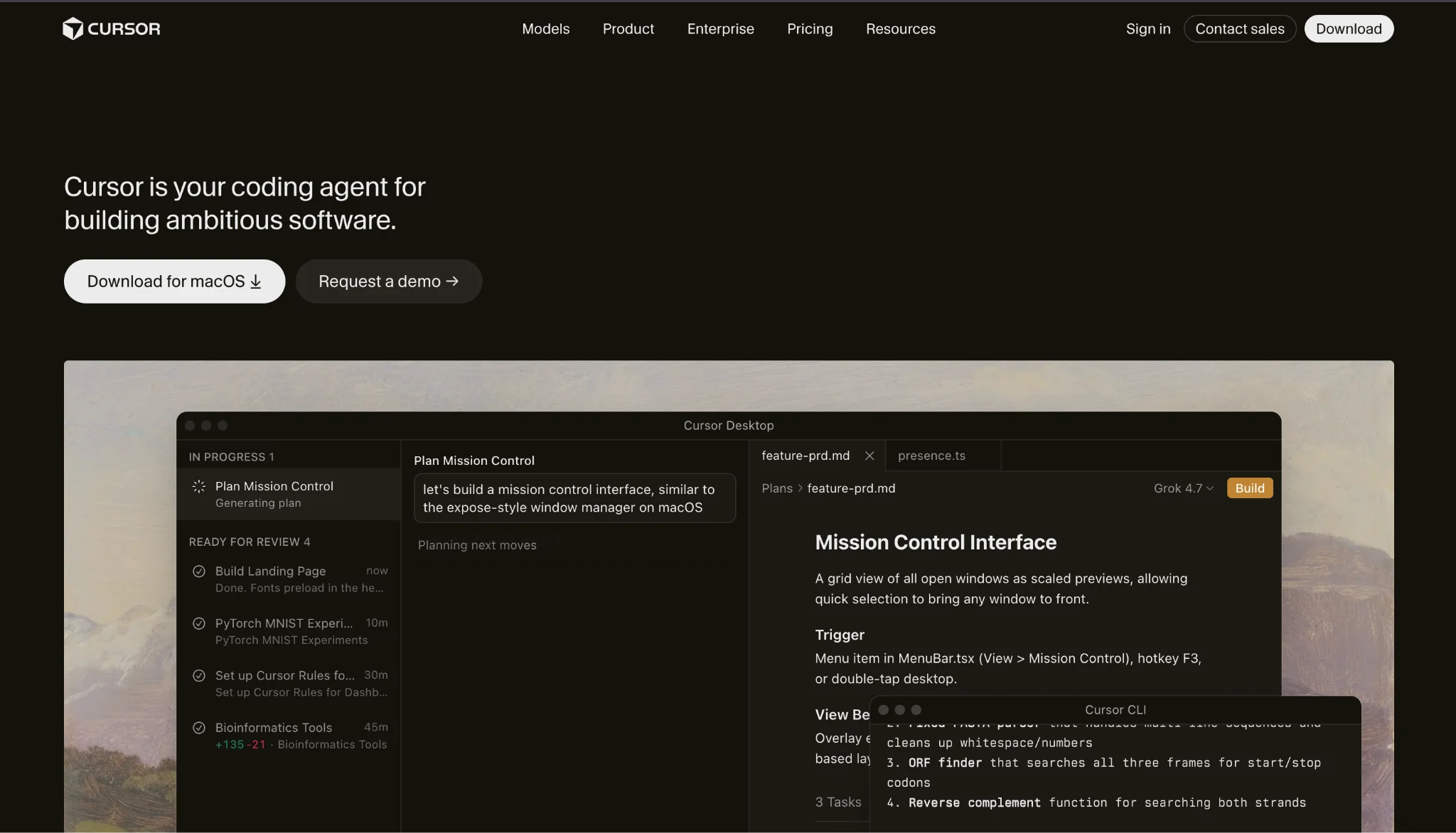
Cursor, now part of SpaceX, is the most direct feature-for-feature competitor to Copilot among dedicated IDEs, built around agentic multi-file editing rather than as an extension layered onto an existing editor. Since 12 October 2026 it has been sold alongside Grok in The X Subscription.
Cursor's plans now run Free, Plus at $8 a month, Premium at $30, Super at $100, and Ultra at $200, with Teams from $30 per user and a custom Enterprise plan, per Cursor's pricing page. Paid plans include Grok model usage that refreshes weekly, while third-party models such as OpenAI's and Anthropic's are billed separately at API list prices on Premium and above. That puts its cost logic in the same category as Copilot's metered credits, so a real comparison now requires modeling expected usage rather than comparing list prices.
Pros:
- Agentic multi-file editing accuracy that's generally ahead of Copilot's, which is the core reason so many enterprise teams have adopted it
- Purpose-built IDE experience rather than a bolted-on extension, with plans that scale from a free tier up through a $200 Ultra plan
- Pairs with orchestration layers like Forge, so teams can add policy checks and an audit trail on top of the editor
Cons:
- Requires standardizing on a new editor rather than staying inside an existing GitHub-centric workflow, which is a real switching cost for large engineering orgs
- Usage-based pricing can get expensive fast under heavy agentic use, and Enterprise pricing still requires a direct sales conversation rather than a published rate
2. Claude Code
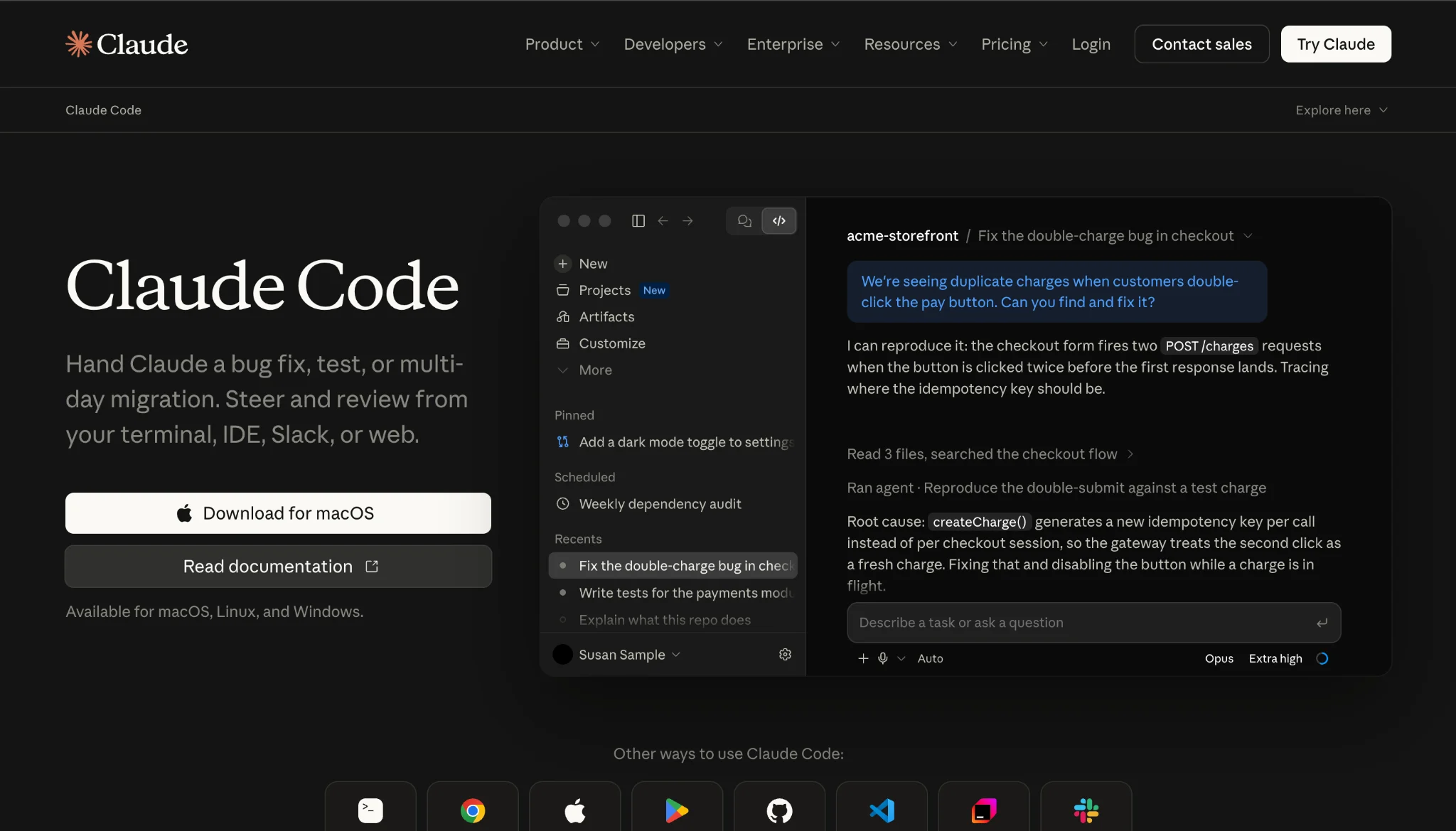
Claude Code runs across the terminal, VS Code, JetBrains IDEs, a desktop app, and a web and mobile interface rather than as a single extension, and it works directly inside GitHub and GitLab issues and pull requests, with tasks that can be kicked off from Slack, per Claude Code's own product page.
That multi-surface approach differs structurally from Copilot, since the same agentic tool attaches to whatever environment a given team already has instead of requiring one. It's included with Claude's Pro, Max, Team, and Enterprise plans, or billed through the Claude Console at standard API rates, and it runs locally with no backend server or remote code index holding a copy of a team's codebase.
Pros:
- Works across the editors, terminals, and project-management surfaces teams already use, with no forced standardization onto a new primary tool
- Strong performance on larger, more structurally complex agentic changes, including long-running, multi-hour refactors that follow imports across an entire repository
- Local execution with no remote code index, which matters directly to security teams evaluating where a copy of their source ends up
Cons:
- Fewer out-of-the-box, org-wide admin controls than Copilot's enterprise tier offers natively
- Multi-surface use means policy has to be enforced per surface without an added governance layer, since there's no single console covering every place it runs
3. Windsurf, Now Devin Desktop
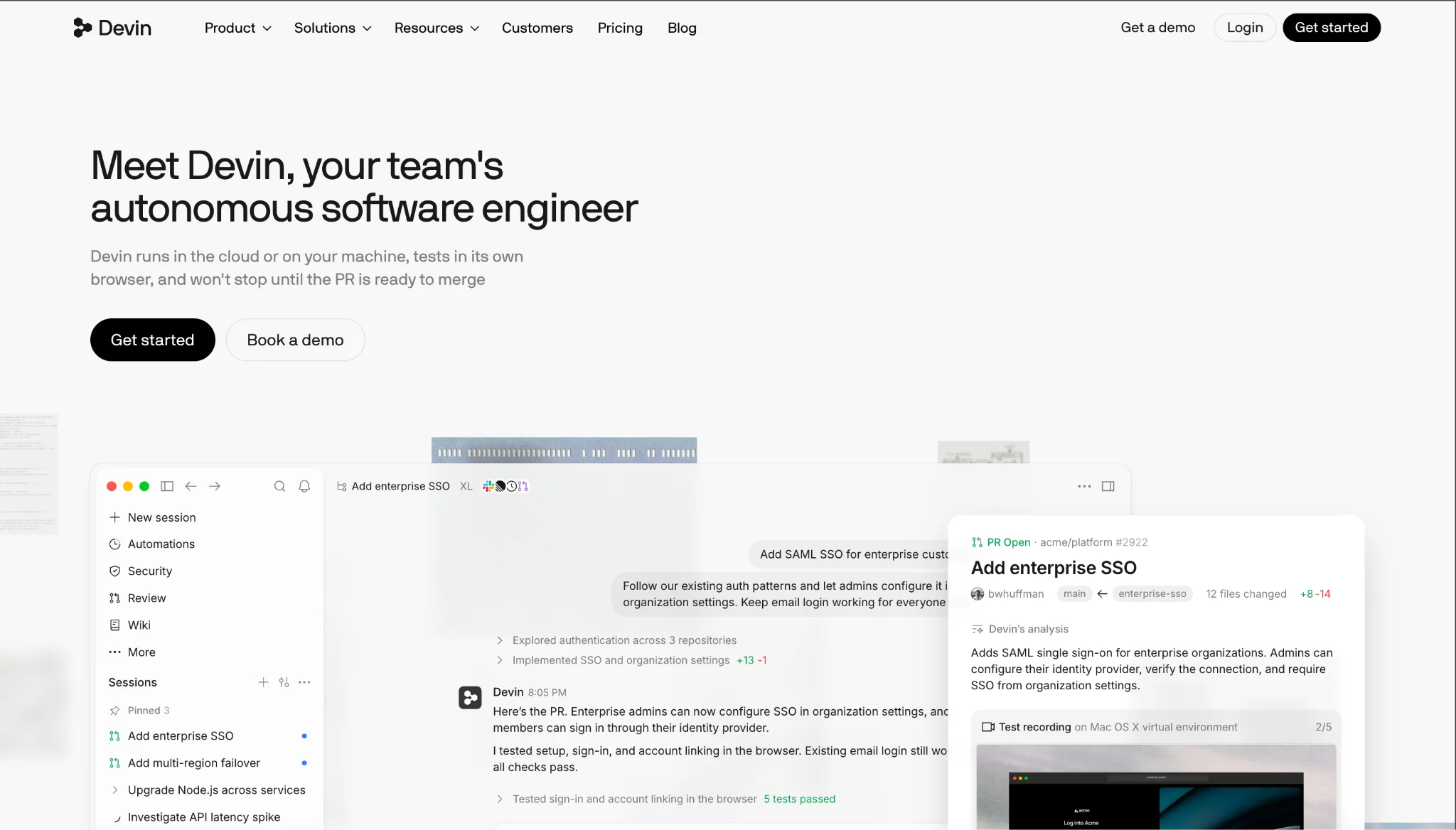
Windsurf competes closely with Cursor on agentic capability, with particular strength in maintaining context across large, multi-file codebases. Its 2025 history is worth knowing before evaluating it on features alone: a planned $3 billion OpenAI acquisition collapsed, and Google then struck a $2.4 billion licensing and talent deal that hired Windsurf's CEO Varun Mohan, co-founder Douglas Chen, and several R&D leads.
Cognition, maker of the autonomous agent Devin, then acquired Windsurf's remaining IP, product, brand, and enterprise base of more than 350 customers, when Windsurf was running at $82 million in annual recurring revenue.
Windsurf's current plans run Free, Pro at $15 a month with 500 prompt credits, Teams at $30 per user with the same allowance, and a custom Enterprise tier, per Windsurf's own pricing page. Cognition has said it intends to merge Windsurf's IDE with Devin rather than operate them separately.
Pros:
- Strong context retention on large codebases, a strength that carried through its sale to Cognition
- Now backed by Cognition's Devin engineering team, which could accelerate autonomous agent capability faster than a standalone product could manage alone
- Credit-based pricing can reward lighter usage patterns better than a flat per-seat fee
Cons:
- A 2025 sale to Cognition, plus plans to merge the IDE with Devin, means the roadmap a team buys into today may change, which matters for any multi-year commitment
- Another dedicated editor outside the GitHub-native workflow, requiring active usage monitoring to avoid cost surprises at scale
4. JetBrains Air
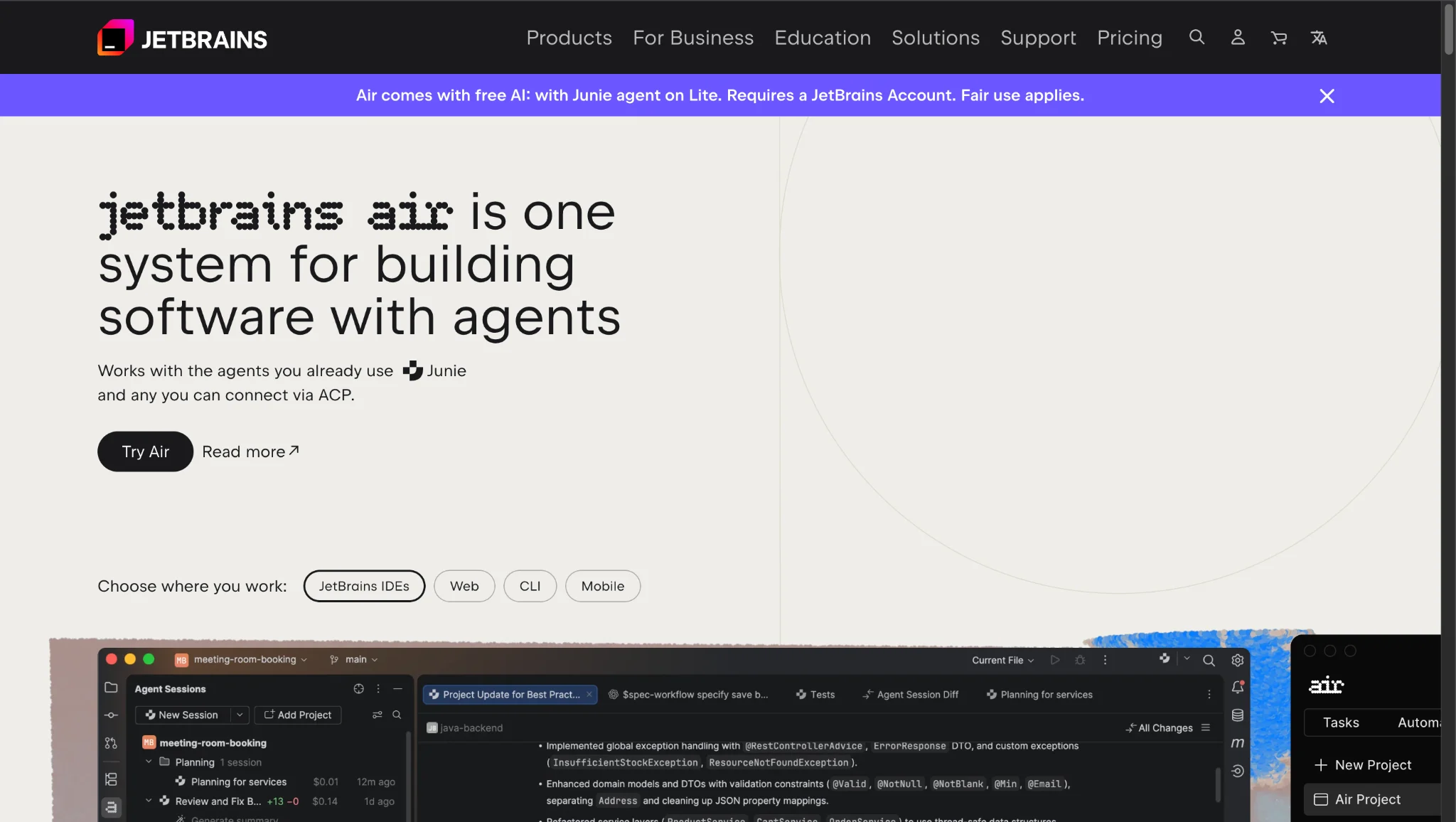
JetBrains' real answer to this category in 2026 isn't the older JetBrains AI Assistant plugin, it's JetBrains Air, a standalone agentic development system the company positions as "one system for building software with agents." Air is the successor to Fleet, the IDE JetBrains introduced in 2021 and never took out of public preview; Fleet stopped being available for download on December 22, 2025, and much of its underlying platform now powers Air instead.
Rather than generating code itself, Air is built to orchestrate agents a team already uses: it works natively with OpenCode and with any agent that speaks the Agent Client Protocol, and it lets a developer choose where to work from, JetBrains IDEs, the web, a CLI, or mobile, while reviewing agent sessions, diffs, and task progress from one place.
Air is in public preview and was initially macOS-only, with Windows, Linux, browser support, and additional agents like Codex, Gemini, and Junie on the roadmap. JetBrains has not published standard per-seat pricing; its Lite plan includes free AI access through the Junie agent, subject to fair use, and sign-in can go through a JetBrains AI subscription, an agent's own login, or a connected third-party provider. The older JetBrains AI Assistant plugin, which lives inside IntelliJ IDEA, PyCharm, WebStorm, and the rest of the JetBrains IDE family, still exists as a separate product and has not been replaced or disabled by Air's arrival.
Pros:
- Agent-agnostic by design, works with OpenCode and any ACP-compatible agent rather than locking a team into one vendor's model
- Lets developers work from whichever surface fits a given task, JetBrains IDEs, web, CLI, or mobile, rather than forcing one entry point
- Free AI access on the Lite plan through the Junie agent lowers the barrier for a team to trial it before committing
Cons:
- Still in public preview with macOS-only full support at launch, so enterprise teams on Windows or Linux can't fully evaluate it yet
- No published per-seat pricing, and being a separate product from JetBrains AI Assistant means teams already on that plugin face a second tool and a second decision rather than an upgrade path
5. Amazon Q Developer
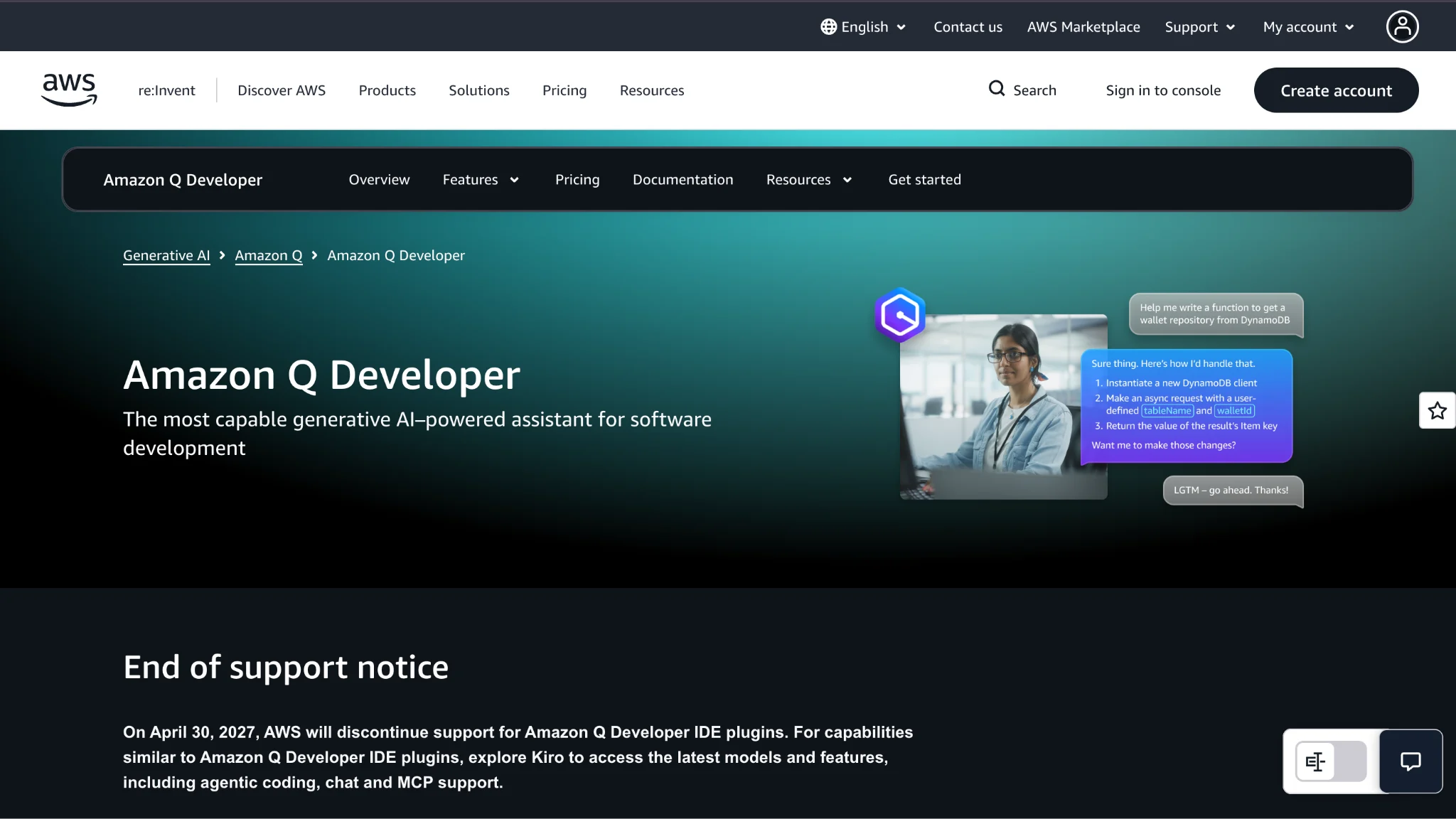
Amazon Q Developer's case rests on AWS-native familiarity: infrastructure-as-code patterns, IAM policies, and AWS service debugging handled more precisely than general-purpose assistants typically manage.
Its pricing stayed comparatively simple through 2026: a Free tier with 50 agentic requests a month and a Pro tier at $19 per user per month, per AWS's own pricing page. The Pro tier adds higher agentic request limits, pooled Java and .NET code transformation allowances, an admin dashboard, and IP indemnity.
Pros:
- Flat, predictable per-seat pricing while most of the field moved to usage-based billing, simplifying budgeting for finance teams
- Strongest fit for AWS-heavy codebases, with legacy Java and .NET modernization built into the Pro tier
- IP indemnity included at the Pro tier, which matters to legal teams evaluating AI-generated code risk
Cons:
- Weaker case outside an AWS-centric stack, where its core differentiator doesn't apply
- Agentic multi-file editing is less mature than Cursor's or Windsurf's, and the Free tier's 50-request monthly cap is tight for anything beyond light exploration
Comparison Table
| Tool | Governance Layer | Deployment | Pricing (2026) | Best Fit |
|---|---|---|---|---|
| Cursor (now part of SpaceX) | None native | Dedicated IDE | Free / $8 Plus / $30 Premium / $100 Super / $200 Ultra / Teams from $30 per user | Agentic-editing-heavy teams |
| Claude Code | None native | Terminal, IDE, desktop, web, mobile | Included in Claude Pro/Max/Team/Enterprise, or pay-as-you-go via Console | Mixed-IDE enterprises |
| Windsurf | None native | Dedicated IDE | Free / $15 Pro / $30 per user Teams | Cursor-style workflow, now part of Cognition |
| JetBrains Air | None native | JetBrains IDEs, web, CLI, mobile | Public preview, Lite plan free via Junie | JetBrains-standardized orgs |
| Amazon Q Developer | None native | IDE extension | Free (50 requests/mo) / $19 per user per month Pro | AWS-native codebases |
Where Forge Fits: The Orchestration Layer Above Your Coding Assistant
Every tool above is a coding assistant. It writes code in the editor or the terminal. Forge is not one more entry on that list, and it does not replace Copilot or any alternative to it. It is Opsera's orchestration layer above the models and coding assistants, and it works with whichever ones a team chooses. That is why it sits at the end of this comparison. Once a team has picked an assistant, or kept Copilot and added a second one, the open question is how specs, guardrails, and approvals stay consistent across all of them.
Forge runs the outer loop around the assistant. Before any code is generated, it maps the existing codebase and turns intent into a versioned spec. While the assistant builds, it enforces policy and architecture. After the change lands, it records who approved what. The assistant keeps doing the inner-loop work it does well, so the two work better together than either does alone.
It Works With the Assistant and Model You Pick
Switching assistants usually means rebuilding rules, prompts, and review habits from scratch. Forge keeps that layer constant while the tools underneath change:
- It works over Copilot, Claude Code, Windsurf, Devin, Codex, and Grok Build, so a team can run two assistants side by side under the same specs.
- Model cost prediction compares models on accuracy, latency, and budget, with a token estimate per task, so model choice becomes a per-task decision instead of a vendor lock-in.
- It connects to existing CI/CD pipelines and to cloud or on-premises environments, so the pipeline a team already trusts stays in place.
It Closes the Gap Copilot's Enterprise Tier Doesn't Reach
Copilot's enterprise controls govern Copilot. The moment a second assistant enters the stack, which is increasingly the norm rather than the exception, those controls stop covering the whole picture.
Forge's spec-driven pipeline, Context, Living Specs, Work Orders, Guarded Build, and Evidence, keeps requirements, tests, architecture, and done-criteria packaged together so a human or an AI agent executes against the same source of truth no matter which assistant is doing the work.
Approval Gates Apply to the Change, Not the Vendor
A rule scoped to one assistant's admin console stops applying the moment a different team adopts a different tool. Forge's gates attach to the change itself: policy and security checks run before code generation starts, and the gate blocks architectural drift rather than catching it in a retrospective.
Every Handoff Is Auditable After the Fact
Architecture decisions, agentic actions, and human approvals land in one evidence trail, which Opsera says the customer owns outright. That matters less on a quiet day and considerably more on the day something breaks, and someone needs to reconstruct exactly what happened without piecing together logs from five separate tools.
Forge's pipeline view shows stage-by-stage status and approval checkpoints across a release.
ForgeScore Gives Modernization Work a Starting Number
Many teams look at Copilot alternatives while they are also moving off a legacy stack. Before any of that work is planned, ForgeScore, Forge's modernization score, rates the codebase across eight engineering dimensions, covering structure, security, and maintainability. The team starts from a number instead of a guess, and has a baseline to measure every later change against.
How To Choose Among GitHub Copilot Alternatives
Choose By Existing Stack, Not Feature Checklist
GitHub-centric orgs lean toward staying on Copilot. JetBrains shops lean toward JetBrains Air. AWS-heavy codebases lean toward Amazon Q Developer. Teams prioritizing agentic editing capability over existing-tool integration lean toward Cursor, Windsurf, or Claude Code, though Windsurf's 2025 sale to Cognition belongs in that evaluation alongside its feature set, not as a footnote.
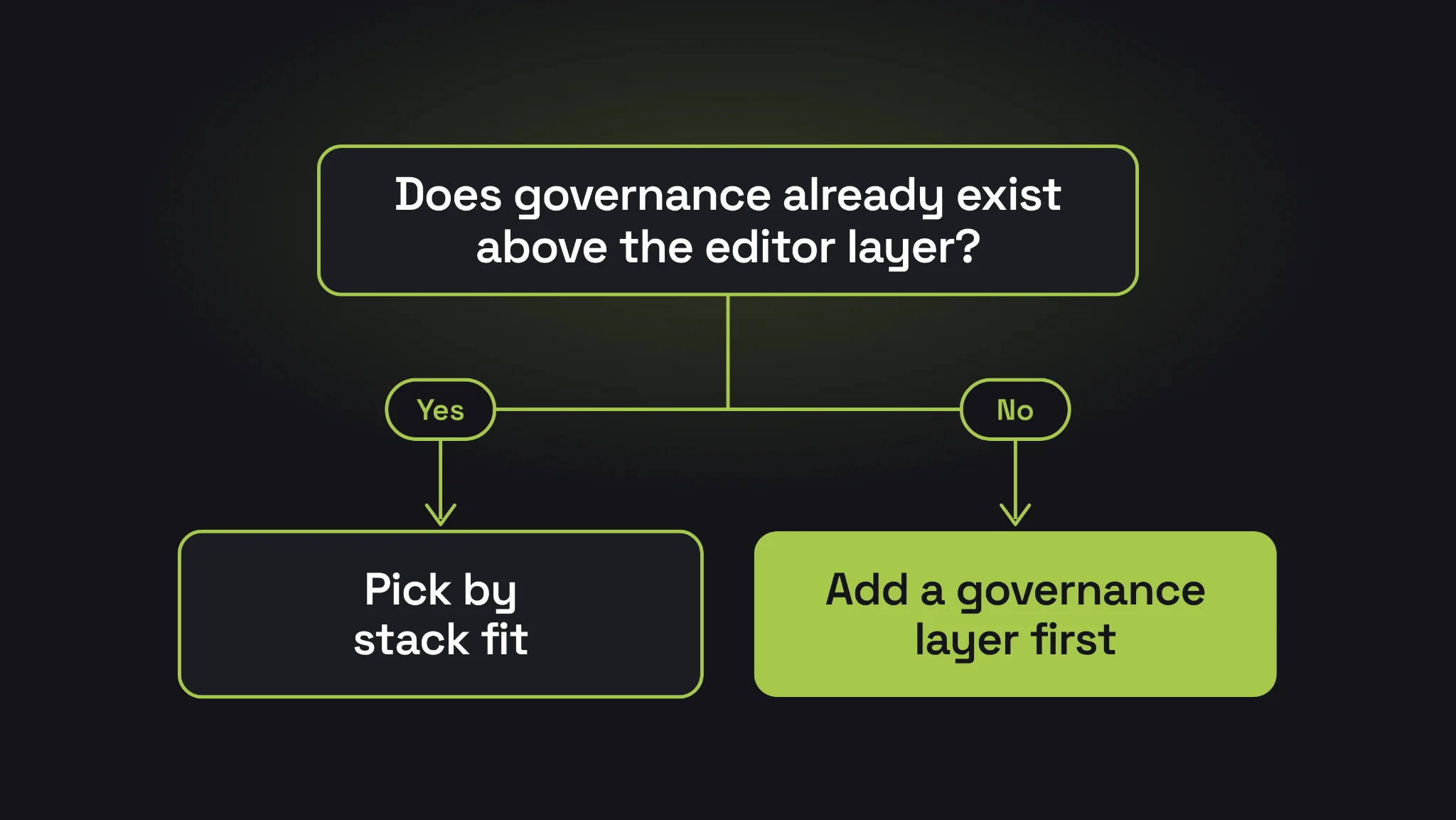
Choose By Whether Governance Already Exists Elsewhere
If approval workflows and audit trails already live somewhere else in the pipeline, Copilot's own enterprise tier may be enough on its own. If they don't, particularly once a second assistant is in play, that gap needs solving separately from the editor decision, and it only gets harder to retrofit the longer an organization waits.
Which GitHub Copilot Alternative Fits Your Team?
Pricing has converged enough across Copilot, Cursor, Windsurf, and the rest of this list that cost alone rarely settles the decision anymore. What settles it is fit with the stack already in place and, increasingly, vendor stability, given how much this category changed in a single year. What's left unsettled no matter which assistant wins is governance once that tool is live in production.
Pick the assistant that fits your team's existing workflow, then decide separately whether anything enforces approvals and keeps an audit trail across it.
Forge is built for that second decision. It is the orchestration layer above whichever assistant and model a team picks, so it works with your choice rather than competing with it.
Questions.
Why did GitHub Copilot move to usage-based pricing in 2026?
On 1 June 2026, GitHub moved every Copilot plan to usage-based billing with GitHub AI Credits. Chat, agent mode, and code review draw down credits at each model's API rates, while code completions stay included on paid plans. Business is $19 and Enterprise $39 per user per month, each including that amount in monthly credits.
Does Copilot's 20 million users make it the safe default choice?
Scale lowers hiring and onboarding friction since more developers already know the tool, but it doesn't settle governance or cost predictability on its own. Copilot's enterprise controls apply only to Copilot, so a team running it alongside any other assistant still needs a layer that covers both.
Is a self-hosted coding assistant necessary for regulated industries?
Not universally, but data residency requirements are common enough in regulated industries that a self-hosted or private-cloud option is often a hard procurement requirement, not a preference.
Can enterprise teams realistically standardize on just one coding assistant?
Many try, but teams often gravitate toward different tools based on IDE preference or project type, and enforcing one tool company-wide can be harder than managing a mix of tools under a shared governance layer.
What does Forge add that GitHub Copilot's own enterprise controls don't cover?
Copilot's enterprise tier manages policy within Copilot itself. Forge, the orchestration layer above the assistants, adds governance that works the same way across every assistant a team uses, including human-in-the-loop approval gates and traceability from architecture through deployment, so every handoff is auditable regardless of which tool generated the change.