LLMs Are Probabilistic. The AI-Harness Makes the Outcome Deterministic.
LLMs vary run to run, and no model upgrade removes it. Why volume fails, how an AI-harness makes outcomes verifiable before they ship, and how Forge puts it into practice.
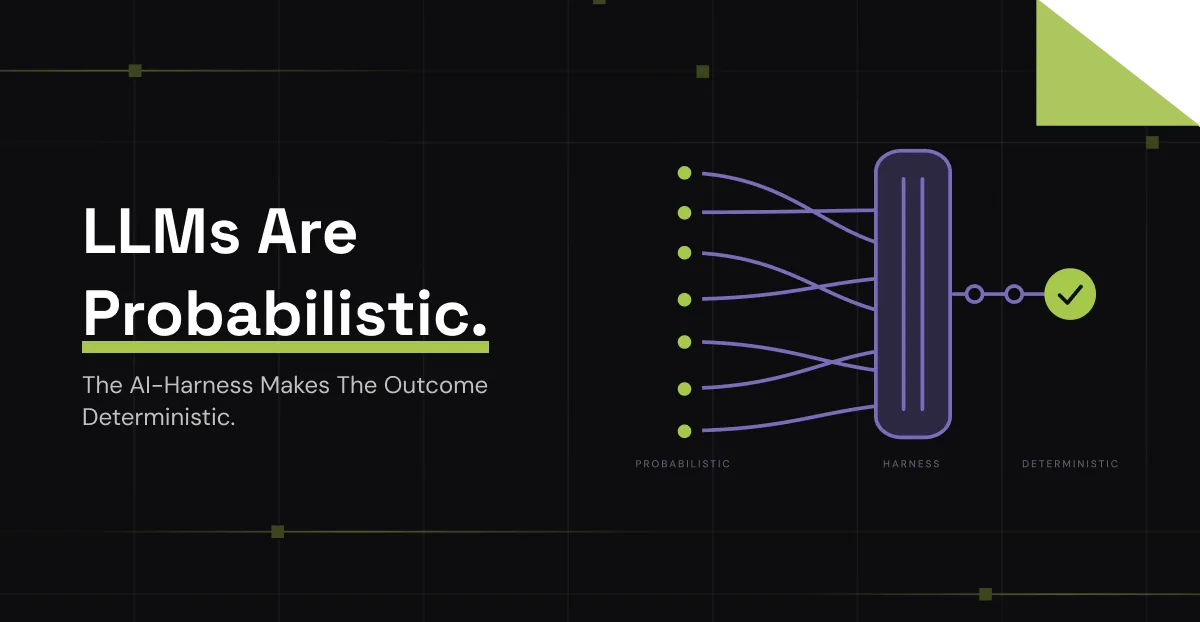
Ask an LLM the same question twice and you may get two different answers. For a draft email, that is fine. For a system that settles payments or closes the books, it is a defect, and no model upgrade removes it, because variation is how these models work.
LLMs and coding agents are probabilistic, yet we push them through a deterministic-era process and expect deterministic, enterprise-grade outcomes. Most enterprises answer this with volume: more tokens per task, more agents per job, more retries until the tests go green. Many point agents at the legacy code, translate it faster and hope the problem goes away. But 90% is not 100%, and the last 10% is the review, the testing, and the verification, and it is where production breaks.
That answer tries to buy certainty from a system that cannot sell it. The model will stay probabilistic. What can become dependable is the outcome, and here deterministic means a result you can verify before it ships, not a model that never varies. That depends on what surrounds the model: the context it sees, the intent it works from, the evals it cannot grade for itself, and the governance it cannot bypass. We call that the AI-Harness.
This piece covers why volume fails, how an AI-harness makes output deterministic, and what legacy code adds to the problem and how Forge puts it into practice.
More Tokens Buy More Attempts, Not More Certainty
Gergely Orosz of The Pragmatic Engineer has compared tokenmaxxing to lines of code as a productivity measure. Both count activity, say nothing about the outcome and are easy to inflate.
Volume also fails at one thing it promises, correctness. Retries do not converge on correct. They converge on whatever passed the last check someone remembered to write, so a business rule nobody wrote down is never tested. More context does not fix that either. Anthropic's engineers describe context rot: as the window fills, the model recalls less accurately, so context is a finite budget.
Our Forge whitepaper calls the cost the exploration tax. An agent given no scoped context rediscovers the codebase on every task and pays for it every time. When context is scoped to each Work Order, our modeling shows the load dropping from 72k to 21k tokens, about 71%.
The alternative to tokenmaxxing is not fewer tokens. It is fewer decisions left to the model.
What the AI-Harness Gives the Model
An AI-harness gives the model what it would otherwise have to guess, and it checks what the model produces. It does that with four things:
- Just-in-time context: only the code, dependencies and history relevant to the task, delivered just in time, not the whole repository.
- Intent: the business goal and the rules the code must preserve, written down as specs.
- Evals: tests that show whether the result does what the spec says, run outside the agent so it cannot grade its own work.
- Governance: the limits and checks the work must clear before it moves on. Guardrails restrict what the agent may touch or do, and are enforced around it. Security checks catch vulnerabilities and unsafe patterns. Compliance checks test the work against the standards and policies the enterprise answers to.
With these in place, the range of what the model can produce narrows until the result can be verified. In practice, the harness works as a control plane above the agents, routing each task to an agent, holding the work to the spec and keeping people in the loop. Birgitta Böckeler of Thoughtworks makes a similar point on martinfowler.com: committing to a structure narrows what an agent can produce, and a narrower output space is one an AI-harness can cover completely. Our guide to AI-harness engineering covers the background.
The rule that matters most is independence. An eval the agent can grade for itself is a suggestion. So the evals sit outside the agent's loop, and each Work Order carries about 8 acceptance criteria (the range is 5 to 11) that the agent is held to. Work Orders are small by design, so evaluation runs at every stage against a unit the spec defines. Some teams instead run swarms of agents that continuously re-evaluate a large codebase, and the checking consumes the capacity and tokens it was meant to protect. Guardrails follow the same logic: the agent runs inside them and cannot opt out, for the same reason auditors do not report to the teams they audit.
All of this assumes the intent exists to be written down. In legacy code, it usually does not.
Legacy Modernization is the Hardest Test of an AI-Harness
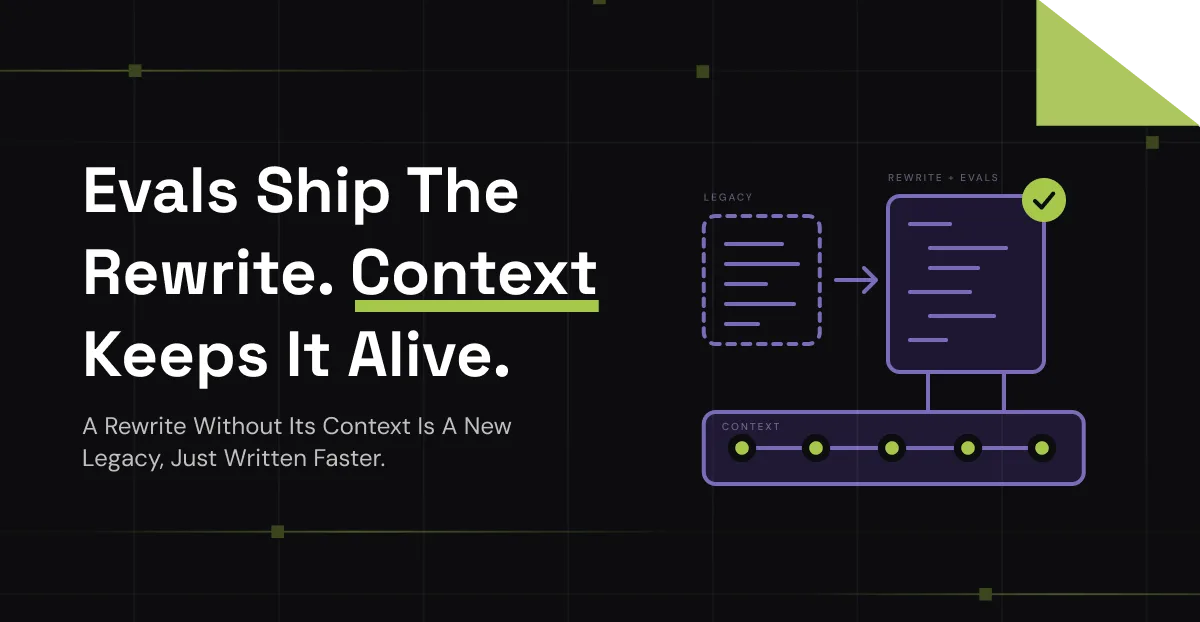
In legacy code, intent is the part nobody wrote down. It lives in people's heads and in behavior the code shows but no document explains. AI has solved the speed problem in modernization, not the understanding problem. A model pointed at old code will produce a rewrite that works and looks clean, yet nobody on the owning team can explain the architecture well enough to change it safely.
An AI-harness closes that gap before the agent starts. It recovers the intent from the code, gives the agent only the context each change needs, and checks every result against how the old system behaved. Nothing ships unverified, and the team that inherits the code can still explain it.
How Forge Builds the AI-Harness
Forge is the Secure Software Factory we built for this. It sits above the coding agents your teams already use and works with the models they choose, so the AI-harness does not change when the model or the assistant does. Each idea in this piece maps to a mechanism:
| Harness idea | What Forge does |
|---|---|
| Intent | Living Specs: business rules recovered from the code, confirmed by their owners and kept current as the code changes |
| Just-in-time context | Each Work Order carries only the context scoped to it |
| Independent evals | Acceptance criteria on every Work Order that the agent cannot grade for itself |
| Governance | RTM ties each change to its requirement, tests and approver; ForgeScore rates each application |
| Works with any model | Native hooks for Claude Code, Cursor, Windsurf, Codex, Copilot and other assistants |
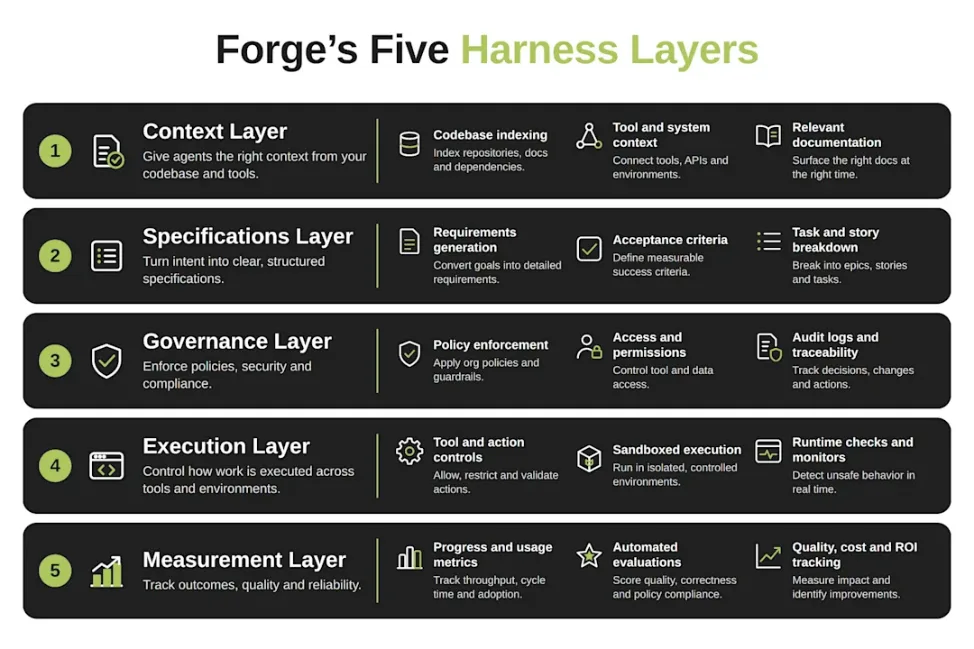
The AI-harness has a cost, and it is worth stating plainly. Recovering intent takes time from the people who own the business rules, because they have to confirm what the code does before agents act on it. And the AI-harness has to be in place before the first Work Order runs. Added afterwards, it checks the work but cannot shape it.
Just-in-time context management. This is the part of the AI-harness we think matters most. Agents usually get context one of two ways: they explore the repository on their own and pay the exploration tax, or someone loads a large slice up front and the window fills with material the task does not need. Forge does neither. When a Work Order starts, the agent receives only what that Work Order needs: the code, the history, the confirmed spec, the dependencies it touches, not the whole repository. When the next Work Order starts, that context is assembled again for the new task. The agent spends its tokens on the change, not on rediscovering the codebase.
The Economics
Token spend and time to first draft measure the agents, not the result. The number a CFO can defend is cost per production-ready component: code that passed its evals, traces to a confirmed spec and was approved by an engineer. The second number most programs never track is what the next migration costs compared with the first. When context stays with the enterprise, the second wave starts from specs and evals that already exist. When it does not, the second wave pays the discovery bill again.
Across nearly 1000 Forge projects, our whitepaper models a 70% to 85% reduction in delivery time and rework falling from 3.2 to 1.3 per task. In one representative initiative, 169 Work Orders and 1,428 story points carry 14,280 baseline hours, about 6.9 person-years. The model puts the same scope at 2,100 to 4,300 hours. Those figures are modelled. The three programs below are customer results.
Results from our enterprise modernization programs
| Customer | Task | Results achieved with Forge |
|---|---|---|
| Leading Telecom Provider | Cloud-to-on-premises Kubernetes conversion for 1M+ wireless radios | • Speed: 7 months to 1 week (a working build within the first week) • Cost: 60% lower token spend, on the same scope • Saved: about $350K on one conversion program |
| Leading Retail Company | Modernization of legacy systems, data pipelines, machine learning and analytics | • Speed: Under 3 hours for discovery and planning vs. ~8 weeks scoped |
| Leading Medical Device Company | Concept to production with AI-Harness, Governance, security and compliance | • Time to value: From 14 weeks to 12 days • Enterprise-grade: 90% production grade code with governance and compliance controls in the first generation • Efficiency: 65% productivity gains |
What You Control
No upgrade will change how much the model varies. What you control is the AI-harness layer around it. Teams that build that layer get outcomes they can verify. Teams that rely on a prompt and a human reviewer get a gamble, however many tokens they spend.
Forge is built to close that gap: Living Specs capture intent, each Work Order scopes the context and carries its own acceptance criteria, and ForgeScore shows where to start and what changed.
Begin with one application and see which business rules and risks the AI-harness surfaces before the first agent runs. Get a ForgeScore on one application, or book a modernization assessment.