Software Factory Pattern: Components, Examples, and How to Implement It
TL;DR
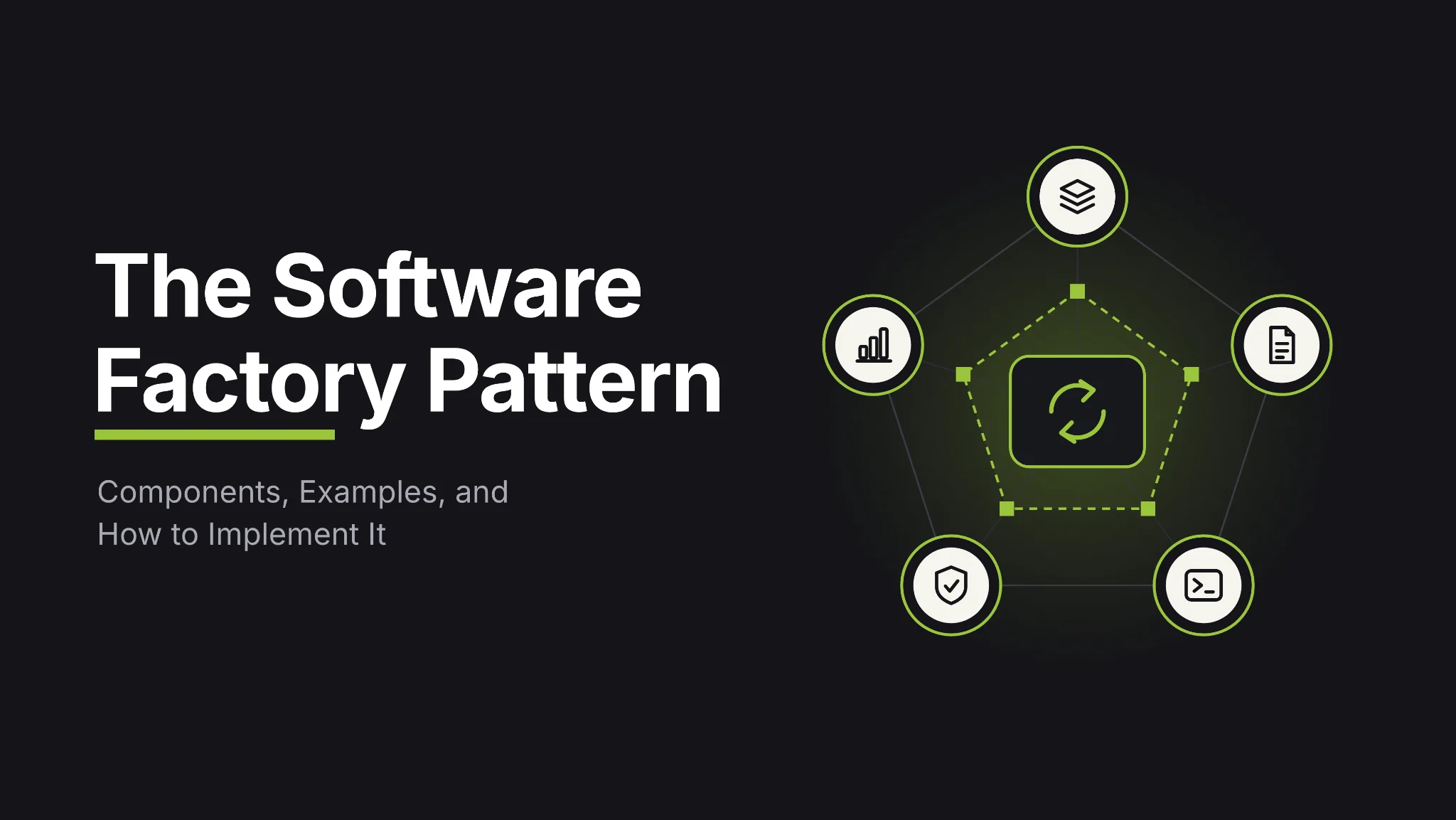
- The software factory pattern consists of five recurring components: context, specifications, execution, governance, and measurement, whether implemented in a 2004-era model-driven toolchain or a 2026-era AI-native delivery system.
- The idea was formalized in Jack Greenfield and Keith Short's 2004 book Software Factories, which described building reusable, domain-specific assets and using them to speed up application assembly.
- The components haven't changed, but their implementation has: context moved from documentation wikis to live, queryable knowledge graphs, and specifications moved from meeting-reviewed documents to structured artifacts an AI agent can execute against.
- The most common anti-pattern isn't a missing component; it's operating all five as disconnected tools nobody has wired into one system.
- Opsera's Forge implements the pattern as five named pipeline stages and sits above the models and coding assistants a team already uses as an orchestration layer, rather than replacing them.
Most enterprises already have fragments of a software factory without realizing it. There's a CI/CD pipeline handling build and deployment. There's a wiki somewhere with architecture decisions nobody has updated in a year. There's a code review process, a security scanning tool, maybe a dashboard tracking deployment frequency. Individually, each piece is sensible. Together, they rarely add up to an actual factory.
Suppose a composite telecom provider with 350 engineers, modernizing its billing platform, found this out the hard way. An audit of its own tooling turned up four separate systems that each claimed to own part of this pattern: a wiki, a Jira instance, a CI pipeline, and a security scanner, none of them talking to each other.
This guide breaks down the software factory pattern as an architecture: where it came from, the five components that recur across every real implementation, how it relates to platform engineering, how it changed shape for AI-native delivery, and how to implement it step by step without falling into the anti-patterns, like the telecom's four disconnected systems, that keep most enterprises stuck with fragments.
What Is the Software Factory Pattern?
The software factory pattern is a recurring architecture for turning business intent into shipped, trustworthy code at scale. It connects five components (context, specifications, execution, governance, and measurement) into one closed loop, so every team builds on shared knowledge, structured requirements, and consistent guardrails instead of reinventing the process.
A pattern means a recurring structural solution to a recurring problem, not a specific product or vendor implementation. The problem here is one every software organization eventually faces: how to turn business intent into shipped, trustworthy code repeatedly, at scale, without every team starting from zero.
That framing matters because it's easy to confuse the pattern with one implementation of it:
- A Kubernetes-based CI/CD platform implements part of it.
- An AI coding agent implements a different part.
- A requirements tool implements another part.
None of these is the pattern itself. Each is a tool that can serve one component, and the pattern only exists once those components are connected into a single system.
Where Did the Software Factory Pattern Come From?
The term is older than most of the tools now marketed under it. In 2004, Jack Greenfield and Keith Short, with contributions from Steve Cook and Stuart Kent, published Software Factories: Assembling Applications with Patterns, Models, Frameworks, and Tools. Their core idea was to cut the cost of building reusable assets for a specific problem domain, then use those assets to speed up assembling applications in that domain.
Key ingredients included:
- Software product lines, treating a family of related applications as one engineering effort.
- Domain-specific languages, so models could drive automation instead of sitting in documentation.
- Frameworks and configurable components, so teams could assemble new applications rather than write them from scratch.
The pattern then moved through three more eras, each keeping the same goal while changing the tooling:
- The DevOps era (2010s) made the factory about automated pipelines: containerized builds, CI/CD, and security scanning built into the path to production.
- The platform engineering era (early 2020s) turned it into internal platforms with self-service capabilities and paved, reusable workflows.
- The AI-native era (mid-2020s onward) made AI agents the main execution engine, which pushed context, specifications, and governance to the front of the pattern.
How the Software Factory Pattern Evolved
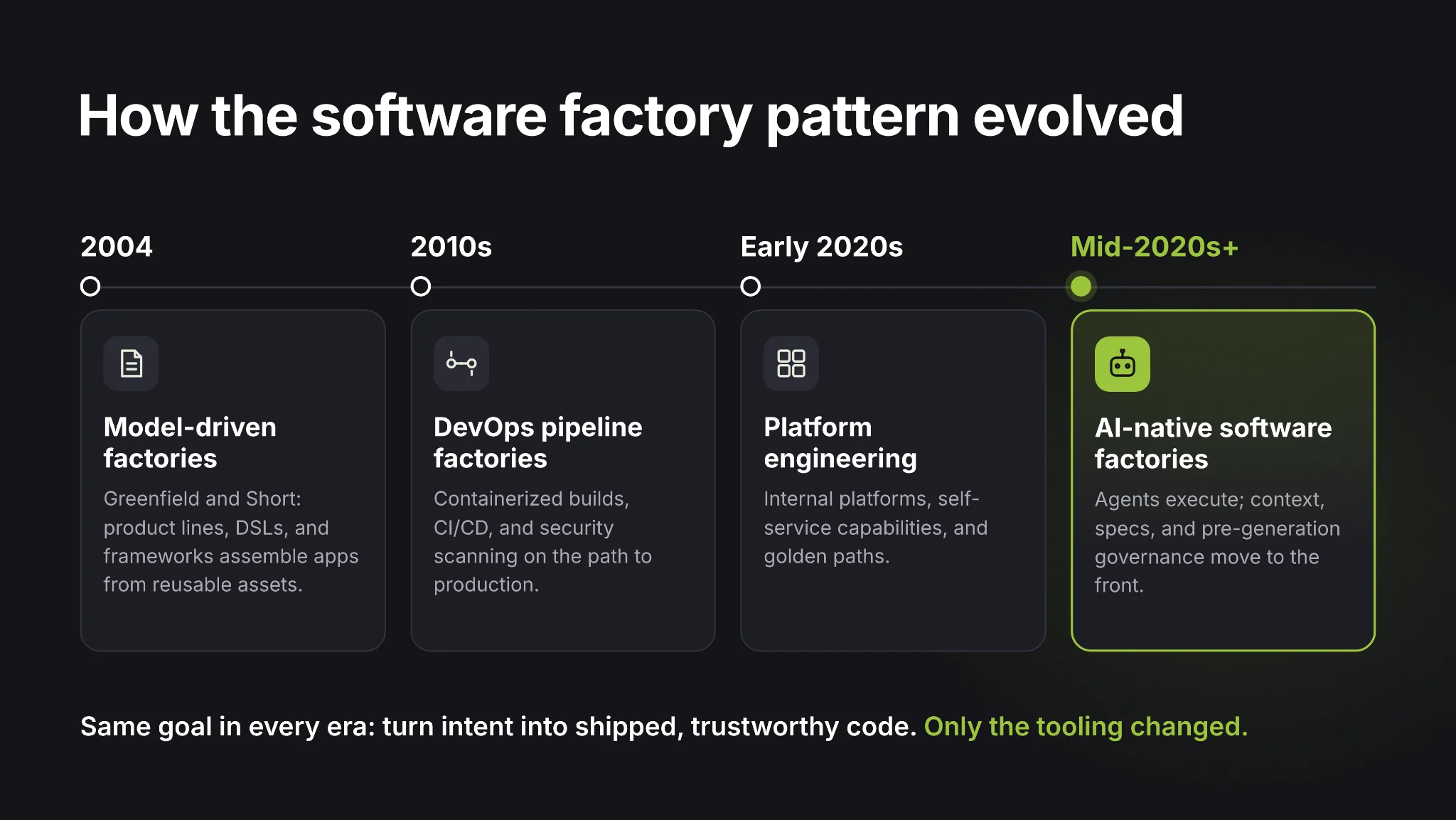
Every era rediscovered the same lesson: execution gets faster with each new generation of tools, and the parts around it decide whether that speed is safe to use.
What Are the Five Components of the Software Factory Pattern?
Every mature implementation of the pattern, from pre-AI enterprise architecture literature to the most current AI-native platforms, breaks down into the same five components:
- Context: A shared, accurate understanding of the codebase, its dependencies, data flows, and policies, so any contributor, human or AI, starts from the same picture.
- Specifications: A structured, testable definition of what needs to be built, turning business intent into something execution can be checked against.
- Execution: The production of code, tests, and infrastructure, the most visible component and the one most AI coding tools focus on exclusively.
- Governance: The checks, policy enforcement, and approval gates that decide whether a given piece of execution is safe to ship.
- Measurement: The feedback loop, defect rates, cycle time, rework, that feeds real outcomes back into context and specifications.
The Five Components as One Closed Loop
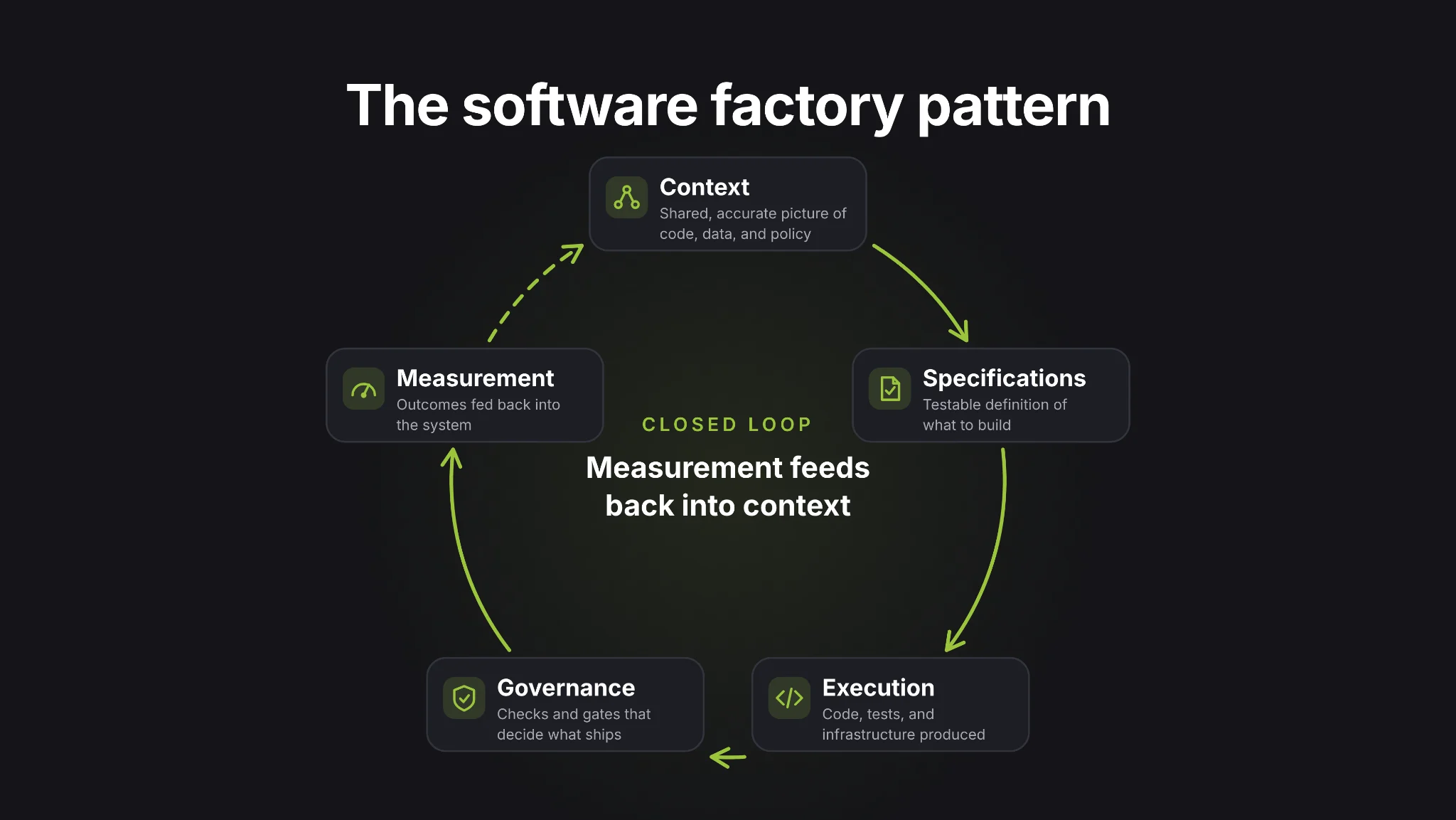
Warp's description of enterprise software factory architecture and the classic DevSecOps software factory literature both describe roughly this five-part shape, despite being written for very different eras of tooling. The telecom's four disconnected systems each covered one or two of these components, mostly execution and a thin slice of governance, with context and specifications barely represented at all.
How Does the Software Factory Pattern Relate to Platform Engineering and Golden Paths?
The two ideas overlap enough that they're often used interchangeably, but they answer different questions. The CNCF Platforms White Paper defines a platform as an integrated collection of capabilities presented according to the needs of the platform's users, and describes a reusable workflow bundled with a starter template and documentation as "a golden path."
| Platform engineering | Software factory pattern | |
|---|---|---|
| Core question | How do teams get self-service infrastructure and tooling? | How does intent become shipped, governed code? |
| Main output | Internal platform and golden paths | A connected intent-to-release loop |
| Center of gravity | Infrastructure and developer experience | Specifications, governance, and traceability |
| Role of AI | Optional consumer of the platform | Increasingly the main execution engine |
In practice, the two fit together:
- A platform is often the foundation a factory runs on. Golden paths make execution and deployment consistent.
- A factory adds what a platform usually lacks. Structured specs in front of execution and traceable governance behind it.
- Neither replaces the other. A great platform with no specs still lets agents build the wrong thing quickly.
How Has the Software Factory Pattern Changed for AI-Native Delivery?
The five components stay constant, but what fills each one has shifted substantially:
| Component | Classic implementation | AI-native implementation |
|---|---|---|
| Context | Static documentation wikis, read and interpreted by humans | Live, queryable knowledge graph an agent searches directly |
| Specifications | Requirements documents, reviewed once and rarely revisited | Structured, versioned artifacts attached to the code they describe |
| Execution | A human developer writing code by hand | An AI agent producing a first draft of code, tests, and docs together |
| Governance | A code review and a security scan, applied after code exists | Policy and security checks applied before generation starts |
Governance is where the shift matters most. In a classic factory, running governance checks after code already existed was acceptable because the pace of human-written code gave the review process time to catch problems.
In an AI-native factory, that design breaks down: an ungoverned agent can generate a large volume of plausible-looking but architecturally wrong code faster than any review process was built to absorb. An AI-native implementation moves governance earlier, running checks before generation starts rather than only catching problems afterward.
What Anti-Patterns Undermine the Software Factory Pattern?
The most common failure isn't a missing component; it's components that exist independently but were never connected:
- Disconnected context. Documentation exists, but it's not what an AI agent queries before generating code, so the agent works from its training data or whatever fragments happen to be in its prompt.
- Specifications as ceremony. A requirements document gets written, reviewed, approved, and then effectively discarded the moment implementation starts.
- Governance as a final gate. Security and policy checks run only after code is written, letting the system produce a large volume of ungoverned output before anything catches a problem.
- Measurement that doesn't feed back. Dashboards track deployment frequency or cycle time, but the data never flows back into context or specifications, so the system reports on itself without learning.
- Tool sprawl as a substitute for wiring. Adding another tool for each gap, instead of connecting the tools already in place.
The telecom's four-system audit matched the list almost exactly: a wiki nobody's agents queried, a Jira backlog treated as a one-time checkpoint, a security scanner that ran only in CI after merge, and a dashboard nobody had looked at in months.
What Does the Software Factory Pattern Look Like?
It helps to follow one change through the loop. Suppose the telecom needs to add a new roaming-charge rule to its billing flow:
- Context: Before anyone writes code, the context layer shows which services touch usage data, which downstream systems consume the charges, and which regulatory policies apply.
- Specifications: A product owner writes the rule as a structured spec: inputs, expected outcomes, edge cases, and done criteria, attached to the services it will change.
- Execution: An AI agent drafts the code, tests, and documentation against that spec, starting from the context layer rather than guessing.
- Governance: Before generation, policy checks confirm the change won't touch restricted data paths. After generation, architecture checks confirm it stays inside the service's boundaries, and a human approves the result.
- Measurement: Once shipped, the change is linked to its spec, tests, and approver. If it causes rework or a defect, that data flows back into context and future specs.
In the telecom's old setup, the same change touched four disconnected systems: a wiki page nobody checked, a Jira ticket closed at kickoff, a pull request reviewed from memory, and a scanner that ran after merge. Each step worked on its own. What was missing was the thread connecting them, which is exactly what the pattern supplies.
The difference shows up most when something goes wrong. In the connected loop, a defect in the roaming rule can be traced back to the exact spec line and approval that produced it. In the disconnected setup, the same investigation means stitching together tickets, chat threads, and commit history by hand.
How Does Opsera's Forge Implement the Software Factory Pattern?
Opsera built Forge as a direct implementation of this five-component pattern, with each component named as a pipeline stage. Forge is the orchestration layer above the models and coding assistants, such as Cursor, Copilot, and Claude, supplying context, specification, and governance around whichever tool handles execution and working with whichever model a team chooses.
Forge's Pipeline Mapped to the Pattern
- Context, a continuously maintained knowledge graph, the live version of the pattern's context component rather than a static wiki.
- Living Specs and Work Orders, together implementing specifications: versioned requirements attached to code, packaged into units a human or agent can execute against, avoiding the ceremony anti-pattern.
- Guarded Build, governance as a pre-generation gate, directly addressing the governance-as-final-gate anti-pattern that's riskiest in an AI-native pipeline.
- Evidence, measurement as a traceability record linking every requirement to its tests and approver, the closed-loop piece most execution-only tools skip.
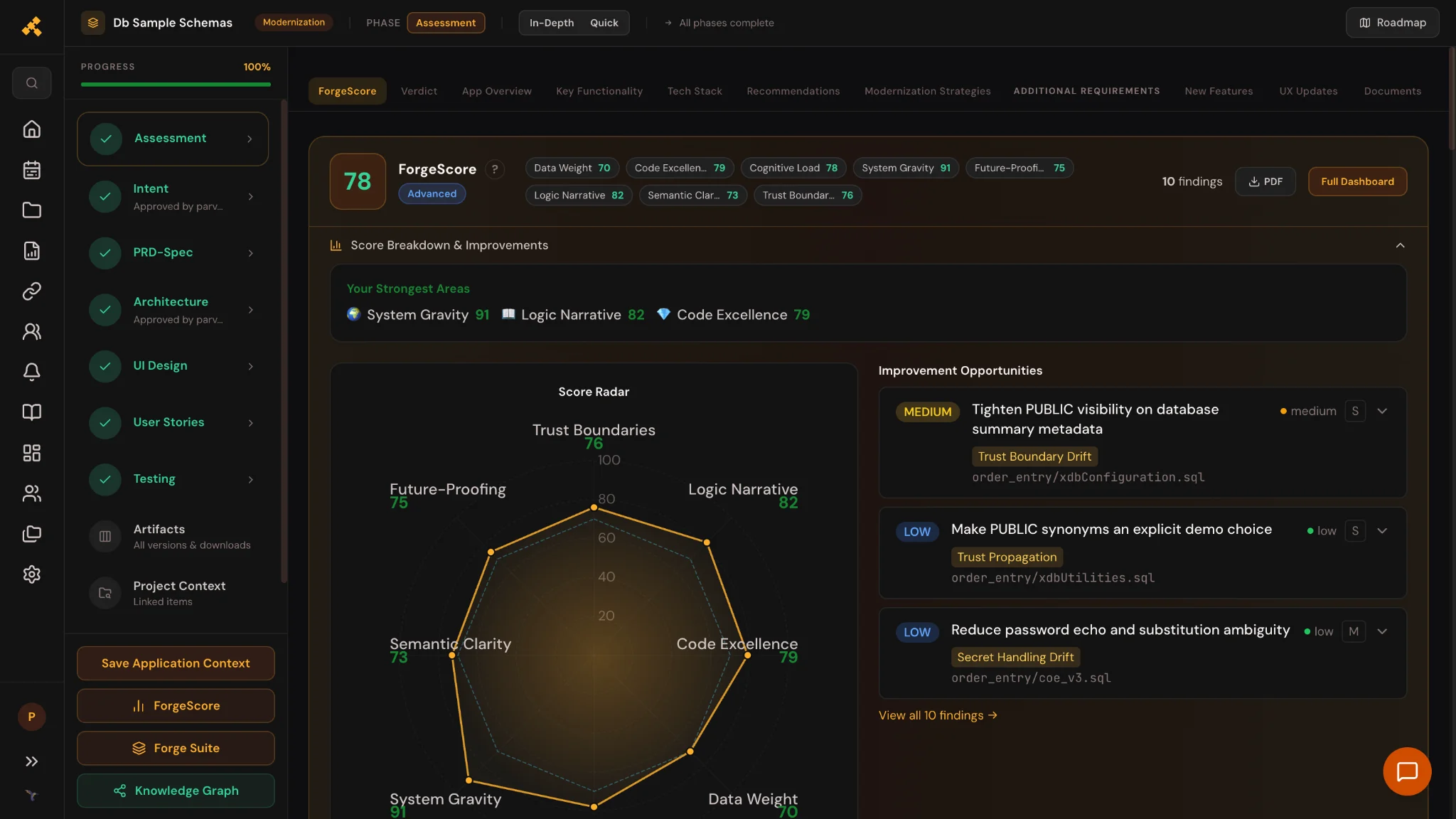
A companion ForgeScore assessment, rating a codebase across eight engineering dimensions, is itself an application of the measurement component, feeding a concrete score back into planning. When the telecom mapped its four disconnected systems against this structure, the gap wasn't new tooling; it was the wiring between what it already had.
How Do You Implement the Software Factory Pattern Step by Step?
You don't need to start from scratch. Most organizations can implement the pattern by mapping and connecting what they already own:
- Map your tools to the five components. List every tool you use and which component it serves. Most organizations find heavy coverage of execution and governance, and thin coverage of context and specifications.
- Fix context first. Make sure the knowledge your agents and engineers rely on is current and queryable, because every other component builds on it.
- Make specifications executable. Turn requirements into structured, versioned artifacts with clear done criteria, attached to the code they describe.
- Move governance earlier. Add policy and architecture checks before generation, and keep review for what only humans can judge.
- Close the loop with measurement. Route cycle time, rework, and defect data back into context and specs so the system improves over time.
- Prove it on one service, then scale. Run one team through the full loop, compare against a baseline, and expand with evidence.
The telecom followed roughly this order. It kept its CI pipeline and scanner, replaced the wiki with a maintained context layer, and turned its Jira backlog into living specs. Its first connected service shipped through the full loop before any new execution tool was added.
How Do You Know Whether Your Organization Already Has the Pattern?
Map existing tools against the five components rather than starting from scratch, then check one thing above all: whether the components are connected, not just present.
- Most organizations already have something serving execution, usually several overlapping tools.
- Most have something serving governance, usually a review process and a scanner.
- The gap is almost always in context and specifications, the two components that need the most ongoing discipline and rarely get the same investment as developer-facing tools.
- If measurement never changes what the team does next, the loop isn't closed.
Closing those connection gaps, not adding a sixth component, is usually the highest-leverage next step for an organization that has factory fragments but no factory. The pattern has survived twenty years of tooling changes because the problem it solves hasn't changed. Only the speed of execution has.
Enterprises that want to implement this pattern as a connected system should look at Opsera's Forge, and Opsera's guide to the software factory model walks through how each pipeline stage maps to the pattern described here.
Questions.
Is the software factory pattern specific to AI-powered development?
No, the pattern dates back at least to Greenfield and Short's 2004 book Software Factories, long before large language models. What AI changed is how each component is implemented, especially execution, which agents now handle, and governance, which has to run before generation.
What's the difference between the software factory pattern and a CI/CD pipeline?
A CI/CD pipeline covers part of execution and governance: building, testing, and deploying existing code. The software factory pattern adds context and specifications in front of that work and a measurement loop behind it, turning a one-way pipeline into a closed loop that improves over time.
Is the software factory pattern the same as platform engineering?
No, but they work well together. Platform engineering gives teams self-service infrastructure and golden paths for building and deploying. The software factory pattern governs how business intent becomes shipped code, adding structured specs, traceable governance, and feedback that a platform alone usually lacks.
Why does governance need to move earlier in an AI-native implementation?
Because AI agents can generate large amounts of plausible but wrong code faster than after-the-fact review can catch it. Running policy and architecture checks before generation stops bad changes from being produced, so reviewers spend their time on judgment calls instead of cleanup.
Can an organization adopt the software factory pattern without a vendor platform?
Yes, you can implement it by mapping your existing tools to the five components and wiring them together. The trade-off is effort: keeping context current and connecting every tool is an ongoing engineering commitment, which managed platforms are built to close.